
From bulk product infeed to finished bottles, blister packs, pouches, cartons, and cases, Grand Machinery provides integrated automated packaging line solutions for gummy and softgel manufacturers. Our systems combine product feeding, electronic counting, filling, sealing, labeling, cartoning, case packing, and palletizing into a coordinated packaging process.
Designed around your product characteristics, packaging format, production capacity, and facility layout, each automated packaging line can be configured as a standalone system or integrated with an existing gummy or softgel production line.
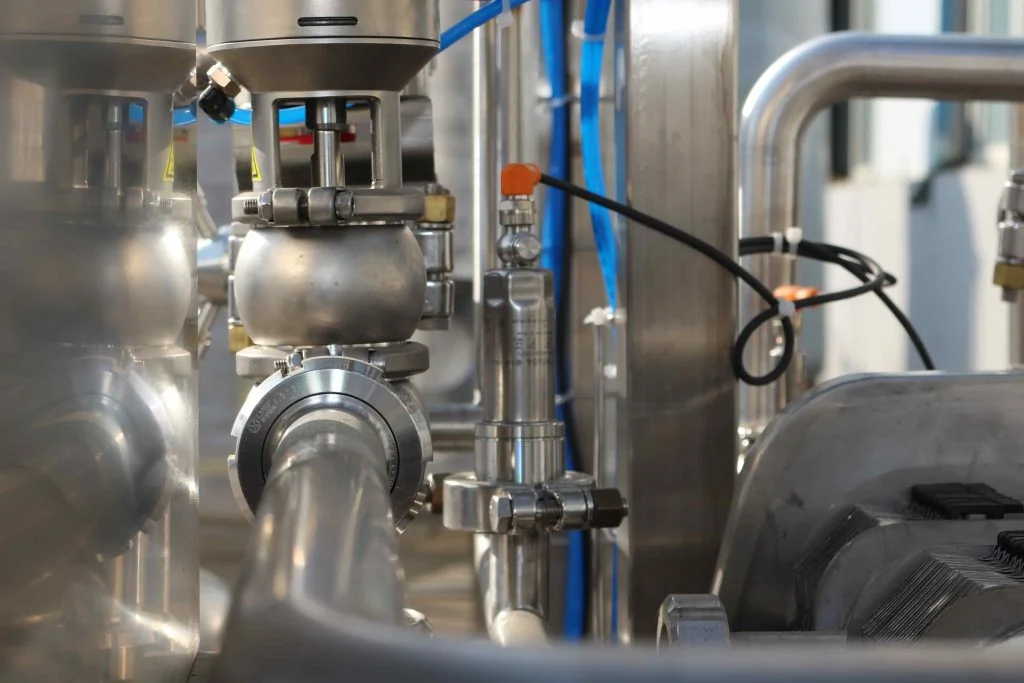
Once your gummies leave the demolding conveyor or your softgel capsules exit the drying tunnel, the real challenge begins: getting the right count into every container, protecting product integrity through the packaging process, maintaining hygiene standards that meet GMP requirements, and running fast enough to match your production output — all without the cost and inconsistency of manual handling.
Gummy and softgel packaging demands specialized solutions that generic lines cannot deliver. Sticky gummies jam in standard counting channels. Softgel capsules require moisture-protected blister seals and precise desiccant placement. Irregular gummy shapes demand vibration-optimized feeding that plastic-bottle lines simply cannot handle.
Grand’s automated packaging line solutions are built specifically for these challenges. From high-speed electronic counting and bottling systems to pharmaceutical-grade blister packaging, retail pouch filling, and complete end-to-end lines that run from bulk product infeed to finished-case palletizing — Grand delivers fully integrated, GMP-compliant equipment with counting accuracy of ±0.1%, line speeds up to 12,000 bottles per hour, and zero manual handling between stations.
Choose the right packaging configuration for your gummy or softgel product
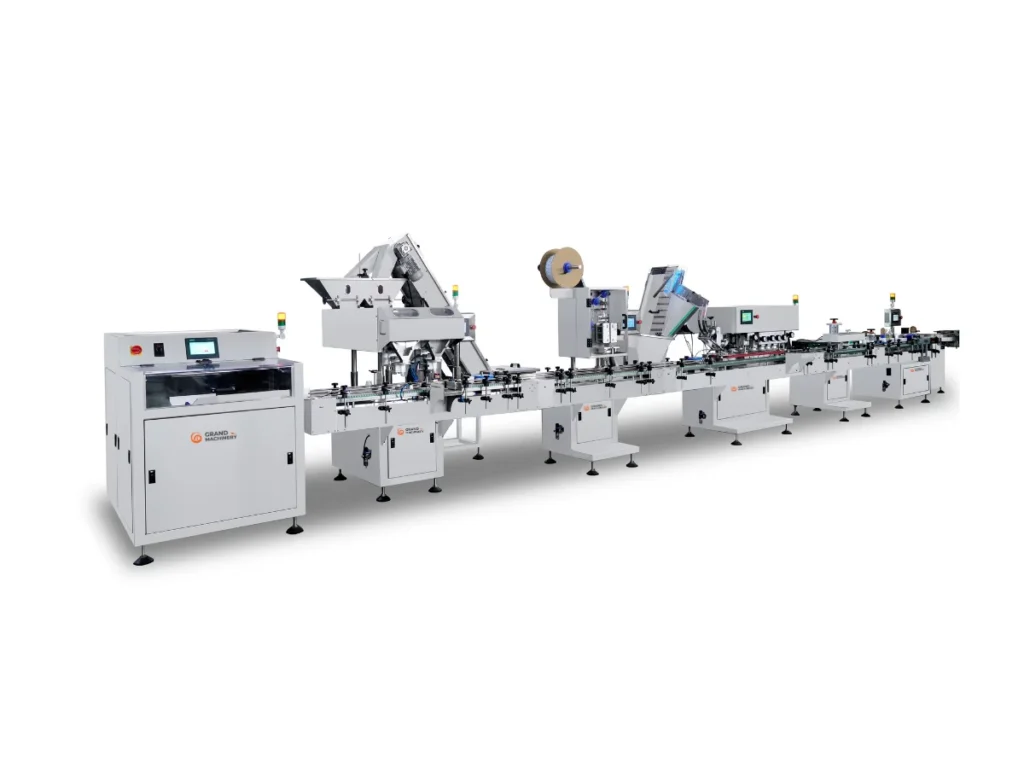
Our high-speed counting bottling line uses 24-channel or 36-channel electronic counting machines with vibration-optimized feed channels to count gummies and softgel capsules into bottles with ±0.1% accuracy — even for irregularly shaped or sticky gummy products that jam in standard counting equipment.
The fully integrated line connects automatic bottle unscrambling, precision counting, desiccant insertion, automatic capping, labeling, and case packing into a seamless workflow that processes 3,000–12,000 bottles per hour. PLC-controlled with touchscreen HMI, it supports rapid changeover between product types and bottle sizes in under 15 minutes, making it the ideal solution for manufacturers who bottle multiple gummy or softgel SKUs on the same line.
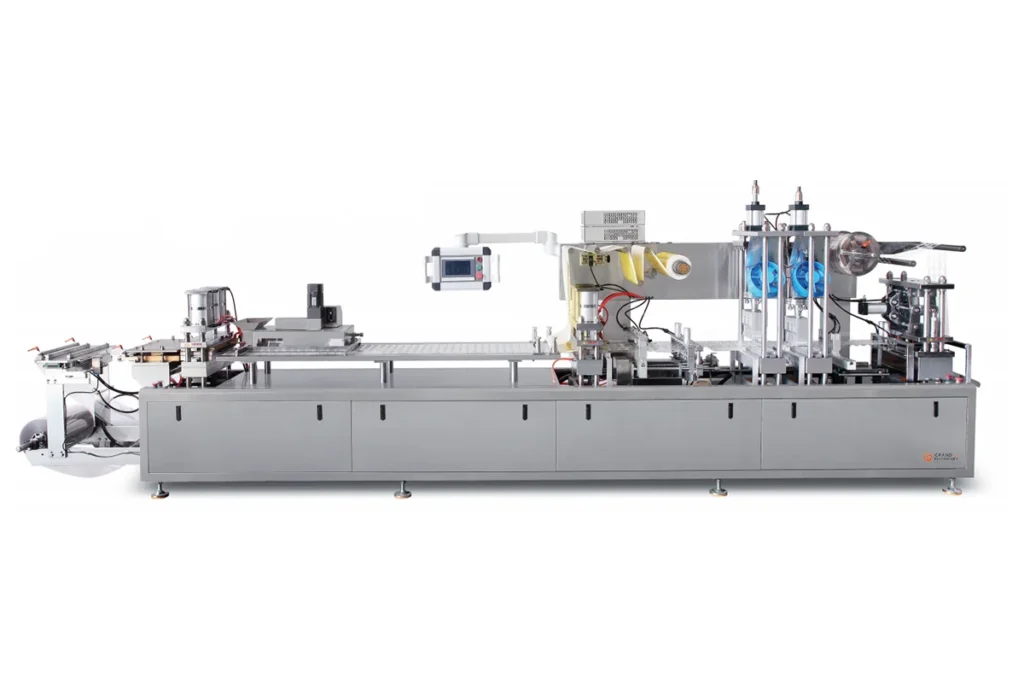
Grand’s blister packaging line forms, fills, and seals individual gummies or softgel capsules into aluminum-plastic (AL/PVC) or aluminum-aluminum (AL/AL) blister packs at speeds up to 400 blisters per minute. The system integrates automatic blister forming, precision product feeding, heat sealing, perforation and cutting, and carton boxing — delivering tamper-evident, moisture-resistant packaging that protects product freshness and meets pharmaceutical compliance requirements.
Designed for both vitamin gummy blister packs and pharmaceutical softgel blister packaging, the line features servo-driven forming stations, intelligent vision inspection for missing or broken units, and quick mold changeover for multi-SKU production. AL/AL configurations provide the highest moisture barrier for sensitive softgel formulations; AL/PVC offers cost-effective visibility for retail supplement gummies.
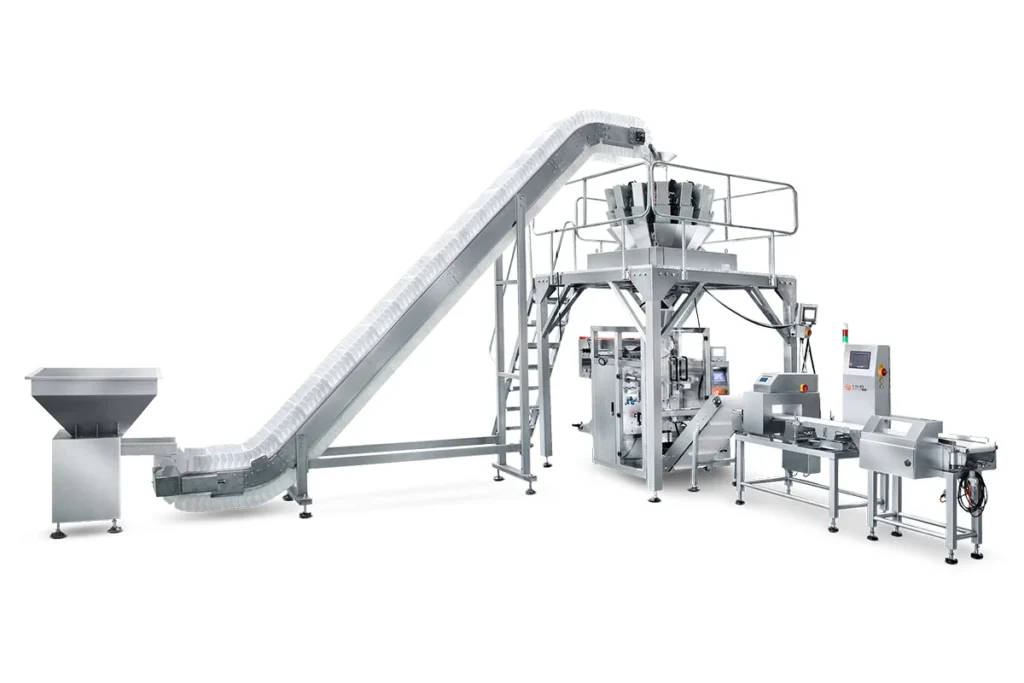
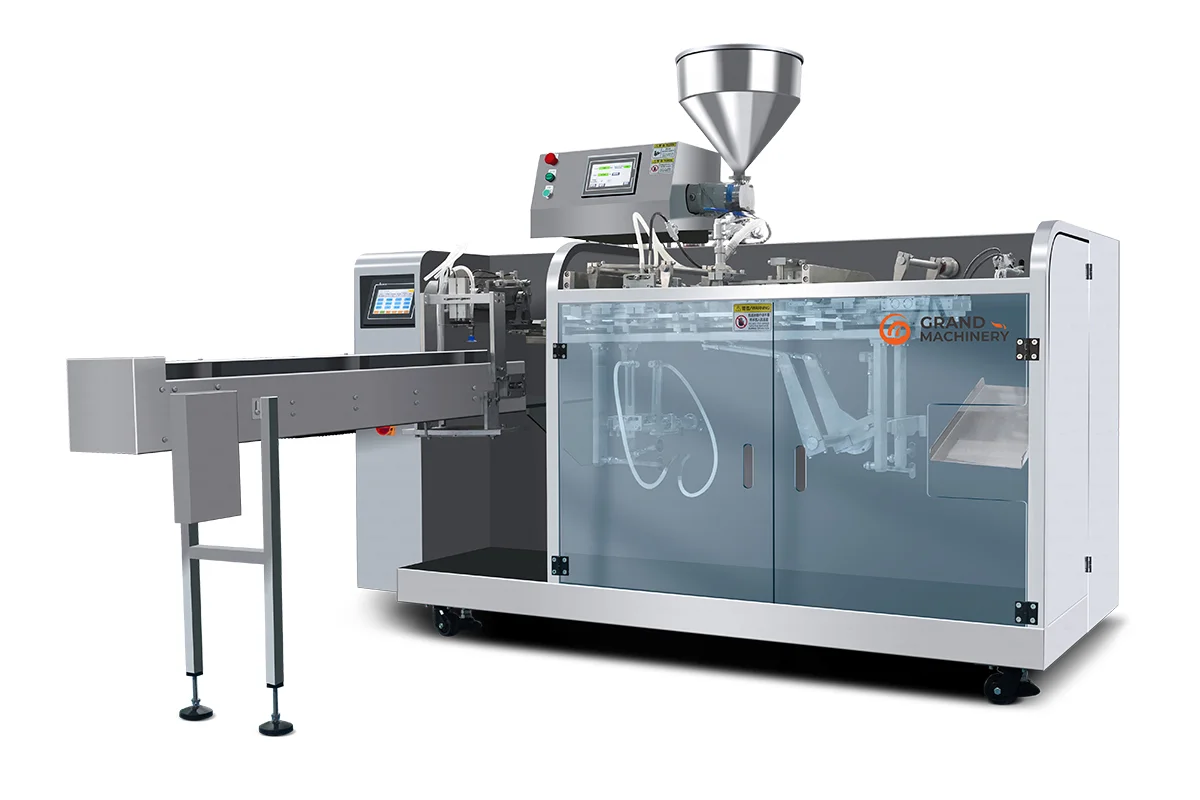
Grand Machinery’s pouch packaging line combines a VFFS (vertical form-fill-seal) machine with a multi-head weigher or counting unit to package gummies into stand-up pouches, flat bags, or zipper bags at 50–120 bags per minute. The system handles pouch widths from 80 to 250 mm and supports zipper, tear-notch, and hang-hole features — making it ideal for retail-ready gummy packaging in the health supplement and confectionery markets.
Equipped with servo film pulling, automatic temperature control for sealing consistency, and an optional nitrogen flushing system for extended shelf life, this line delivers attractive, airtight pouches that protect gummy quality from production to consumer. It is the go-to format for brands targeting single-serve, sampler, and bulk-retail gummy products where bottle or blister formats are not the best fit.
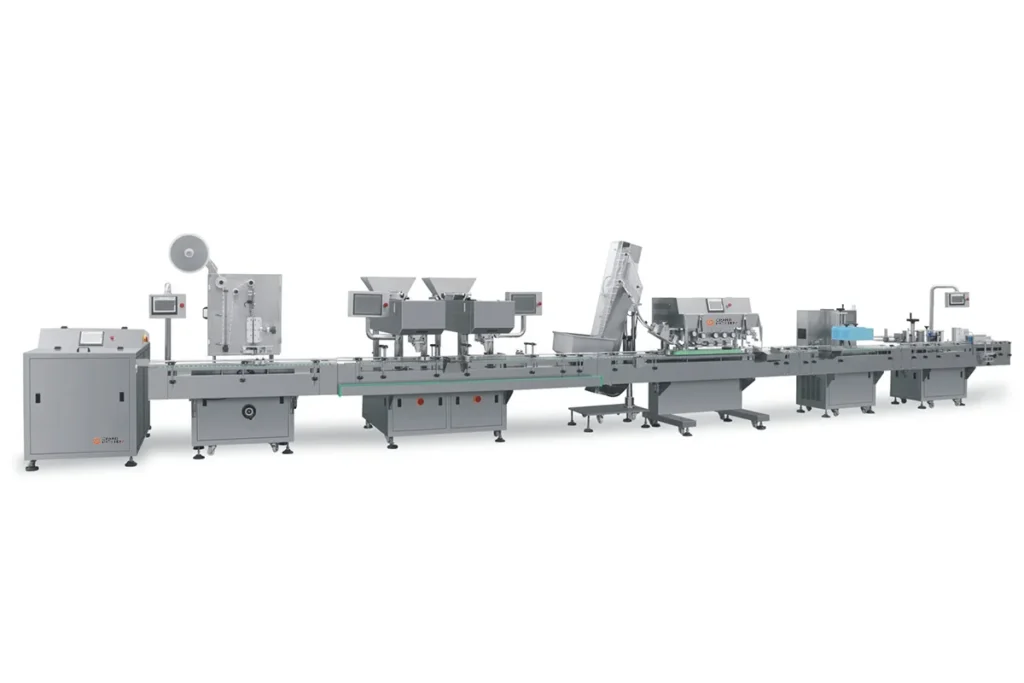
The complete gummy packaging line is Grand’s flagship end-to-end packaging solution: a fully integrated system that takes bulk gummies directly from your production output conveyor through electronic counting, bottle filling or blister packaging, capping, labeling, carton erection, product insertion, case sealing, and palletizing — with zero manual handling between stations.
Designed for high-volume gummy manufacturers seeking maximum labor savings and line efficiency, this system achieves throughput of 6,000–15,000 finished units per hour with a <0.3% overall line reject rate.
Every station is linked via smart PLC synchronization that prevents upstream overflow and downstream starvation, ensuring smooth, uninterrupted packaging from first gummy infeed to last pallet out. The modular architecture allows you to choose bottling, blister, or pouch as the primary packaging format — or run multiple formats in parallel with shared counting and feeding stations.
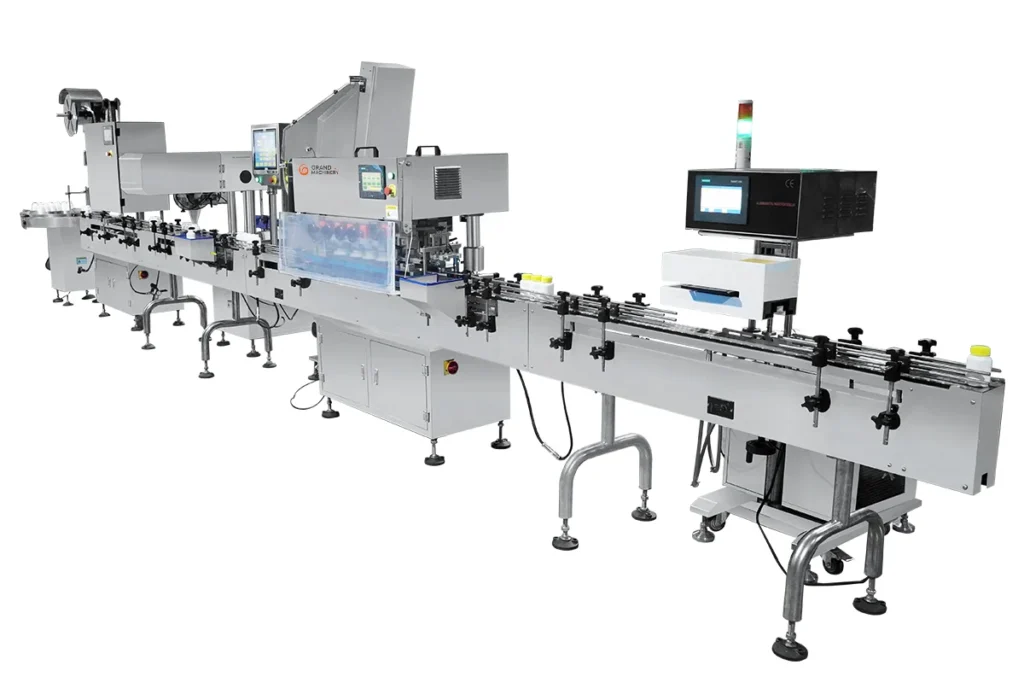
Grand’s complete softgel packaging line takes bulk softgel capsules from your drying tunnel output and delivers them through counting, blister forming or bottle filling, desiccant insertion, capping, labeling, cartoning, and case palletizing in one continuous, automated workflow — eliminating the contamination risk and product damage that come with manual transfer between production and packaging areas.
The line integrates electronic counting (±0.1% accuracy), AL/PVC or AL/AL blister packaging, desiccant and cotton insertion, automatic capping, adhesive or wrap-around labeling, automatic carton erection and product insertion, case sealing, and palletizing — with full GMP traceability and vision inspection at every critical checkpoint. Ideal for pharmaceutical and nutraceutical softgel manufacturers who demand cleanroom-compatible, closed-loop packaging with batch-level data logging and exportable compliance reports.
Whether you are launching a new gummy product, scaling up softgel capsule packaging capacity, or upgrading from semi-automatic to fully automated line operation, Grand’s packaging engineering team is ready to design and deliver a line configuration that matches your exact product specifications, floor layout, and throughput targets. From initial process design and equipment selection through installation, commissioning, and operator training, we manage every detail — so you can focus on growing your market share.
Here are the most frequently asked questions about automated packaging lines for gummies and softgel capsules.
An automated packaging line for gummies and softgels is a series of interconnected machines that receive bulk product from production, then handle counting, blister forming, bottle filling, capping, labeling, cartoning, and palletizing in a continuous, PLC-controlled workflow. It replaces manual packaging steps with synchronized automation, ensuring consistent count accuracy, product protection, and high-speed output — typically 3,000 to 15,000 finished units per hour depending on line configuration.
Electronic counting machines use photoelectric or infrared sensors mounted above vibration-feed channels. Gummies or softgels flow through calibrated channels in single file; each unit triggers the sensor as it passes, and the PLC counts units until the target per-bottle or per-blister quantity is reached. Advanced systems use 24–36 channels simultaneously, handle sticky or irregularly shaped gummies with anti-jamming vibration control, and achieve ±0.1% count accuracy. Talk to our counting specialists →
Sticky gummies present a unique counting challenge that standard pharmaceutical counting machines cannot handle — they clump together, bridge across feed channels, and adhere to channel surfaces due to their sugar coating, gelatin content, or oil finish. Grand addresses this with vibration-frequency-optimized channels that maintain single-file flow, anti-static surface coatings that prevent adhesion, and dual-sensor verification that catches double-counts from overlapping units. These features deliver ±0.1% accuracy on gummy products that would jam or miscount on conventional lines.
Gummies and softgels are packaged in three primary formats: bottles (most common for supplements — with desiccant inserts for moisture protection), blister packs (AL/PVC for retail visibility, AL/AL for maximum moisture barrier and tamper evidence), and stand-up pouches (ideal for single-serve or bulk retail gummy products). Grand offers automated lines for all three formats, and our modular design allows the same counting unit to feed into any downstream packaging station.
The choice depends on your product’s moisture sensitivity, target market, and regulatory requirements. Blister packaging (AL/AL) provides the strongest moisture barrier and tamper-evidence — ideal for pharmaceutical softgels and high-value supplements. Bottling offers higher output speed (up to 12,000 bottles/hour), easier desiccant integration, and lower per-unit cost for large-volume nutraceutical products. If you serve both segments, Grand’s modular lines allow you to switch between blister and bottling configurations on the same counting platform. Get a format recommendation →
Line speed depends on your packaging format and configuration. A counting-and-bottling line for softgels typically runs 3,000–12,000 bottles per hour. A blister packaging line achieves 200–400 blisters per minute (1,200–2,400 capsules/minute equivalent). A complete end-to-end line — from bulk infeed to palletizing — maintains 6,000–15,000 finished units per hour with synchronized PLC control that prevents bottlenecks between stations.
Yes. All Grand Machinery’s packaging lines for pharmaceutical and nutraceutical applications are designed to meet GMP requirements. Product-contact surfaces use 304 or 316L stainless steel; the line supports cleanroom-compatible operation with enclosed transfer conveyors between production and packaging zones; vision inspection stations verify every unit for presence, integrity, and contamination; and full batch traceability is enabled through PLC data logging with exportable production reports.
Grand’s packaging lines are designed to integrate directly with your production output — whether that is a gummy demolding and conveyor system or a softgel drying tunnel. The bulk-product infeed station uses an enclosed, GMP-compatible transfer conveyor with adjustable speed matching to synchronize with your production output rate. PLC communication between production and packaging zones ensures that if production slows or stops, packaging automatically adjusts — no overflow, no starvation, no manual intervention required at the transition point.
A standard counting-and-bottling line installation takes 7–10 business days from delivery to full commissioning. A complete end-to-end line with blister packaging, cartoning, and palletizing requires 15–20 business days, including mechanical setup, PLC programming, station synchronization, and operator training. Grand provides on-site engineers for the full commissioning period and remote support for the first 90 days of production.
Most gummy and softgel manufacturers achieve full ROI within 8–14 months. Key savings come from labor reduction (an automated line requires 1–2 operators vs. 8–12 workers on a manual line), reduced product waste (±0.1% counting accuracy vs. ±2–3% manual error rates), and increased throughput (3–5x output increase over semi-automatic setups). For a detailed ROI calculation based on your current production data, request a cost-benefit analysis →.
Absolutely. Grand’s modular architecture is designed for step-by-step investment. You can start with a standalone electronic counting machine, then add capping, labeling, cartoning, and palletizing stations as your volume grows. Every module uses the same PLC communication protocol and mechanical interface, so expansion is plug-and-play — no line redesign or major downtime required. This approach lets you validate ROI at each stage before committing to the next investment.
Let's Chat