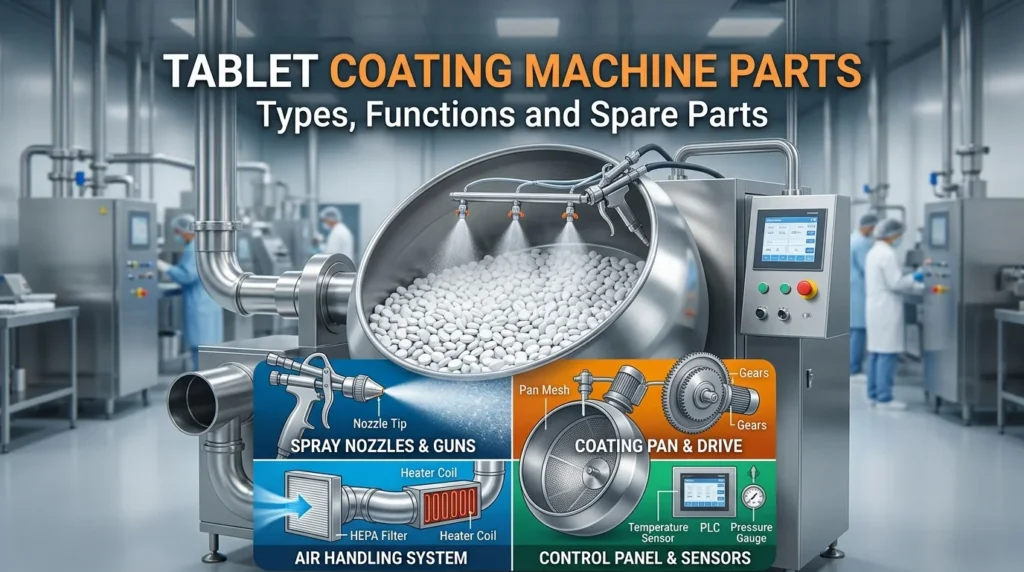
Orange peel, picking, bridging, twinning – tablet coating defects usually get blamed on the formulation first and on the machine second. In practice the order is worth reversing. A worn nozzle, a thinned pump tube or a blocked run of perforations takes minutes to rule out; a reformulation takes weeks.
This page is the troubleshooting companion to our tablet coating machine parts guide. It groups the defects you actually see on the tablet surface, then maps each one to the part to check first – each row names that part and the mechanical fault behind it.
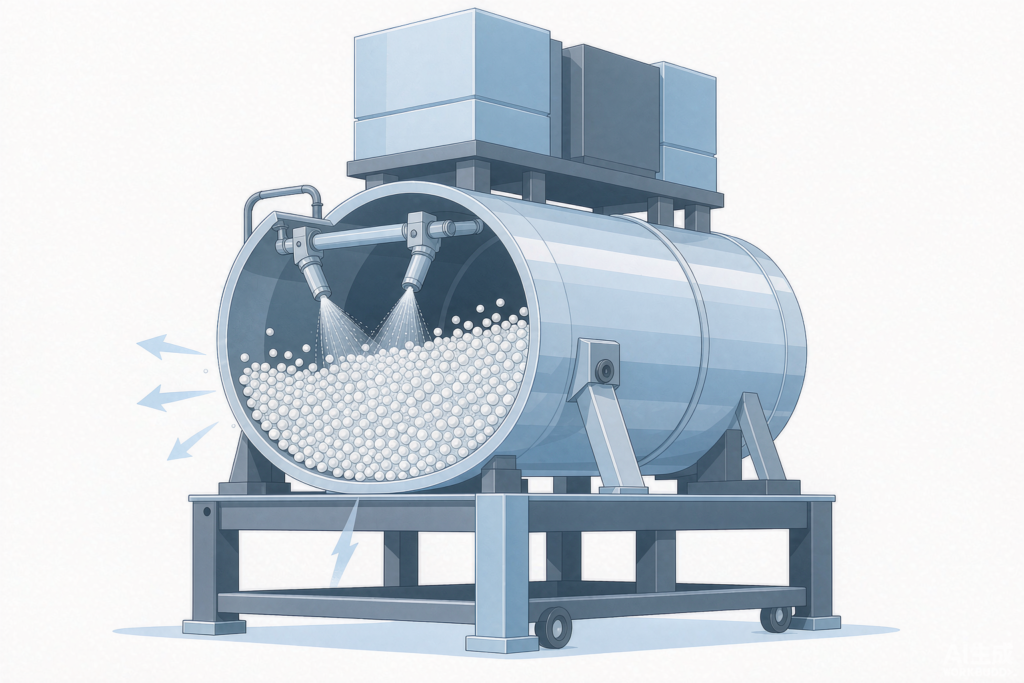
Read the defect before you open the cabinet
Three questions narrow the search before you touch a setting:
- Is it across the whole batch or localised? Even across the batch points to a setting – spray rate, inlet temperature, pan speed. Localised to one zone points to a part: a blocked run of perforations, a baffle, or a single gun.
- Did it appear overnight, or drift in over weeks? A sudden change means something failed. A slow drift means something is wearing, and pump tubing and nozzle orifices are the usual candidates.
- Does it land in the same place every batch? Same place, every time, is mechanical and positional – the drum zone, the gun alignment or the exhaust path on that side.
Spray side defects – orange peel, picking, bridging, rough edges
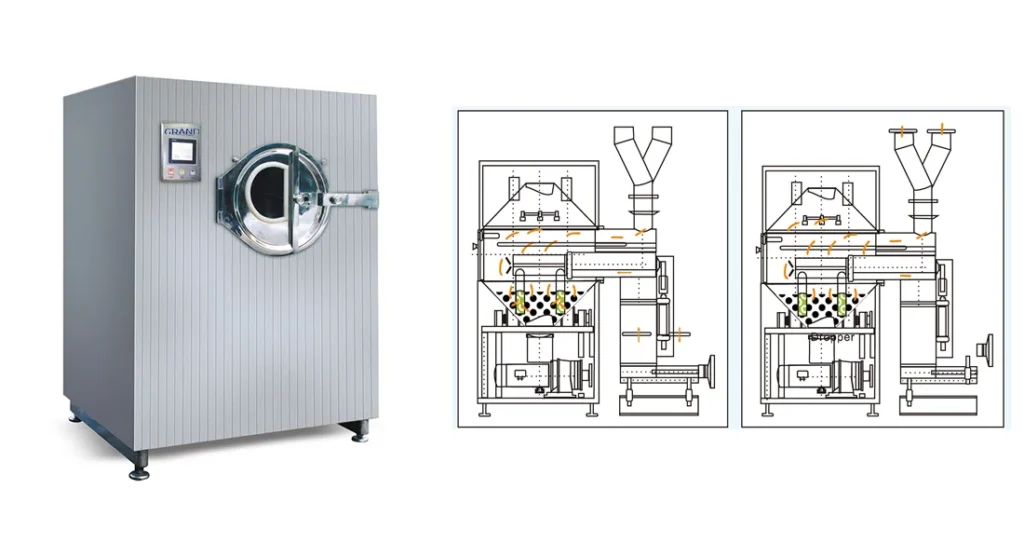
Most spray-side defects trace back to the spraying system, especially the spray nozzles and atomization air. Orange peel appears when the coating liquid is overly thick, poorly atomized, or dries too quickly. Lower viscosity by adjusting solvent ratios or solid content. Higher atomization pressure creates finer droplets that may dry before reaching the tablets, producing a rough surface. Lower pressure yields larger droplets that over-wet the tablet bed.
The spraying gun must hold a consistent pressure across the whole run. Worn gun tips change droplet size, so inspect the gun before every batch. Both a raised and a lowered atomization pressure can end in the same rough surface – telling the two apart is what the section below is for.
Picking and bridging point to a different part of the spray delivery. Picking happens when a sticky formulation or localized over-wetting leaves the tablet surface tacky; improve evaporation by adjusting polymer or plasticizer. Bridging, where the film fills imprints or logos, comes from low atomization pressure or excessive spray volume. Increase atomization pressure for finer droplets and reduce spray volume. Tablets with engraved details demand careful control of the spray pattern.
Drying side defects – sticking, over wetting, batches that run long
Sticking and over-wetting signal trouble in the inlet air temperature and airflow. When spray rate outpaces drying capacity, the tablet surface stays tacky too long. Insufficient air movement leads to over-wetting, sticking, and picking. Corrective actions include reducing fluid delivery rate, raising atomizing air pressure, and increasing inlet air temperature. Verify the exhaust air path is not restricted. Exhaust temperature gives an indirect reading of the tablet bed condition.
Batches that run long often trace back to the coating pan and its drum speed. Pan speed governs tablet bed turnover and dwell time in the spray zone. Too slow creates poor mixing, non-uniform coating, and twinning. Too fast increases edge chipping and dust. The tablet coating process depends on a balance between heat, humidity, and atomization. If that balance shifts, drying slows and the batch extends. Watch exhaust humidity and pan speed together to keep production on schedule.
Cracking, peeling and chipping – when the film fails after it dries
Cracking across the crown usually shows up after the tablets leave the pan, not inside it. Published troubleshooting tables put the cause on the formulation – too little plasticizer, or a core that expands at a different rate than the film. That is often correct. Three machine-side variables still decide whether the film is stressed in the first place.
The first is the drying-down step. A batch discharged hot and cooled in ambient air lets the core contract faster than the film, and the crown splits. Bring the bed down inside the pan with the exhaust still running before you unload.
The second is weight gain. Coating past the validated target builds a thicker and more brittle film. Film coats normally run at a small percentage of tablet weight, while sugar coats run far higher. If your batch keeps drifting past the target, check pump delivery before you blame the formulation.
The third is mechanical wear on the tablet itself. Chipped edges and eroded logos come from attrition – tablets grinding against each other. A pan run too fast, or held tumbling before the first spray lands, wears edges before there is a film thick enough to protect them.
Peeling and flaking at the edges are adhesion failures. Reduce pan speed, check that the spray rate is not re-wetting film that has already dried, and confirm the core hardness and friability are inside specification. If the core is out of specification, no setting on the machine will hold the film on. Core hardness and friability are set on the press rather than in the pan, so if they are the constraint the fix belongs upstream – see our rotary tablet press range.
Colour variation and mottling – the mixing and spray pattern defects
Uneven colour between tablets in the same batch is an exposure problem before it is a pigment problem. Every tablet has to pass through the spray zone the same number of times, at the same distance, and receive the same amount of liquid. When one of those three is off, the shade drifts.
Start with mixing. Baffles and pan speed set how the bed cascades. If the bed slides as a mass instead of tumbling, the tablets on the outside collect more coating than the ones in the middle. Watching the bed for thirty seconds tells you more than any setpoint.
Then check the guns against each other rather than against the setpoint. Two guns on the same manifold deliver different flow if one needle is worn or one fluid line is partly blocked. Measuring each gun into a cup for a fixed time is the fastest way to find the odd one out.
Mottling – a blotchy or marbled surface – is different from simple shade variation. It usually comes from soluble dye migrating as the water leaves the film, and slowing the drying rate reduces it. Logo bridging and infilling sit at the other end of the same scale: too much liquid, too little atomization, or guns set too close to the bed.
Why the same defect has two opposite fixes
Search any coating troubleshooting table for orange peel and you will find both “increase atomization pressure” and “reduce atomization pressure” listed as the fix. Both are correct, because roughness has two opposite mechanisms, and the table rarely tells you which one you have.
Under-atomized. The droplets are too large, they land wet, and the surface never levels before it dries. The film looks rough and feels uneven. Raise the atomization pressure, lower the spray rate, or thin the suspension.
Spray-dried. The droplets are so fine, or the gun sits so far from the bed, or the inlet air is so hot, that the liquid loses its solvent before it reaches the tablet and nothing is left to spread. Reduce the atomization pressure, bring the guns closer, or lower the inlet temperature.
Three checks tell you which one you have. Read the exhaust and bed temperature – high and still climbing points to spray drying. Compare the gun-to-bed distance against your validated setup. Then look at a tablet under magnification: a continuous but uneven film is under-atomization, while a dull, powdery surface that rubs off is spray drying.
Change one variable, then run long enough to see it. Adjusting spray rate, atomization and inlet temperature inside the same batch is how a small defect turns into a rejected one.
Defect to part – where to look first
| Defect you see | Check this part first | Typical mechanical cause |
|---|---|---|
| Orange peel | Spray gun – fluid nozzle and air cap | Worn nozzle changes droplet size; atomization pressure out of range |
| Picking | Spray gun needle, then pattern air | Needle not seating; poor fan overlap causes local over-wetting |
| Bridging or logo fill-in | Atomization air pressure and spray volume | Pressure too low for the formulation viscosity; guns set too close |
| Rough edges | Gun-to-bed distance, then pan speed | Guns set too close to the bed; bed turnover too slow |
| Sticking and over-wetting | Inlet air temperature and airflow, then exhaust path | Drying capacity below spray rate; blocked filter or dampers out of balance |
| Twinning | Pan speed and baffles | Bed not cascading; fill level outside the drum working range |
| Wet spots in the same place, every batch | Drum perforations | Clogged holes in that zone |
| Batch runs long | Exhaust blower and filters, then pump tubing | Restricted exhaust raises drum humidity; thinned tubing drops flow |
| Coat weight drifts low, no alarm | Peristaltic pump tubing | Tube wall thinned by constant pinching |
| Cracking across the crown after discharge | Drying-down step, then coat weight | Batch discharged hot; weight gain above the validated target |
| Peeling or flaking at the edges | Pan speed, then spray rate against drying capacity | Attrition, or a dried film being re-wetted by the next pass |
| Chipped edges and worn logos | Pan speed and fill level, then core friability | Bed tumbling too long before the first spray lands |
| Uneven colour between tablets | Baffles and pan speed, then per-gun flow | Bed not cascading; one gun delivering off rate |
Read the table as a search order, not a diagnosis. Start at the part that fails most often, confirm it, then move outward – most defects have one mechanical cause and one process cause, and the mechanical one is cheaper to rule out.
What to log so the same defect does not come back
Most “random” defects are not random. They are a trend nobody plotted. Pump tubing loses a little delivery every batch, a nozzle orifice opens up slowly, a filter loads up over weeks. One batch record tells you almost nothing; six in a row tell you which part is drifting.
Log the same values in the same units for every batch:
- spray rate, atomization pressure and pattern air pressure
- inlet air temperature and volume, exhaust temperature, and bed temperature
- pan speed and batch load
- gun count, gun-to-bed distance, and the per-gun flow check
- suspension solids content, and whether it stayed stirred for the whole run
- ambient temperature and relative humidity in the coating room
- nozzle and tubing changes, plus the date of the last full clean
The two columns that pay for the sheet are per-gun flow and bed temperature. Per-gun flow catches a worn needle before it reaches the tablet. Bed temperature catches a drying problem before it becomes sticking or roughness.
If you are setting the sheet up for the first time, tell us the machine model and we will send the parameter list we use for that pan and spray system, together with the spares we would keep on the shelf for it. For the part-by-part view, our tablet coating machine parts guide is the companion page.
If you have worked through the table and the defect is still there, send us the symptom, your coating type and solvent, and the machine model – we will tell you which parts we would check or replace first, and what to keep in stock for the next campaign. If the machine itself is the constraint, start from our tablet coating machines.

Frequently Asked Questions
What causes orange peel roughness on film-coated tablets?
Two opposite mechanisms produce it. Under-atomized coating leaves droplets too large to level before they dry, so the surface stays rough – raise atomization pressure or lower the spray rate. Spray-dried coating loses its solvent before the droplet reaches the tablet, so nothing spreads – reduce atomization pressure, bring the guns closer, or lower the inlet temperature. Check bed temperature and gun-to-bed distance before you change anything.
Why do tablets stick together or twin during coating?
The spray rate is running ahead of what the drying air can remove, so the tablet surface stays tacky through the spray zone. Low pan speed and flat tablet faces make it worse. Reduce the spray rate first, then confirm inlet air temperature and airflow, then look at pan speed and the tablet shape.
Why does a film coating crack or peel after the tablets leave the pan?
Cracking is usually a formulation or core problem – too little plasticizer, or a core that expands differently from the film. The machine contributes three things: a hot discharge without a drying-down step, coating past the validated weight gain, and a pan speed that wears the edges. Peeling at the edges is adhesion failure; reduce pan speed and check that the spray is not re-wetting a film that has already dried.
Why is the colour uneven between tablets in the same batch?
Because the tablets did not get equal exposure to the spray. Check the bed movement first – baffles and pan speed – then measure each gun separately, since one worn needle or partly blocked line changes that gun’s flow. Mottling, a blotchy or marbled surface, is soluble dye migrating as the water leaves the film, and slower drying reduces it.
How often should spray gun nozzles and peristaltic pump tubing be replaced?
Inspect nozzles, needles and seats every batch, and replace on measured condition rather than on a calendar date – a worn orifice changes droplet size long before it looks damaged. Pump tubing is a consumable that thins with every pinch; replace it when the delivered flow drifts below what the batch record shows, which is why logging per-gun flow matters.
Can blocked pan perforations cause coating defects?
Yes. Blocked holes in one zone leave wet spots in the same place every batch, slow the drying of the whole load, and extend the cycle. If the defect is positional – always the same area of the drum – the perforations are the first thing to check, not the spray settings.