Choosing a tablet coating machine by drum diameter is the most common way to buy the wrong one. The dosage form decides the pan style, the batch size decides the drum volume, and the solvent decides the explosion proofing – and that last one cannot be added after delivery.
This page is the buying-side companion to our tablet coating machine parts guide. It is how to choose a tablet coating machine from the parts list up: which specification each decision locks in, and what it costs to change later.
Start from dosage form and batch size, not from machine size
Buyers often start with the drum diameter. That approach leads to the wrong tablet coating machine. The dosage form comes first. A sugar-coated confection needs a standard pan. An aqueous film coating on a compressed tablet needs a perforated drum. The product dictates the pan style, the spray count, and the air volume.
Batch size follows the dosage form. A small clinical batch fits a laboratory unit. A production batch needs a drum volume that matches the working load. Remember that the working load stays well below the full drum volume. That headspace allows the bed to tumble. A drum filled too high will not mix well.
Sizing: match the working range, not your biggest batch
Rated capacity is a drum volume; your batch is a weight. Convert one into the other with the bulk density of your product before you compare anything – the same drum holds very different weights of a light, porous tablet and a dense one. Then place your normal batch in the middle of the working range rather than at the top of it.
A machine sized exactly to your largest batch runs every normal batch at the edge of its range, which is where bed movement and drying are least predictable. If your batches span a wide range, the question is not the largest one but the ratio between smallest and largest.
At the low end of the working range the bed stops cascading properly, and at the top you lose the headspace the tablets need to tumble. Where the span is wide, interchangeable drums or a second pan size on the same platform usually costs less than fighting the range on a single drum.
Match the spray system to the drum width
A wide drum needs more guns to cover the bed. A narrow drum needs fewer. The pump flow rate must match the total spray demand. Undersized pumps force slow spray rates, and the batch runs long.
Aqueous vs solvent based coating – explosion proofing and solvent recovery change the spec
| Decision | Aqueous film coating | Solvent-based coating |
|---|---|---|
| Carrier | Water | Ethanol or another organic solvent |
| Drying | Slow – water carries a high latent heat of vaporization | Fast – shorter cycles for the same weight gain |
| Air handling | Larger heater duty and higher airflow; dehumidification often needed | Lower heat duty, but the exhaust stream has to be treated |
| Safety | No explosion proofing required | Explosion-proof motors, sensors, panel and full grounding |
| Exhaust | Moisture only | Solvent recovery or abatement, concentration monitoring |
| Utilities | More heat and more air | Chilled water or refrigerant for recovery |
| Changing later | Explosion proofing cannot practically be added after delivery | You carry the safety and solvent burden permanently |
The solvent choice changes the parts list more than any other decision. Aqueous film coating uses water as the carrier. Water is safe, cheap, and needs no explosion proofing. The trade-off is slow evaporation. Water has a high latent heat of vaporization, so the air handling unit must supply more energy and more airflow.
Solvent based coating uses organic carriers such as ethanol. Ethanol evaporates faster, which speeds drying. The vapor is flammable. Every motor, sensor, and control panel must meet explosion proof standards. The exhaust stream also needs solvent recovery. These additions raise the cost of the right tablet coating machine well above an aqueous unit.
What explosion-proof construction actually covers
Explosion proofing is not one line item. It reaches the pan drive motor, the exhaust fan motor, the solenoid valves on the spray system, every sensor and transmitter in the air path, the control panel and its enclosure, the cabinet lighting, and the grounding and bonding of the whole skid. Ask which of these are included and which are quoted as options, because an unrated panel makes the rest of it pointless.
The room matters as much as the machine. Solvent coating needs an exhaust path that goes outside, a solvent concentration monitor, and – depending on your local code and the solvent load – a recovery or abatement unit on the exhaust. None of that can be retrofitted cheaply once the machine is standing on your floor.
Solvent recovery and the running cost you inherit
Solvent recovery is usually justified on the price of the solvent, but the larger effect is on the air handling duty. Recovering solvent means condensing it back out of a large exhaust stream, which needs chilled water or a refrigerant circuit sized to that volume. That is a utility decision, not an accessory, and it belongs in the first budget round.
The choice also affects the drum and ductwork. Solvent lines need grounded components and closed transfer. Aqueous lines need corrosion-resistant wetted parts. Review the parts list against the solvent before you compare different types of tablet coating machines. The wrong spec creates a safety hazard, not just a quality problem.
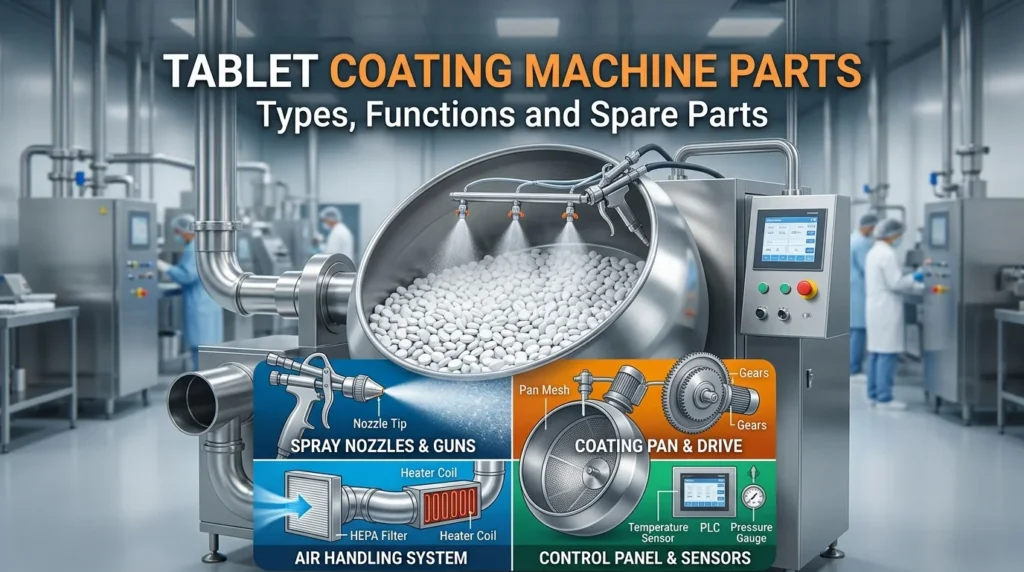
Every part in a tablet coating machine shapes the final product. The pan tumbles the bed. The spray nozzle sets droplet size. The exhaust system removes solvent vapor. A weak link in any of these parts shows up as a defect on the tablet surface – or in a batch that simply runs long.
Selection should start from the whole system, not one component. A perfect spray gun cannot fix poor airflow. A large drum cannot fix an undersized pump. Buyers should review the full parts list and compare machine types against their dosage form and batch size.
The four machine types and what each one is actually for
Most shortlists come down to four machine types. The comparison below is the short version; the column that usually decides it is the last one.
| Machine type | Best for | Automation | Where it falls short |
|---|---|---|---|
| Conventional solid pan | Sugar coating, confectionery, simple colour coating | Manual to semi-automatic | Drying only happens at the bed surface, so film coating cycles run long |
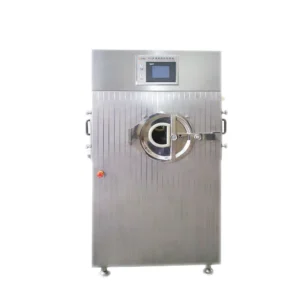
| Perforated pan coater | Aqueous film coating, enteric coating, most tablet work | Fully automatic, PLC + HMI | Over-specified and over-priced if you only ever run sugar coating |
| Fluid bed / Wurster | Pellets, granules, multiparticulates, small tablets | Automatic | The air velocity that suspends the bed also wears large or fragile tablets |
| Interchangeable-drum platform | R&D through pilot, plants running many batch sizes | Automatic | Higher capital cost, and drum changeover time between campaigns |
Perforated pan – the default for film coating
The perforated pan is the default for a reason: drying air passes through the bed instead of over it, so the whole load dries at the same time. That is what makes a short aqueous film cycle possible. If you are coating compressed tablets with an aqueous film, start here and move off it only for a specific reason.
When a fluid bed or a solid pan is the better buy
A fluid bed earns its place when the product is a pellet or a granule, or when the coating is functional and the uniformity requirement is tight. It is the wrong tool for standard tablets. A conventional solid pan is the right buy when the product is sugar-coated confectionery and the process is a multi-stage build rather than a single film.
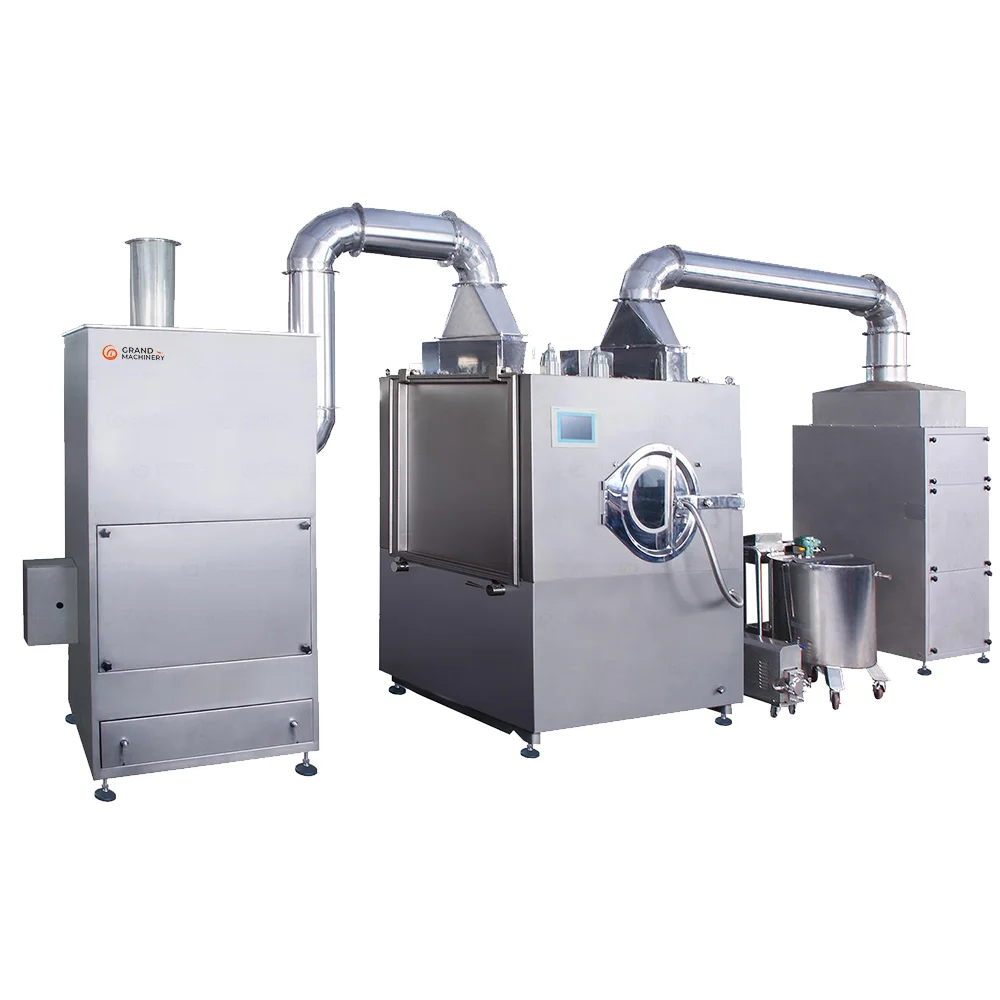
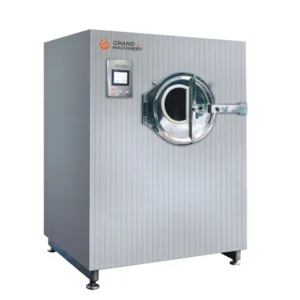
Our own range sits on the perforated-pan side of this table: the high efficiency intelligent coating machine for automated film and enteric work, and the integral high efficiency machine where the plant wants the air handling and control built into one skid.
Utilities, floor space and the checks that kill a shortlist
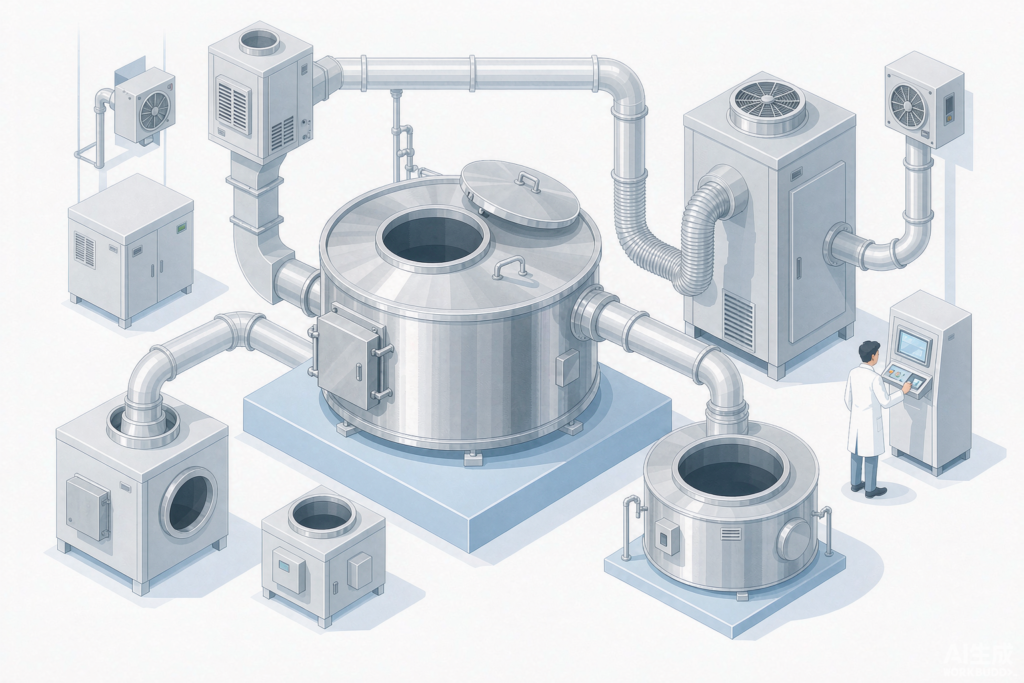
A coating machine is not a standalone purchase; it is a load on your utilities. Settling this before you sign is cheaper than discovering it at installation.
Air, power and heat
Compressed air feeds atomization, the gun cylinders and the cleaning cycle. It is specified as both a pressure band and a consumption figure, and both matter – a compressor that holds the pressure but not the volume will starve the guns part-way through a batch.
Heat is the second one. Decide early whether the air handling unit heats electrically or from steam. Steam needs boiler capacity you may not have and a condensate return you may not have routed. Electric heating is simpler to install and usually costs more per batch to run.
Power, exhaust ducting and – for aqueous coating in a humid climate – dehumidification complete the list. Ask for the utility schedule as a separate document before you sign, not as a paragraph in the manual after delivery.
Floor space, access and drainage
The machine has to get into the room and be serviced once it is there. Check door widths and corridor heights against the skid dimensions, floor loading against the machine weight, and the service clearances the manufacturer states for the rear and side doors. Wet cleaning needs a floor drain close to the machine.
These are unglamorous checks, and they are the ones that slip. A machine that cannot be moved in, or cannot be opened for cleaning, stops being a machine and becomes a project.
The documentation and validation pack to ask for before you sign
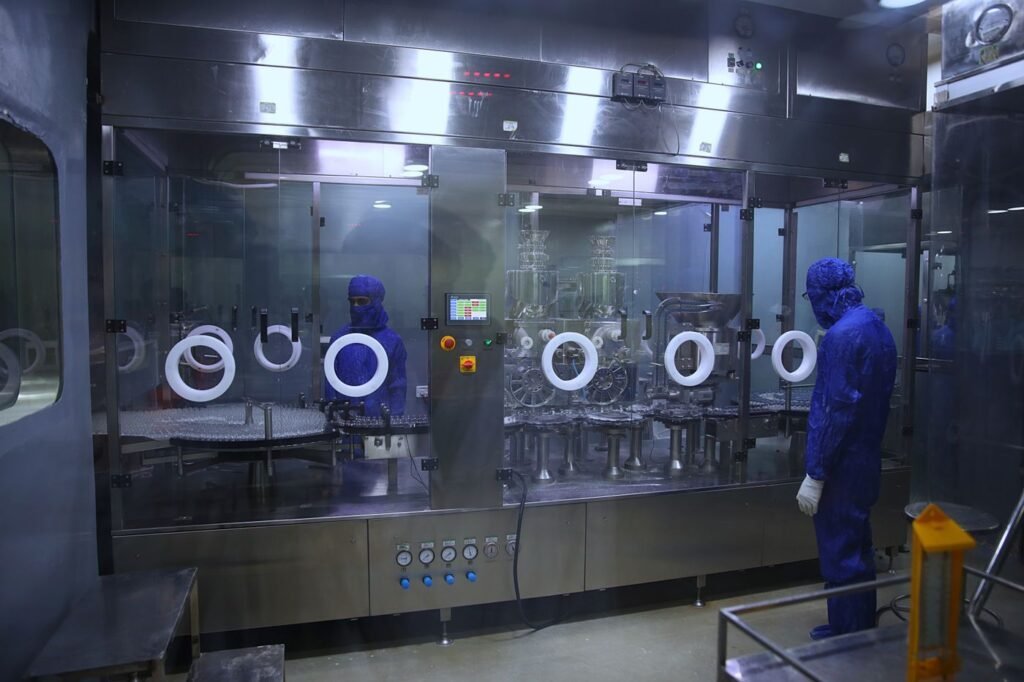
Two machines that coat equally well are not equivalent if one arrives with a validation pack and the other arrives with a manual. For regulated markets the pack is part of the product.
The validation documents
Ask for these by name, and ask who executes them:
- material certificates for every product-contact part, with the stainless grade stated
- surface finish and weld documentation for the pan and the ducting
- DQ, IQ, OQ and PQ protocols
- calibration certificates for the temperature, airflow and pressure instruments
- software documentation for the PLC and HMI – recipe storage, user access levels, audit trail, and electronic records that meet 21 CFR Part 11 and EU GMP Annex 11
- a spare parts list with lead times, split into consumables and capital spares
FAT, SAT and what you have to supply
Factory acceptance testing is where you find out whether the machine does what the datasheet said, before it ships. Agree the protocol in advance: what gets coated, at what batch size, to what weight gain, and what the acceptance limits are. You supply the cores and the coating material; the manufacturer supplies the machine, the utilities on their floor and the instruments.
Site acceptance repeats it on your floor with your utilities. The gap between the two is almost always a utility that was assumed rather than specified – which is the argument for settling the utility schedule first.
What a quote should break out line by line
Two quotes for “the same” machine are rarely comparable unless they are broken out the same way. Ask for these as separate line items:
- the machine itself, with the pan or drum size stated
- the air handling unit – filtration stages, heater duty and dehumidification, not just “AHU included”
- the spray system, with the gun count and nozzle type named
- loading and unloading, which are not bundled by default
- the spare parts kit, split into consumables and emergency parts
- explosion-proof motors, sensors and control panel, if you are running solvent
- installation, commissioning and the documentation pack you need for validation
A quote that gives one number for the whole line gives you nothing to compare, and nothing to claim against later.
Send us your dosage form, batch weight, coating type and solvent, and we will quote the machine that matches – gun count, air handling duty and the spare parts kit included. If you are still comparing machine types, our tablet coating machines range is the place to start.
Frequently Asked Questions
What size tablet coating machine do I need?
Work from your normal batch weight, not from the drum diameter. Convert the rated drum volume using your product bulk density, then place your normal batch in the middle of the working range rather than at the top of it. If your batch sizes span a wide range, look at interchangeable drums or a second pan size on the same platform instead of oversizing one drum.
How much does a tablet coating machine cost?
Quotes for the same nominal capacity can differ several times over, because automation level, air handling duty and explosion proofing move the number more than the drum does. That is why a line-by-line quote matters more than a headline figure: without the break-out you cannot compare two offers or claim against either of them later.
Can one machine handle film, enteric and sugar coating?
A perforated pan covers aqueous film and enteric coating as standard, and can run sugar coating with a longer cycle. A conventional solid pan is the better tool if sugar coating is the main product. What does not transfer freely is the solvent: moving from aqueous to solvent-based coating needs explosion proofing and solvent recovery that must be specified at the order stage.
Do I need explosion-proof construction?
Only if you coat with a flammable organic solvent. Water-based film coating does not require it. Because it cannot practically be added after delivery, the decision has to be made before you order, and it covers the pan and exhaust motors, the spray system valves, every sensor in the air path, the control panel, and the grounding of the skid.
What validation documents should the supplier provide?
Material certificates for product-contact parts with the stainless grade stated, surface finish and weld documentation, DQ, IQ, OQ and PQ protocols, calibration certificates for the instruments, and software documentation covering recipe storage, user access levels, audit trail and electronic records under 21 CFR Part 11 and EU GMP Annex 11. Ask who executes the protocols, not just whether they exist.
How long does a coating batch take?
It depends on batch size, target weight gain and the drying capacity of the air handling unit. Aqueous film coating on a perforated pan commonly runs in the range of a few hours per batch; sugar coating takes considerably longer because the coat is built up over many stages. If your cycles are stretching, check exhaust airflow and filter condition before raising the temperature.