(Last Updated: Nov. 7th)

Gummy vitamin manufacturing requires more than producing gummies with a consistent shape and texture. Manufacturers must also control nutrient dosage, ingredient stability, and product quality throughout production. From formulation and depositing to testing and packaging, every stage affects the finished product. This guide explores the equipment, quality controls, and scale-up decisions behind commercial gummy vitamin production.
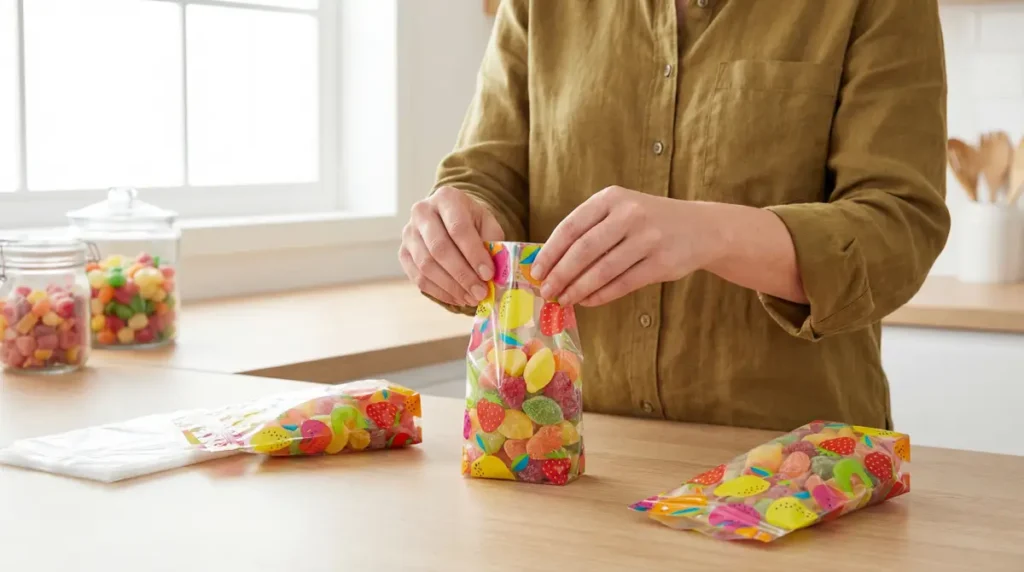
Finished gummies illustrate product appearance only. A photo cannot demonstrate vitamin potency or finished-batch compliance.
What makes gummy vitamin manufacturing different from ordinary gummy candy?
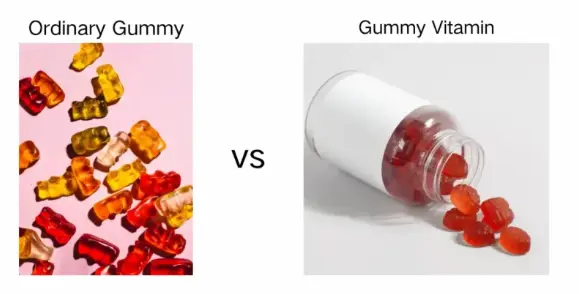
A candy gummy is judged largely on appearance, texture, flavor and food safety. A vitamin gummy must also deliver its declared dietary ingredients consistently at the stated serving size and, where a shelf-life claim is made, remain suitable for the claimed period. A perfectly shaped, correctly weighed gummy does not establish that its vitamin content is correct.
A 2026 review by researchers affiliated with the US FDA, Perspective on Gummy Dietary Supplements Manufacturing and Testing, highlights the formulation, processing and analytical-testing challenges unique to this dosage form. This is why a nutrient-containing gummy should not simply be treated as a standard candy recipe with vitamins stirred in at the end.
On a manufacturing floor, this difference changes the work instructions: suppliers must qualify ingredients; development teams must assess ingredient interactions; operators must control mixing and depositor performance; and quality personnel must evaluate assays, contamination risks and finished product specifications. An equipment vendor can provide a suitable process platform, but cannot independently guarantee your supplement’s label claim.
Five decisions to make before choosing a gummy vitamin production line
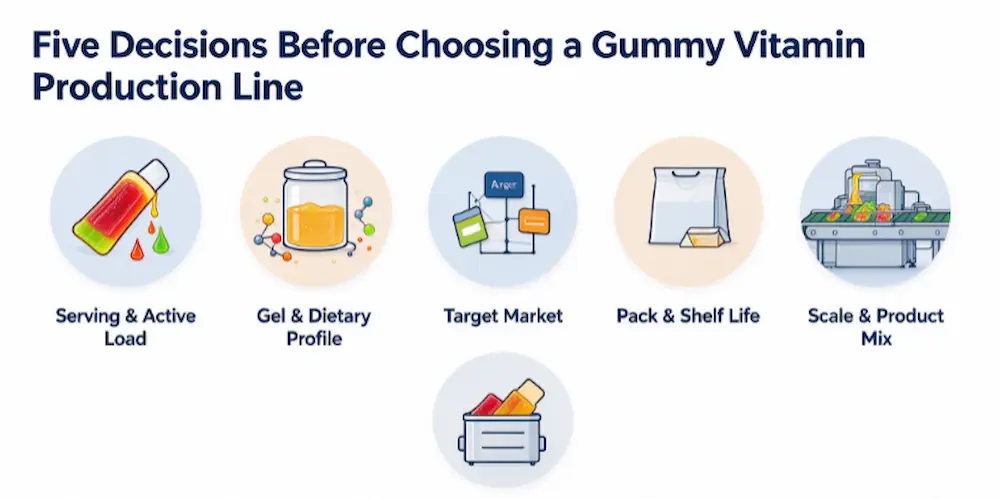
- Serving and active load: decide which ingredients are declared, their target amounts per serving, serving size, acceptable variability, and practical gummy size. A higher active load can change taste, viscosity, gel structure or the number of gummies per serving.
- Gel and dietary positioning: choose gelatin, pectin or another validated hydrocolloid system, accounting for vegan/vegetarian positioning, allergens, bite, heat tolerance and pH requirements.
- Target market: determine whether the product is legally a dietary supplement, conventional food or another category in each intended country; requirements are not interchangeable.
- Pack and shelf life: define the intended package, storage conditions, protective barrier and analytical stability plan before finalizing the formulation.
- Scale and product mix: set normal batch size, kilograms per hour, gummies per minute, expected product changes and cleaning/changeover needs rather than shopping on headline capacity alone.
The core question for buyers is: Can this equipment repeatedly produce my approved formula at the specified unit weight, nutrient content and release quality? If a vendor cannot demonstrate that with the intended formulation, a published throughput number is not enough.
A practical gummy vitamin manufacturing process and its control points
The exact order and equipment vary by gel chemistry and active ingredients. For a high-level view, see our commercial gummy manufacturing process guide. The following table instead maps each stage to the evidence a vitamin gummy manufacturer should ask to see.
| Manufacturing stage | Equipment typically involved | Process evidence to capture |
|---|---|---|
| 1. Ingredient reception | Weighing, storage, screening and traceability | Ingredient identity, supplier documentation, lot and allergen control |
| 2. Gel/base preparation | Jacketed tanks, cooking/mixing system | Recipe, time/temperature history, solids and relevant pH checkpoints |
| 3. Active premix addition | Controlled dosing and blending/holding system | Addition stage, ingredient compatibility, dispersion and mixing records |
| 4. Depositing and molding | Depositor, nozzles, molds and conveying | Unit-weight distribution, fill repeatability, residue and mold identification |
| 5. Setting/conditioning | Cooling and humidity-controlled conditioning | Conditioning profile, texture, water activity and demolding outcome |
| 6. Finishing and inspection | Demolder, optional oiling/coating, inspection | Surface quality, damage, handling and contamination checks |
| 7. Release and packing | Sampling, counting, bottles or pouches, sealing | Assay results, accepted counts, seal integrity, labeling and batch traceability |
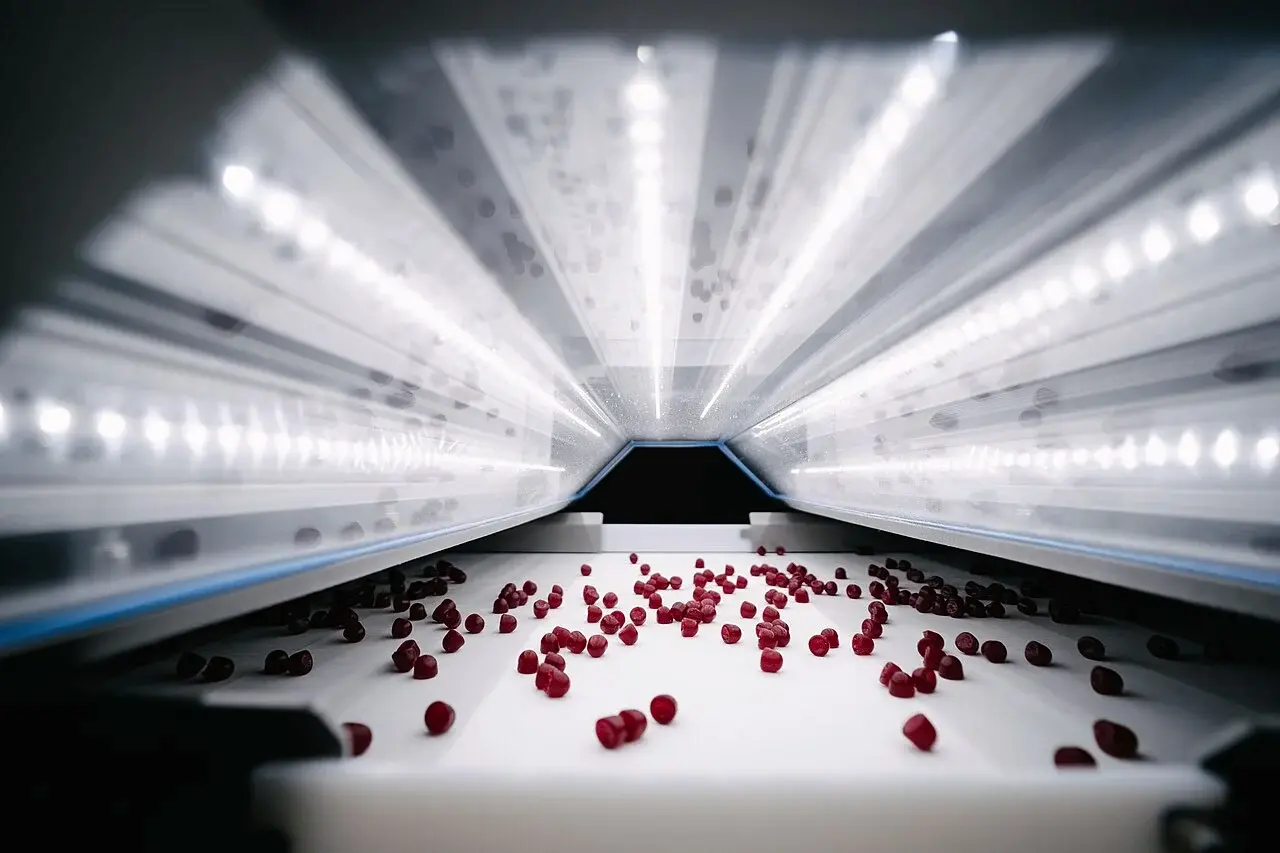
Real gummy manufacturing photo from TopGum (a third-party facility, not Grand Machinery equipment). Photo by Aharon Gedalia via Wikimedia Commons, licensed under CC BY-SA 3.0; resized for the web. The production sequence varies by formulation and factory layout.
A line can be automated across several stages, but the required sensors, recipe controls and testing devices are configuration dependent. Claims such as “GMP compliant” or “±0.1 g accuracy” should be interpreted only with a named model, test method and validated operating conditions—not as blanket performance of every installed line.
Gelatin or pectin: choose for the formulation and the process
| Decision | Gelatin gummy | Pectin gummy |
|---|---|---|
| Main gel material | Animal-derived protein | Plant-derived polysaccharide |
| Typical sensory direction | Elastic, chewy bite | Can create a shorter, clean bite; depends on pectin type |
| Gel-setting approach | Cooling-dependent gelation | Depends on high-/low-methoxyl pectin, sugar, acid and/or calcium |
| Manufacturing constraint | Temperature history affects gel properties | pH, soluble solids and available ions can strongly affect process window |
| Nutraceutical positioning | Not suitable for vegan/vegetarian claims | May support plant-based positioning with other ingredients verified |
| Equipment implication | Control mixing, holding, depositing and cooling | Control acid/pectin addition, viscosity, temperature and depositing timing |
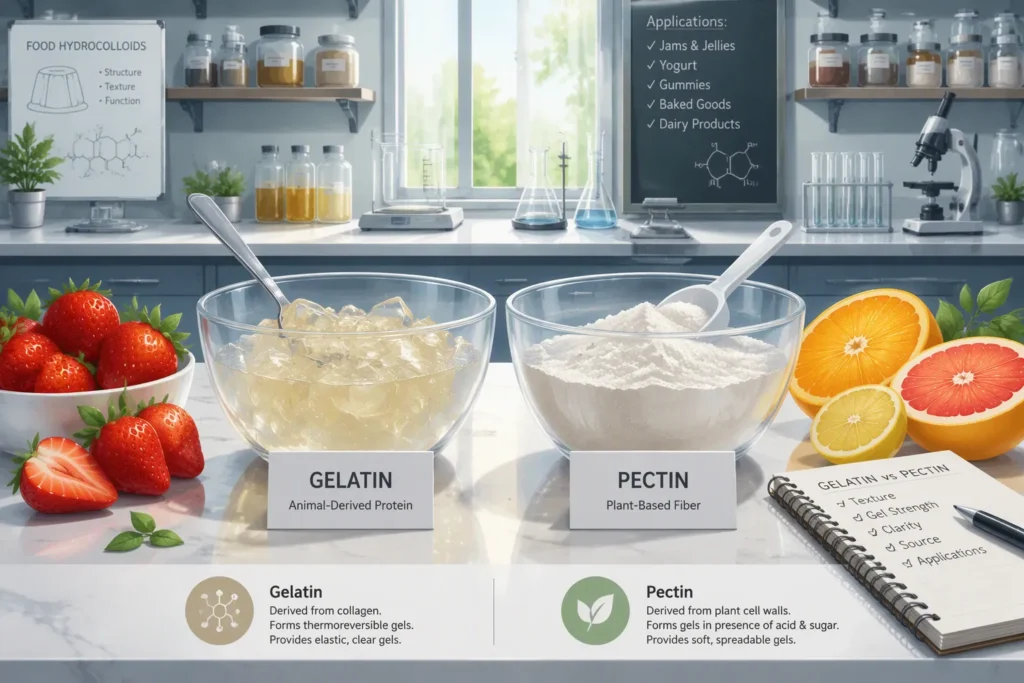
Neither platform automatically protects heat-sensitive vitamins. Even within “pectin,” high-methoxyl and low-methoxyl formulations can have different setting requirements. Ask the formulation developer for a pilot-proven process window and then configure the cooker, feed system, depositor and cooling/conditioning around it. For a deeper comparison, read Gelatin vs Pectin: choosing a gelling system.
Starchless depositing versus starch molding
Starchless depositing fills reusable molds and is often evaluated where mold traceability, cleaning access and frequent formula changes matter. Starch molding offers other shape and throughput options but adds starch handling and its own hygiene/conditioning controls. Neither method is inherently qualified for regulated supplements: the appropriate choice depends on the product, contamination assessment and evidence collected during qualification.
Grand Machinery offers integrated gummy depositing lines and gummy depositing machines. These are equipment options to evaluate, not proof of any finished vitamin potency or product-specific regulatory approval.
Protecting vitamin potency and dose uniformity
1. Choose the point of active addition deliberately
Heat, oxygen, light, acidity, moisture and holding time can affect different vitamins in different ways. Instead of applying an arbitrary maximum temperature for every ingredient, confirm stability with the ingredient supplier and formulation scientist. Some ingredients may be added after the hottest cooking stage, but that can only work if the premix disperses uniformly within the available processing window.
Vitamin C is a useful cautionary example. A 2026 peer-reviewed study on vitamin C gummy stability investigated a particular protective formulation and found that ingredient delivery and stability can depend strongly on the chosen matrix. That finding does not establish a universal retention rate or guarantee that an ordinary gummy line achieves the study’s results.
2. Separate physical portioning from analytical content
Depositors are designed to deliver a controlled mass of gummy mixture to the mold. However, a consistent deposited weight does not by itself prove that every piece contains the correct vitamin or mineral amount. Evaluate premix uniformity, homogeneity during holding, distribution across the depositor and the finished batch assay using an appropriate sampling plan. Consider whether ingredients settle, separate or become unevenly distributed during transfers or shutdowns.
3. Treat overages as a formulation decision, not a machine setting
Some supplement formulas use a justified manufacturing or stability allowance (“overage”) to account for loss of active content. The amount must be supported by product-specific stability and safety data and compliant with the destination market’s rules. Do not adopt a generic percentage from an equipment brochure. Document the target assay at release and the evidence supporting the amount declared at the end of the claimed shelf life.
4. Control water activity, conditioning and packaging
Measured water activity (aw) informs microbial and physical stability, whereas moisture content is only part of the picture. The FDA’s technical explanation of water activity discusses its relationship to available water and microbial growth. There is no single water-activity target suitable for every vitamin gummy. Set specifications from formulation, microbiological risk, texture and stability data.
After cooling and setting, evaluate surface tackiness and compatibility with any oiling/coating operation. Protect the product in bottles or pouches with an appropriate moisture/oxygen barrier; test the packaged product under relevant storage conditions. For related troubleshooting, see why gummy vitamins stick together and our gummy packaging guide.
Which gummy vitamin manufacturing equipment should you compare?
Equipment procurement should start with the product requirement and a test plan. The machine categories below are a buyer’s comparison framework, not a claim that any specific configuration is suitable for every vitamin formulation.
Cooking, mixing and active-dosing systems
Assess vessel geometry, batch size, agitation/shear, temperature logging, transfer time, access for cleaning, and handling of small-dose active premixes. If multiple supplements are produced on one line, establish cleanability and cross-contact controls consistent with the ingredient risk assessment. A conventional candy cooker without a documented addition and mixing plan is not automatically sufficient.
Gummy depositing machines and matched molds

Evaluate depositor nozzle configuration, shot repeatability, heated feed/hopper where appropriate, number of cavities, changeover time, mold cleaning, and allowable viscosity range for the intended formula. Ask for actual batch samples at the beginning, middle and end of a representative production run. Mold design also affects piece mass and demolding, not merely the gummy’s appearance.
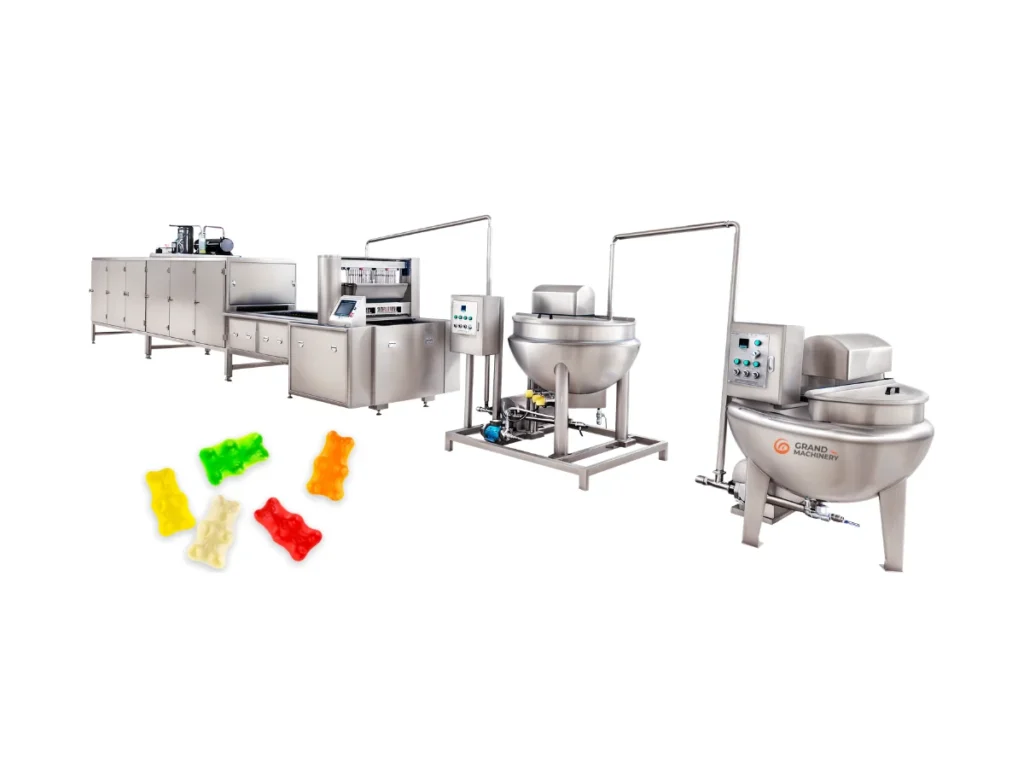
GM300 pectin gummy depositing line (manufacturer image). Nutrient retention and dosing accuracy require product-specific trials.
For specific options, compare Grand Machinery’s GM150 gelatin depositing line with the GM300 pectin depositing line. Their public specifications are manufacturer information; acceptance tolerances and operating ranges should be confirmed in the quotation and FAT.
Custom gummy mold illustration: mold geometry and deposited mass affect portion consistency and demolding.
Learn more about mold materials, cavity geometry and custom tooling in the gummy mold buying guide.
Conditioning, inspection, counting and packaging
Define required temperature/humidity control, demolding damage limits, any finishing additives, and inspection/contamination controls. Downstream equipment must be matched to gummy friction, tackiness and pack size. For bottling, verify counting accuracy with the actual gummies and evaluate closure, induction seal or other pack-protection requirements with the selected container. See our gummy counting equipment guide for line integration considerations.
Quality control and GMP: what the manufacturer must demonstrate
In the United States, facilities manufacturing dietary supplements are subject to current good manufacturing practice requirements in 21 CFR Part 111, as applicable. The FDA’s dietary supplement CGMP guide describes component, in-process, finished-batch, packaging and labeling controls. Under 21 CFR Part 111, manufacturers are responsible for established specifications, appropriate testing or examination, production records, qualified quality-control review and related requirements.
For a gummy supplement sold in the US, the FDA’s Supplement Facts labeling guide explains required dietary-ingredient and serving declarations. Requirements can differ when a gummy is marketed as conventional food or in another jurisdiction. Neither FDA nor a machine supplier pre-approves a generic “vitamin gummy recipe” as safe and compliant for every market.
| Quality question | What to test or document | Why the buyer needs it |
|---|---|---|
| Are the ingredients what the label says? | Raw-material identity and supplier qualification | Avoids substitution and ingredient-related quality failures |
| Is each serving formulated correctly? | Premix records, weight distribution and appropriate analytical assay | Physical unit weight does not prove nutrient content |
| Can the batch be released? | Defined specifications, justified sampling, QC approval | Links the production evidence to batch disposition |
| Is the product microbiologically suitable? | Risk-based microbiological controls and relevant water-activity tests | Helps manage spoilage and product safety |
| Will nutrients remain within specification? | Real-time or justified stability study and packaging assessment | Supports stated storage conditions and shelf-life claims |
| Can the line be traced and cleaned? | Batch records, changeover, cleaning and calibration procedures | Supports reproducibility and investigations |
A 2026 scientific perspective on gummy supplements emphasizes analytical-testing challenges alongside manufacturing challenges; it is an important reminder that a finished-product potency assay should be performed by an appropriately qualified laboratory using a suitable method, not inferred from what entered the mixing tank.
How to run a useful factory acceptance test (FAT)
A meaningful FAT is planned before the machine is purchased. Ask the supplier to operate the proposed configuration with a representative recipe and your actual molds or packaging where feasible. Distinguish an equipment trial from full qualification of the commercial supplement: finished-batch stability and regulatory compliance remain the manufacturer’s responsibility.
- Define the test batch: document formula family, gummy mass and intended batch size, active or approved surrogate, mold and target piece mass.
- Record process conditions: monitor temperatures, times, mixing/holding intervals, viscosity where applicable, pH/soluble solids and cooling/conditioning conditions.
- Measure quality yield: record start-up scrap, pieces by weight class, defects, rejected packs, downtime and acceptable output per hour.
- Check repeatability: take samples from different depositor heads and at multiple times in the run; separate weight checks from any relevant active-content testing.
- Confirm hygiene and changeovers: show how operators open, clean, inspect and reassemble contact parts, and describe any recipe or format change workflow.
- Obtain the report: request a signed FAT/SAT scope, raw measurement records, unresolved deviations, spare parts, training and agreed acceptance criteria.
Scaling gummy vitamin manufacturing without losing quality
Scaling is not simply multiplying the lab recipe. Larger kettles and holding tanks change heating/cooling profiles, residence times and mixing behavior. Faster depositors can also change the time available for active addition and transfer. Run a staged scale-up so that product-specific attributes—not only machine speed—stay within approved limits.
An illustrative capacity check: a machine delivering 120 acceptable gummies per minute for a full 60 minutes would produce 7,200 accepted pieces under those assumed conditions. Actual planning must allow for rejects, changeovers, clean-downs, packing constraints and equipment availability. For buying decisions, compare accepted gummies per production hour and cost per compliant finished serving, not theoretical shots per minute.
Also establish the process owner for formula development, equipment commissioning, laboratory methods and documentation. Grand Machinery can be evaluated as an equipment supplier, while the brand or contract manufacturer should retain responsibility for recipe specifications, ingredient suitability, claims and finished-product release.
Gummy vitamin production line request-for-quotation checklist
Send the same brief to each shortlisted supplier to obtain comparable machine configurations and trial proposals:
- Formula family and target markets; whether the finished product is a dietary supplement or food
- Target actives and declared amount per serving, including sensitive ingredients and processing constraints
- Gelatin, pectin or other gelling matrix; dietary/allergen positioning
- Pilot, normal and peak batch sizes; desired good-piece throughput and number of SKUs
- Gummy piece weight, mold/cavity design, number of colors and optional fillings
- Heating, mixing, active dosing, holding and depositing system requirements
- Conditioning/drying environment, finishing method, contamination controls and cleaning needs
- Pack format (bottle or pouch), counts per pack and relevant shelf-life/barrier specifications
- Required FAT/SAT criteria, documents, material contact information, utilities, layout and after-sales service
For an equipment discussion, explore Grand Machinery’s gummy line configurations and send your process requirements to the Grand Machinery team. Ask for evidence from trials using your own formulation instead of assuming a catalog model is suitable without testing.
Gummy vitamin manufacturing FAQ
What is the gummy vitamin manufacturing process?
It is the controlled production of vitamin-containing gel pieces, typically involving formulation, gel-base cooking, active addition, depositing, setting or conditioning, inspection, testing and packaging. The equipment and specifications depend on the ingredient and target market.
Can a regular candy gummy line make vitamin gummies?
Some candy-line equipment may be adaptable, but a dietary supplement requires appropriate ingredient controls, validated mixing and dosing, cleaning, documentation, testing and compliant labeling. A candy line does not automatically establish a compliant vitamin gummy process.
Is pectin or gelatin better for gummy vitamins?
Neither is universally better. Gelatin and different pectin systems offer different textures and processing requirements. Choose based on dietary positioning, ingredient compatibility, stability, process capability and a successful pilot trial.
How do manufacturers keep vitamin dosage consistent in each gummy?
They control ingredient identity and premix preparation, mixing and holding conditions, deposit weight and variability, sampling, and analytical verification of active content. Weight uniformity alone cannot prove dose uniformity.
What is the biggest challenge with heat-sensitive vitamins?
Preventing ingredient loss while retaining a workable gummy gel is a major challenge. The active-addition point, exposure to heat, oxygen and moisture, and finished-product stability must be assessed for the actual formula rather than set from a universal temperature rule.
What machines are needed to manufacture gummy vitamins commercially?
A typical line may include mixing and cooking tanks, controlled ingredient dosing, a gummy depositor with molds, cooling or conditioning, demolding and optional finishing, plus quality checks, counting and packaging. Required modules depend on throughput and recipe.
Does a gummy depositing machine guarantee FDA or GMP compliance?
No. Equipment can support hygienic, controlled manufacturing, but compliance belongs to the operating manufacturer and depends on facilities, processes, documentation, ingredient specifications, testing, quality systems and the applicable market rules.
Sources, authorship and editorial disclosures
Published: November 4, 2026. Written by: Grand Machinery Editorial Team. This buyer’s guide is based on publicly available scientific publications, FDA regulatory guidance and manufacturer equipment descriptions. It does not present independent laboratory results, validate a particular nutrient formula, or certify any manufacturing facility. Bruce Fu’s founder profile elsewhere on this site is not a technical-review credit for this article.
Selected references: Hu et al., Perspective on Gummy Dietary Supplements Manufacturing and Testing (2026);
Amalraj et al., Vitamin C gummy formulation and stability study (2026);
FDA Dietary Supplement CGMP Guide (21 CFR Part 111);
FDA Dietary Supplement Labeling Guide;
FDA Water Activity Technical Guidance.
Supplier equipment photographs and product details are identified as Grand Machinery material.
Product formulas, regulations and machine offerings can change. Always obtain current written specifications and independent, product-specific analytical results before product launch. To report an error or request equipment configuration information, contact Grand Machinery.