(Last Updated: Nov. 7th)
Quick answer:
Sustainable food packaging machines are packaging systems selected and configured to run a verified lower-impact packaging format while protecting food safety, shelf life, seal integrity and production efficiency. For flexible food packs, common options include vertical form-fill-seal (VFFS), premade pouch and flow-wrapping machines. The crucial question is not whether a machine is marketed as “eco-friendly,” but whether it can process the exact film or pouch reliably and document the results.

For food manufacturers and packaging buyers: Start by choosing the pack’s required protection and the end-of-life route available in the destination market. Then qualify the film or pouch on the proposed machine. This guide compares materials, machine types, acceptance tests, cost drivers and compliance considerations for 2026.
Equipment illustration: Grand Machinery GM720B VFFS. A machine photograph does not verify compatibility with every recyclable or compostable film.
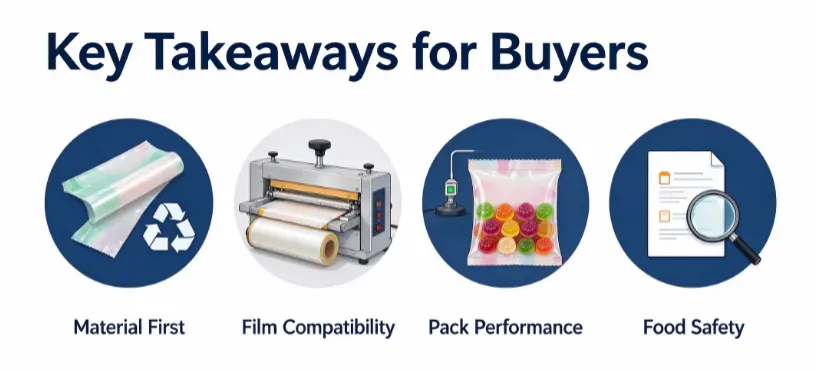
Key takeaways for buyers
- Material first, machine second: mono-PE or mono-PP flexible packaging may support recycling-oriented designs, but local collection, barrier layers and pack construction determine real-world recyclability.
- A new film is not automatically compatible: forming friction, film tension, seal initiation temperature, dwell time and seal contamination may require new tooling or recipes.
- Measure good packs, not just maximum speed: compare material used per saleable pack, reject rates, energy, leak failures and shelf-life results.
- Protect food safety: recycled content and food-contact suitability are separate questions; request documentation for the actual food, temperatures and market.
- Ask for a documented trial: request factory acceptance results using your product, printed packaging samples and the machine configuration you intend to buy.
What makes a food packaging machine sustainable?
A packaging machine is part of a production system: product + package + sealing process + end-of-life infrastructure. A machine may reduce scrap or support a lighter pack, yet the final sustainability benefit still depends on measured performance and the destination market. The Sustainable Packaging Coalition’s packaging design guidance recommends a holistic approach that includes material use, sourcing, transport and food-waste prevention—not one material label.
For example, reducing packaging weight is not an improvement if the new pack develops leaks that shorten the product’s usable shelf life. Similarly, a technically recyclable bag is not necessarily collected or recycled at scale. Buyers should avoid blanket promises such as “100% green” without product-specific evidence, a distinction also reflected in the US FTC Green Guides.
Packaging materials compared: what must the machine handle?
| Packaging option | Potential sustainability route | Main machine and validation questions |
|---|---|---|
| Mono-PE flexible film | Recycling-oriented polyolefin design where appropriate collection exists | Seal window, stiffness, slip, forming collar, barrier and print/adhesive structure |
| Mono-PP flexible film | Recycling-oriented polyolefin design where appropriate collection exists | Temperature/dwell/pressure, machinability, pack integrity, available film grade |
| Barrier-coated paper | Potential paper-recovery route only when construction and local facilities qualify | Coating sealability, moisture resistance, forming stress, tearing and dust |
| Certified compostable film | Composting under stated certification and available collection conditions | Film stability, seal strength, shelf life, machine trials and precise disposal claim |
| Recycled-content material | Reduced virgin-material demand in suitable applications | Legal food-contact status, source controls, migration review and film variability |
The CEFLEX Designing for a Circular Economy guidance favours mono-PE and mono-PP structures where technically suitable, while evaluating inks, adhesives, coatings, barriers, zippers and sorting outcomes. These are design-for-recycling principles, not guarantees that every mono-material pack will be recycled.
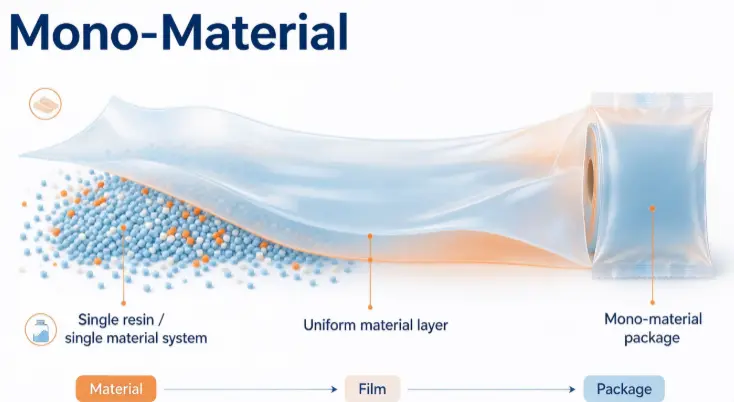
Mono-PE and mono-PP: promising, but test the complete structure
A film described as “mono-material” can still include coatings, inks, tie layers and other components that affect recycling compatibility. The finished bag’s sealant layer, thickness and friction also determine how it forms and seals. PE and PP grades behave differently, and heat-sealing parameters should come from the converter’s data sheet followed by controlled machine trials—not from a generic online temperature setting.
Ask the film converter for its structure, thickness range, seal-initiation and hot-tack data, coefficient of friction, oxygen/moisture barrier where relevant and the recyclability assessment applicable to your sales region. Ask the equipment supplier whether the forming tube, sealing jaws, cooling arrangement, coding and film path can be configured for those specific properties.
Paper-based packaging: verify barrier and sealing performance
Paper-based alternatives can be appropriate for some dry food products, but food-contact coatings and functional layers may affect recyclability. Paper also behaves differently from stretchable flexible films during folding and forming. The Ellen MacArthur Foundation’s 2026 report cautions that paper substitution requires responsible design, collection systems and a comparison of environmental trade-offs.
For oily, oxygen-sensitive or moisture-sensitive products, test the finished paper structure for required barrier performance and shelf life. A paper-like appearance alone does not establish that a package can be recycled with ordinary paper.
Compostable and recycled-content films: do not confuse the claims
“Industrial compostable,” “home compostable,” “biodegradable,” “recyclable” and “contains recycled content” are different claims. A compostable material must be assessed against the intended composting environment and collection access; it is not automatically an acceptable contaminant in a plastics recycling stream. The FTC guidance warns against unqualified compostable and recyclable claims.
When post-consumer recycled plastic will contact food, review the applicable safety and authorization requirements for the material and intended use. The FDA’s recycled-plastics guidance discusses source controls and potential contamination; recycled content by itself is not evidence of food-contact approval.
Types of sustainable food packaging machines
1. Vertical form-fill-seal (VFFS) machines
VFFS equipment unwinds film from a roll, forms a tube, doses the food product and creates longitudinal and cross seals. It is a useful category to evaluate for rice, nuts, grains, coffee, powdered ingredients, candy and certain gummies. By forming bags as needed, it offers opportunities to study film usage and bag-length optimization—but actual savings depend on format, seal design, material and reject rate.
Grand Machinery publishes the GM320B, GM520B and GM720B VFFS family for different film widths and bag sizes. Its product information describes heat-sealable laminates and mono-material structures as potential formats. That is a supplier-described capability, not a certification for every mono-PE, mono-PP, paper or compostable film. Confirm your actual rollstock by a documented sample run.

Film-web layout illustration. For a new substrate, verify tracking, tension, forming and registration with actual rollstock.
2. Premade pouch filling and sealing machines
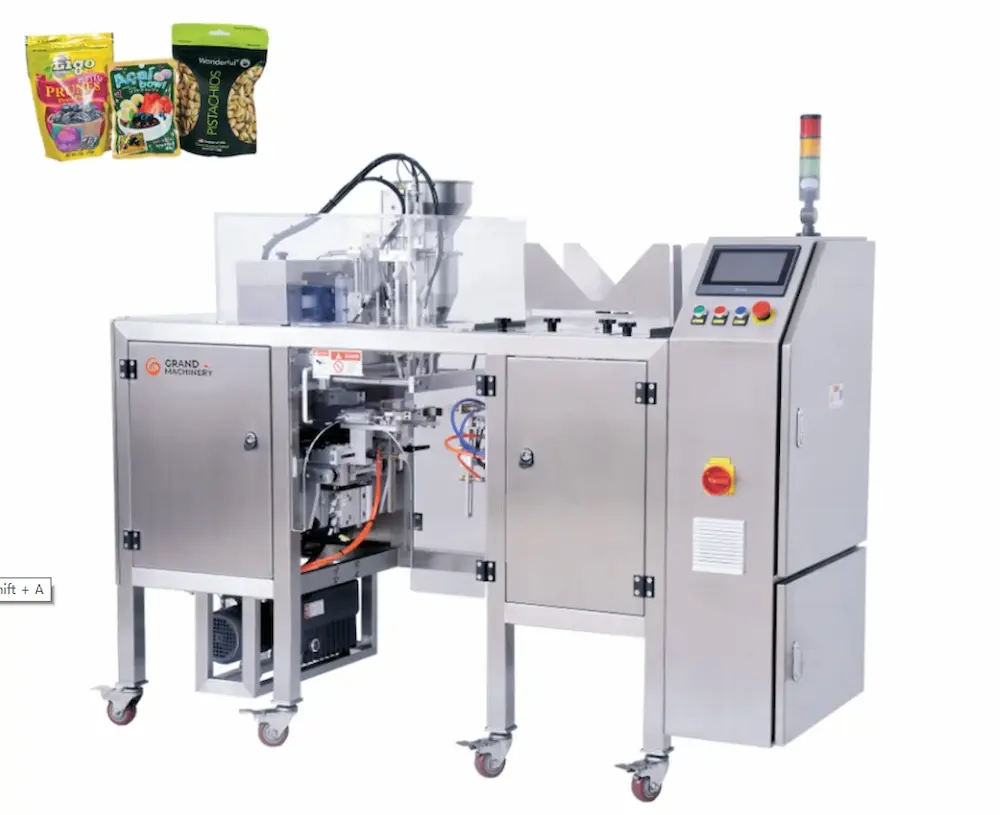
Premade pouch systems open a finished pouch, fill it and seal the mouth. These are particularly relevant to stand-up pouches, zippers and branded snack or supplement packs. For recycling-oriented designs, pay attention to zipper resin, spout material, pouch stiffness, opening performance and heat-seal quality. The pouch’s final structure matters more than a “recyclable film” claim on a single component.
Grand Machinery’s premade pouch packaging machine range covers several pouch formats and food types. Use the quoted model’s approved pouch dimensions and sample trials rather than assuming all pouch constructions work at nameplate speed.
Pre-made pouch packaging equipment with sample packs. Pouch material and sealing performance must be confirmed in trials.
3. Flow wrappers, tray sealers and rigid-container lines
Flow wrappers can be evaluated for bars, baked goods and single products where a flexible wrap is appropriate. Tray sealers need verified lidding-film/tray compatibility and food-life testing, especially when changing to a different mono-material tray or barrier film. Reusable or recyclable rigid containers bring different rinsing, filling, capping and logistics requirements.
This article focuses on the flexible packaging equipment relevant to Grand Machinery’s published offering. Flow-wrapping, tray-sealing and returnable-container options are included for comparison and should not be interpreted as a claim that every category is supplied by Grand Machinery.
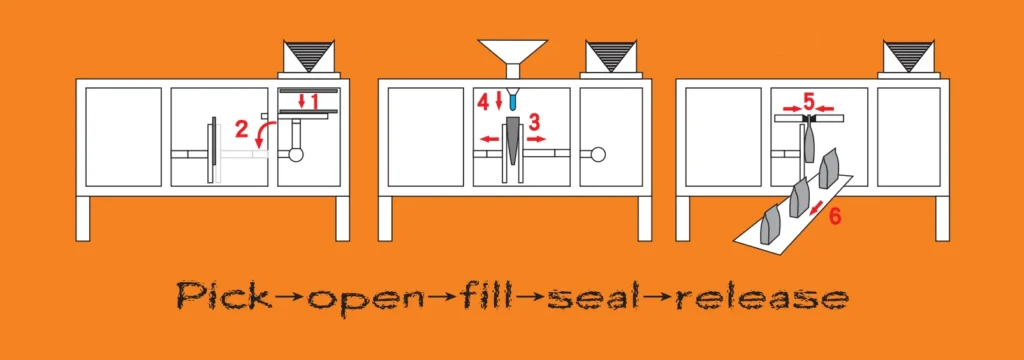
Pre-made pouch line workflow: pick, open, fill, seal and discharge. Actual steps and options vary by model.
Six machine specifications to check before switching materials
1. Seal formation and leak integrity
Ask for a repeatable test matrix covering sealing temperature, dwell time, pressure and line speed for each proposed material. Examine contaminated and clean seals using your actual food (for example, powder dust or sugar particles). Report peel strength, burst/leak integrity and the mode of seal failure. For flexible-barrier seal strength, ASTM F88/F88M-23 provides a recognized laboratory method; the acceptance limit must be appropriate to your pack.
2. Film path, tension and registration
Request demonstrations of film unwind stability, photocell registration and seal positioning with printed rollstock. Thin or lower-stiffness structures can wrinkle, wander or stretch differently from a conventional laminate. Ask which guides, forming collars, jaws or servo settings would need to change.
3. Barrier, food safety and shelf life
A strong seal does not substitute for product-specific oxygen and moisture protection. Set an acceptable oxygen transmission rate (OTR), water-vapour transmission rate (WVTR), oxygen level after gas flushing, or equivalent product-protection metric where relevant. Validate microbiological or quality shelf life using a qualified protocol, not just a machine demonstration.
4. Pack-quality yield and material use
Record total material consumed, good finished packs, scrap at start-up, rejects due to sealing, and scrap during each format change. Compare grams of packaging material per accepted pack, rather than only film grams per meter or the unverified maximum machine speed. This avoids claiming progress when a lighter film causes more defects.
5. Energy, air and service requirements
Request measured electricity and compressed-air consumption during comparable runs, with product, pack size, line speed and auxiliary equipment stated. A meaningful metric is kWh per 1,000 accepted packs at a defined operating condition. Do not infer energy savings solely from installed motor power.
6. Changeover, cleanliness and maintainability
Investigate recipe management, time to rethread the new film, change of sealing jaws, accessible hygiene points, spare-parts availability and the support needed during ramp-up. Frequent SKU changes may make a slower line with fewer rejected packs more economical than a higher-speed line that takes longer to stabilize.
How to evaluate total cost rather than the purchase price alone
Sustainable packaging material may cost more or less depending on specification and contract volume. Compare total cost per accepted, protected pack: packaging material + product loss + energy and utilities + labour + changeover and scrap + maintenance + end-of-life or producer-responsibility costs where applicable.
Illustrative arithmetic—not a performance claim: reducing film weight by 1 gram across one million accepted packs saves 1,000 kg of material before accounting for start-up waste, rejects and differences in shelf life. If the new film increases rejected packs, recalculate the net result from the actual pilot production log.
| Metric | How to measure | Why it matters |
|---|---|---|
| Accepted packs per hour | Good, inspected packs divided by run hours | Makes throughput comparisons credible |
| Material per accepted pack | Total net film used divided by accepted packs | Captures scrap as well as lightweighting |
| Seal/leak reject rate | Rejected seals divided by inspected packs | Protects the food and finished yield |
| Energy per 1,000 accepted packs | Metered line electricity on comparable runs | Shows real operating energy |
| Changeover waste and time | Film discarded and minutes per SKU change | Matters for mixed-product factories |
| Verified shelf life | Product-specific stability and package-integrity tests | Avoids reducing packaging at the expense of food waste |
Three-stage material and machine acceptance plan
- Stage 1 — Before quotation: send product characteristics, fill weight, target shelf life, finished pouch dimensions, candidate film composition/structure, thickness range, targeted disposal claim and destination market. Request a preliminary compatibility assessment and proposed trial plan.
- Stage 2 — Factory acceptance test (FAT): run your actual product and approved film in the quoted machine setup. Capture seal-window settings, test samples, accepted output, reject reasons, changeover conditions, film consumption and measured energy if energy savings are part of the business case.
- Stage 3 — Site acceptance and ramp-up: validate package integrity and food quality after transport, confirm downstream handling, document operator instructions, and repeat the KPIs during a representative production campaign. Approve final sustainability messaging only after the material and supply-chain evidence is available.
2026 packaging rules and environmental claims
EU: Packaging and Packaging Waste Regulation (PPWR)
The EU’s Packaging and Packaging Waste Regulation, Regulation (EU) 2025/40, began applying in phases on 12 August 2026. Its framework covers packaging prevention, material composition, recyclability, reuse and specific food-contact restrictions; additional design-for-recycling and recycled-content measures phase in later, including 2030 milestones. Use the European Commission implementation timeline for the current schedule and review packaging-specific obligations before launch.
United States: food-contact compliance and environmental messaging
For the US market, verify food-contact authorizations and conditions of use for the finished package, including inks, adhesives, coatings and recycled-content structures when applicable. Consult the FDA food-contact packaging overview and the FTC guidance on recyclable and compostable claims. A supplier’s generic “eco-friendly” label does not replace these checks.
Local collection infrastructure, producer responsibility and labelling rules differ between markets. The final compliance judgement belongs to the brand owner and its qualified advisers, not to a packaging-machine specification sheet.
What to ask Grand Machinery about a sustainable packaging project
Grand Machinery’s public portfolio includes vertical form-fill-seal machines, premade pouch equipment and integrated pouch packaging lines. For snacks, dry foods, candy or gummies, the suitable starting configuration depends on the fill system and packaging format.
When requesting a quotation, send your actual proposed film or pouch samples, food-product properties, target pack size, output, shelf-life goal and intended environmental claim. Ask which sample trials, tooling changes and acceptance measurements can be included in the quotation. Grand Machinery’s published product descriptions are vendor information; they do not constitute third-party verification of recyclable, compostable or lower-carbon performance.
Contact Grand Machinery to discuss a material-compatibility trial or read our small-batch packaging automation guide and premade pouch buying guide for related equipment decisions.
Frequently asked questions
What are sustainable food packaging machines?
They are packaging systems configured and validated to work with a packaging format designed to reduce measured impacts while maintaining food safety, shelf life and production quality. No machine is automatically sustainable regardless of the material it runs.
Can a VFFS machine run recyclable mono-PE or mono-PP film?
Some VFFS configurations may handle suitable mono-PE or mono-PP heat-sealable structures. Compatibility depends on film grade, friction, forming behavior, seal temperature, dwell time and pack requirements. Require a trial with your exact film and food product.
Is paper packaging always better than plastic packaging?
No. The result depends on sourcing, barrier needs, packaging mass, food waste, transport and the local collection or recycling system. Paper coatings may also change end-of-life options. Evaluate the entire product-and-package system.
Can compostable films run on standard food packaging machines?
Sometimes, but not by assumption. Seal-window, film tension, mechanical strength, speed and shelf-life requirements must be tested on the quoted equipment. A compostability claim must identify the applicable certification and disposal conditions.
Which machine is better: VFFS or premade pouch packaging?
VFFS forms packs from film rollstock and is often evaluated for repeated, high-volume formats. Premade pouch equipment is often considered for stand-up, zipper and retail-oriented pouches. Choose based on accepted throughput, pack construction, material trials and total cost per accepted pack.
What evidence should I request before buying a sustainable packaging line?
Request the material structure and food-contact documentation, the supplier’s film compatibility assessment, seal and leak test results, accepted-pack throughput, film consumption per good pack, changeover scrap, energy readings where relevant, and written FAT/SAT acceptance criteria.
Sources, authorship and editorial scope
Written and maintained by: Grand Machinery Editorial Team. Last research review: 29 October 2026. This guide uses source-linked desk research, published technical references and Grand Machinery’s public product materials; it does not report original comparative laboratory trials or certify the environmental performance of any machine, film or pouch. Bruce Fu’s founder biography on this site is not a technical-review credit for this article. See our editorial policy and author profile.
Primary references: CEFLEX circular flexible-packaging design principles;
European Commission on PPWR (2026);
FDA recycled plastics in food packaging;
Ellen MacArthur Foundation report (2026);
ASTM F88/F88M-23 seal-strength standard.
Refer to these primary documents and your local regulations when making product-specific claims.
If you find a product specification or source link that needs correction, contact our editorial team.