(Last Updated: Nov. 11th)
For gummy, softgel, tablet and capsule bottling projects
Manual capping can remain the right choice when a qualified process meets your output and handling requirements. A semi-automatic capper is worth evaluating when powered tightening would help but operators can still load bottles and place caps. A fully automatic system becomes relevant when cap feeding, bottle transfer and line coordination also need to be automated.
The buying question is not simply “Which machine is faster?” It is “Which complete workflow produces acceptable bottles at the required rate and cost?”
This guide compares all three approaches and explains how to evaluate Grand Machinery’s automatic capping machine range, including ZSG80 and GM200A. Manual and semi-automatic methods are comparison options—not additional Grand Machinery models offered in this article. The scope is threaded screw-cap bottles, not the formation or sealing of softgel capsules themselves.
What Is Manual Capping—and What Changes with Automation?
Manual: the operator handles and tightens the closure
With a hand-operated tool, the operator positions the cap, turns the tool and transfers the bottle. Manual does not necessarily mean uncontrolled tightening: a torque-limiting clutch can restrict the applied torque. Kinex’s manual cap-tightener explanation describes a hand-turned tool whose clutch releases at its specified setting.
Evaluate a manual method where the required output, operator workload and verified closure results make it practical. Include tool setup and package checks in the purchase—not just the tool itself.
Semi-automatic: the machine tightens, but operators still handle the package
In an operator-loaded benchtop arrangement, the operator may place the cap and load the bottle, then initiate a powered tightening cycle before removing the finished bottle. Kinex’s documented semi-automatic workflow provides one example of this division of work.
A powered handheld capper is another operator-assisted arrangement. Supplier terminology varies, so ask exactly who loads, places the cap, holds the bottle, starts the cycle and unloads it. Do not compare a tightening-cycle time with another supplier’s complete production-cycle output.
Fully automatic: handling and tightening work as a coordinated system
For this comparison, “fully automatic” means that the agreed equipment scope handles bottle transfer, cap feeding and placement, and tightening. A tightening machine attached to a conveyor is not necessarily a complete automatic system if people still place every cap.
Confirm the feeder, bottle support, conveyors and controls included in the proposal. Automatic operation still requires replenishment, changeovers, checks and maintenance; it does not mean an unattended factory.
Manual vs Semi-Automatic vs Fully Automatic Capping

| Buying criterion | Manual | Semi-automatic | Fully automatic |
|---|---|---|---|
| Bottle handling | Operator loads, supports and transfers the bottle. | Operator normally loads and unloads; a fixture may provide support. | Specified conveyors and guides transfer and support bottles. |
| Cap placement | Operator places the cap. | Often still operator-placed; confirm the arrangement. | Included cap-feeding and placement equipment performs this step. |
| Tightening | Operator turns the cap or a hand-operated tool. | Powered tightening, with operator loading and/or initiation. | Tightening is coordinated with the handling system. |
| Useful starting point | Short runs where the existing qualified method meets requirements. | A workstation where tightening effort or repeatability needs attention, but manual handling remains workable. | A line where handling, sustained output or station coordination justifies integration. |
| Output evidence | Measure the full operator cycle and accepted bottles. | Include loading, cap placement and unloading—not only tightening time. | Test sustained accepted output with the specified feeding and line conditions. |
| Changeover questions | Does each cap need a different tool or setting? | Which fixture, chuck and settings change? | Which guides, feeder parts, tooling and settings change? |
| Cost items to compare | Tooling, workstation, labor and quality checks. | Machine, fixtures, utilities, operator time and checks. | Complete feeding/handling scope, integration, utilities, training and maintenance. |
Selection rule: do not assign a universal bottles-per-minute limit to an automation category. Compare the actual package, staffing, test duration and accepted output. Closure compatibility and quality remain pass/fail requirements for all three methods.
Three Purchasing Scenarios for Supplement Bottling
These are illustrative application scenarios, not completed Grand Machinery customer projects or verified performance results. Their purpose is to show how a buyer can reach different, reasonable decisions.
Scenario 1: a small gummy brand with frequent product changes
The operation uses screw-cap bottles and changes formats frequently. Its current manual method meets the required closure checks and production schedule.
Option to evaluate: retain the qualified manual process rather than buying automation purely because a faster catalogue model exists. Review tool fit, settings, bottle support and the time spent checking finished packs.
What would change the decision? Measured evidence that the operation can no longer meet quality, output or workload requirements. If a new cap introduces a closure problem, qualify the package first; do not assume a conveyor will resolve it.
Scenario 2: a capsule packer whose main issue is repetitive tightening
Operators can place caps and move bottles at the required rate, but the tightening task is the part of the workflow the buyer wants to improve.
Option to evaluate: an operator-loaded semi-automatic workstation. Trial the fixture and powered cycle with the actual bottle and cap. Check the entire sequence, including cap placement and removal of the finished bottle.
What would change the decision? If manual cap placement or bottle transfer is also a bottleneck, a benchtop purchase may leave the main problem unresolved. That is the point to compare a more complete automatic workflow—not to assume the semi-automatic option will deliver a particular output gain.
Scenario 3: a growing softgel bottling project
Assume the buyer needs 12,000 acceptable bottles in 300 available production minutes, after planned changeovers:
Required average accepted output = 12,000 ÷ 300 = 40 bottles/min
This is a planning example, not a machine test. The next task is to establish whether counting/filling, cap handling, tightening or downstream sealing limits the line.
Option to evaluate: an integrated automatic capper if capping and handling are the demonstrated constraint. Screen ZSG80 and GM200A against bottle and cap geometry, then verify the proposed configuration and line coordination.
What would change the decision? If counting or sealing is the limiting stage, replacing only the capper may not achieve the target. Also confirm usable operating speed and any buffering or intermittent-operation arrangement: 40 bottles/min is the example’s line requirement, not a revised ZSG80 specification or a promised result for either model.
Planning a manual-to-automatic upgrade? Share your bottle and cap dimensions, liner details, target accepted output and current workflow. Ask Grand Machinery to assess an automatic capping configuration before choosing a model. A useful enquiry identifies the bottleneck as well as the desired machine.
Three Technical Checks That Matter to a Buyer
Check the package result, not just a torque setting. Application torque is the tightening input; removal torque is the effort needed to open the closure later. They are not interchangeable. Induction sealing can also affect subsequent removal torque. Enercon’s application/removal torque guidance explains the distinction. Agree the actual bottle, cap, liner, test timing, measurement method and acceptance limits; do not copy a universal torque value from another package.
Ask what the control system actually does. ZSG80’s published description identifies PLC touchscreen control. GM200A’s description identifies PLC/HMI servo control and friction-wheel tightening. These descriptions do not establish a controller brand, numerical torque tolerance, per-bottle torque recording or a particular closed-loop measurement system. Require evidence for any function essential to the order.
Define inspection separately from sealing. A cap-presence or foil-presence check is not proof of torque accuracy or an intact induction seal. State the defects to detect, the rejection arrangement and the finished-pack checks in the acceptance plan. Do not infer unlisted inspection functions from the word “automatic.”
Grand Machinery Automatic Capping Machines to Shortlist
The table below reproduces the numerical specifications in the corresponding product records checked on 11 November 2026. These are published specifications, not application-specific acceptance results. Product titles use ZSG80 and GM200A; the original parameter tables use ZSG-80 and GM-200A.
| Published specification | ZSG80 Automatic Capping Machine | GM200A Bottle Capping Machine |
|---|---|---|
| Model in parameter table | ZSG-80 | GM-200A |
| Production capacity | 60–200 bottles/min | 160 bottles/min |
| Suitable cap size | 15–70 mm | Φ15–70 mm |
| Bottle diameter | Not specified in the product parameter table | Φ20–80 mm |
| Bottle height | Not specified in the product parameter table | 45–120 mm |
| Air pressure | Not specified in the product parameter table | 0.4–0.7 MPa |
| Published power value | 1.3 kW | 2 kW |
| Dimensions | 2440 × 1100 × 1680 mm | 2440 × 1000 × 1700 mm |
| Weight | 100 kg | 450 kg |
The ZSG80 page labels the 1.3 kW entry “Power Supply.” It is retained as a power value here, not a voltage or frequency specification. Confirm electrical supply and any unlisted utilities in the quotation. The table does not specify the order of the dimensional axes.
ZSG80: examine the cap-feeding and handling scope
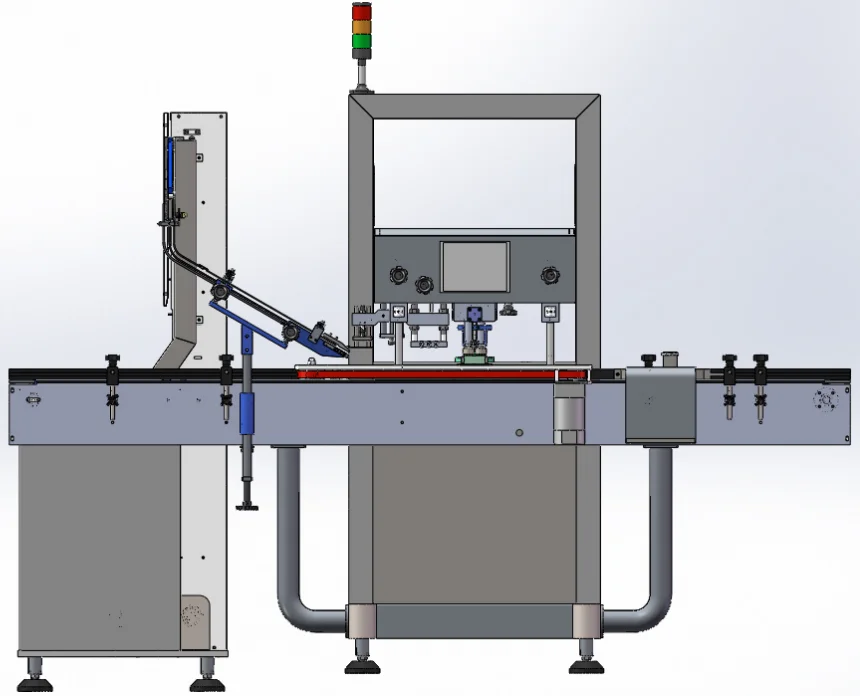
The product description identifies bottle conveying, automatic cap sorting and feeding, and PLC touchscreen operation. For selection, confirm the actual tightening mechanism, bottle dimensions, feeder suitability and included equipment. A cap within the published diameter range still needs a package-specific assessment.
GM200A: begin with the published bottle envelope
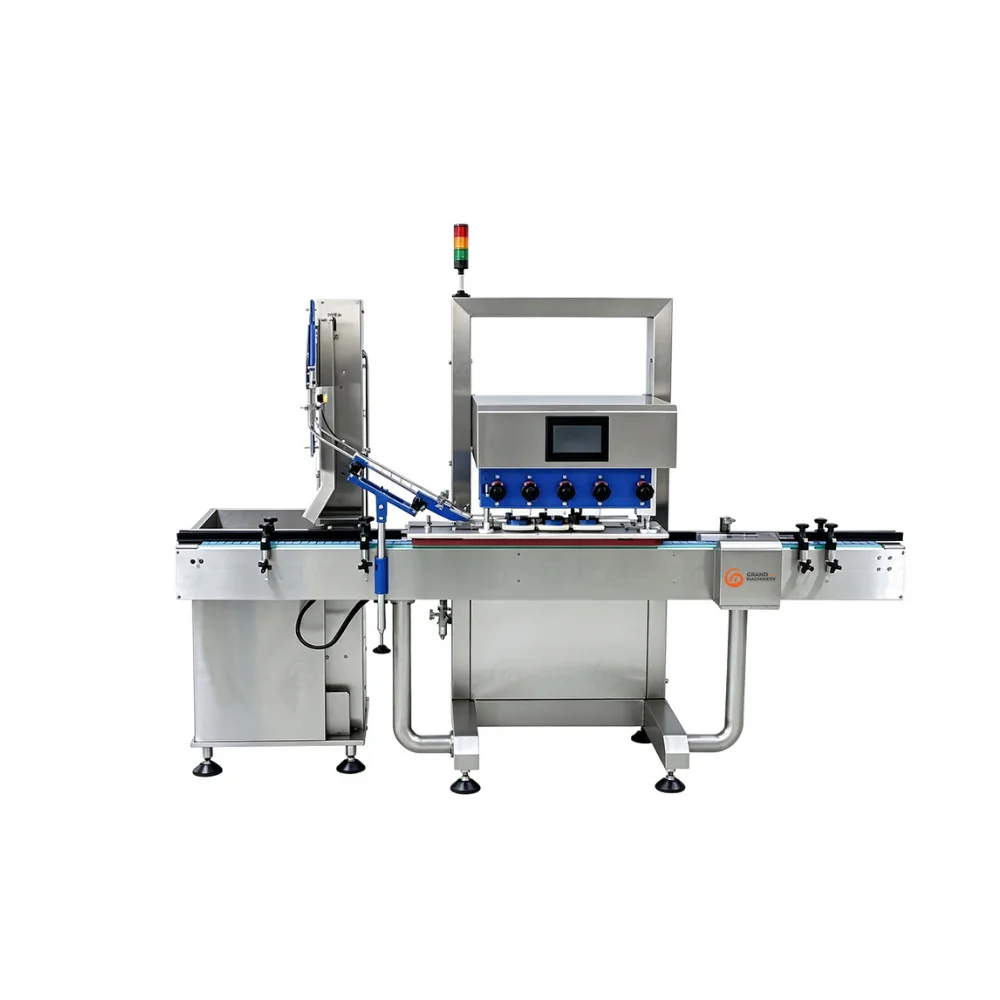
Its published bottle-diameter and height ranges provide an initial dimensional screen. The description identifies friction-wheel tightening and individually adjustable functional sections. It also describes rejection for missing caps or foil; confirm the actual detection equipment, included scope and test method rather than interpreting this as complete seal-integrity inspection.
Neither machine should be selected simply because one listed capacity is higher. Package compatibility, required operating range and sustained accepted output determine whether a proposal is suitable.
How the Capper Fits into a Gummy or Softgel Bottling Line
Grand Machinery’s counting bottling line presents bottle packaging for tablets, capsules, softgels and gummies. Its published sequence includes bottle unscrambling, counting/filling, desiccant insertion, capping, induction sealing and labeling. Include desiccant insertion and induction sealing only where the package specification requires them.
For this article, the capper is the bottle-and-closure station within that project. The product inside the bottle does not, by itself, establish closure compatibility. Crown caps, crimped vial closures, corks and unqualified child-resistant closures require separate assessment; do not infer suitability from a screw-cap diameter range.
A Decision Workflow That Does Not Skip Quality Problems
The following activity diagrams summarize the procurement decision process. Select a diagram to view it at full size.
A. Diagnose the current method before choosing a replacement
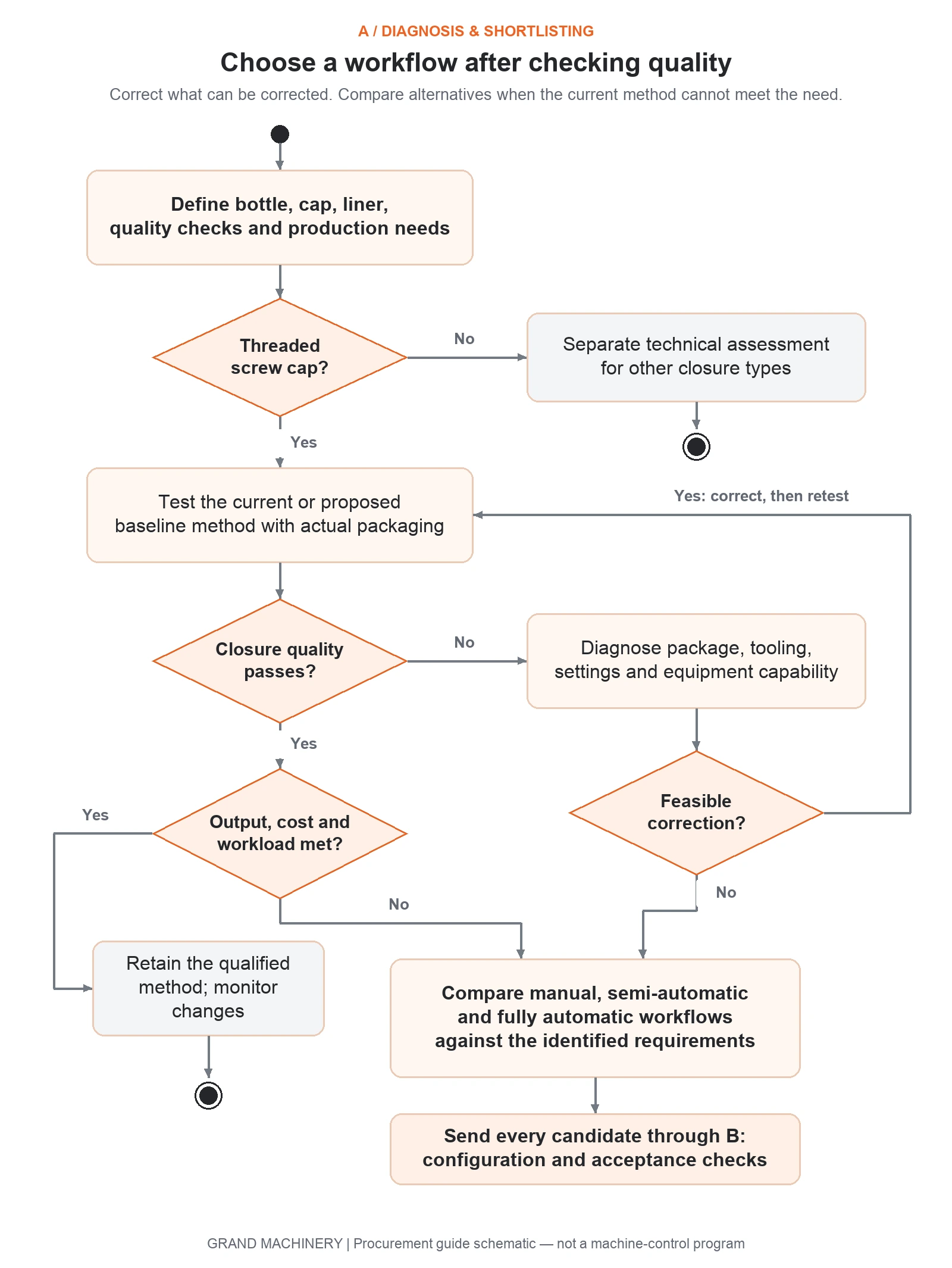
In words: define the package and requirements, test the baseline method, and investigate any quality failure. Correct and retest where feasible. If the current method cannot deliver acceptable results, compare alternatives on the identified failure—not speed alone. Retain an existing qualified method when quality, output and cost requirements are already met.
B. Apply the same acceptance gate to every candidate
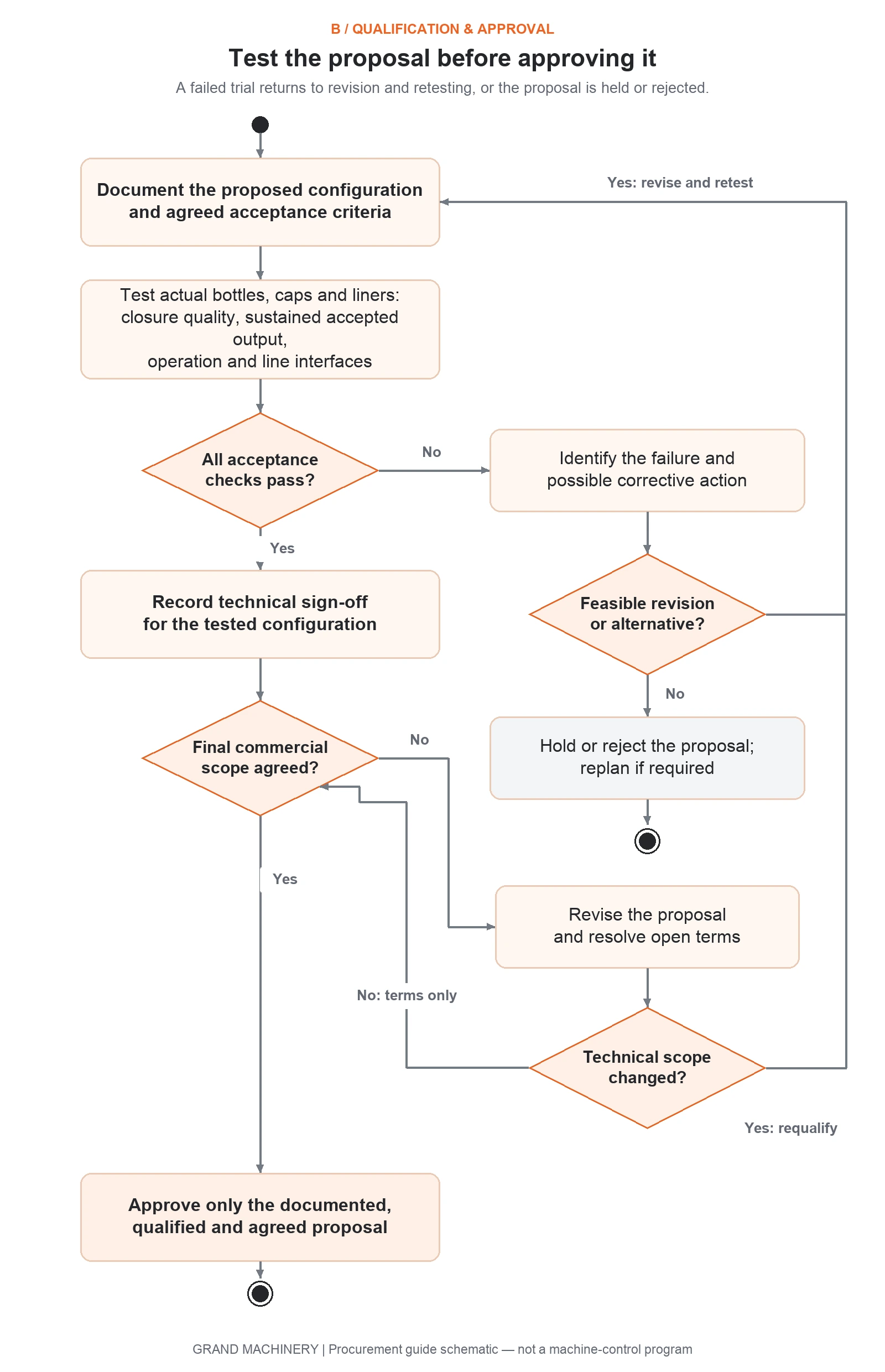
In words: document the proposed configuration and acceptance criteria, then test the actual packaging components. A revised package, tool, setting or machine must be requalified. Unresolved package incompatibility blocks approval even when the proposed machine is automatic. Technical sign-off and agreement on the final commercial scope are both needed before approving the documented proposal.
Compare the Installed Cost—not Just the Machine Price
Request comparable quotations covering the machine, cap-feeding equipment, bottle handling, format parts, utilities, integration, inspection options, installation and training, as applicable. Separate included items from options and buyer responsibilities.
Operating cost per accepted bottle =
(labor + utilities + consumables + maintenance + rework costs)
÷ accepted bottles
Use the same period and cost boundaries for each option. Measure staffing across the whole task, not only the moment a cap is tightened. Treat the production example above as a requirement calculation, not a savings forecast. Do not count additional production capacity as guaranteed sales or accept a fixed payback claim without project data.
Why Include Grand Machinery in Your Capping Project Shortlist?
A capper and its surrounding bottling stages can be assessed together. Grand Machinery lists ZSG80 and GM200A alongside a counting-bottling solution covering feeding, counting, capping, sealing and labeling. This gives buyers a defined equipment range to discuss rather than an isolated speed claim. Ask the proposal to identify interfaces, responsibility boundaries and the exact modules included.
Installation, staff training and replacement-parts support are part of Grand Machinery’s published service offering. The Grand Machinery company and support overview describes these areas. Make them concrete in the order instead of assuming every service is included at no additional cost:
| Service area | What to specify in the project quotation or handover plan |
|---|---|
| Installation support | Delivery method, location, utilities, site preparation, responsibilities and any separately charged work. |
| Operator training | Who is trained, delivery format, operating/setup topics, available language and agreed handover material. |
| Replacement-parts support | Applicable part numbers, recommended initial spares, ordering contact and quoted availability or lead time. |
| Equipment and line scope | Selected capper, cap-handling equipment, format parts, interfaces, acceptance criteria and exclusions. |
These are ways to make the published offering verifiable for your order—not a promise of free installation, a fixed response time, guaranteed parts inventory or a universal delivery date. The best reason to choose a supplier is a technically qualified solution with clear delivery responsibilities.
What to Request Before Approving a Purchase
| Approval item | Required clarification or evidence |
|---|---|
| Package definition | Actual bottle/cap samples or drawings, liner information and relevant tolerances. |
| Configuration | Exact model, included feeder/conveyors, format parts, guards, inspection options and utilities. |
| Closure acceptance | Agreed checks for cap seating, thread condition, torque and package integrity where required. |
| Accepted production rate | Agreed test duration, staffing, replenishment conditions, changeovers and reject-counting method. |
| Detection and rejection | Demonstration of each specified defect-detection function; no assumption of unlisted capabilities. |
| Changeover | Adjustment steps, replacement parts and post-changeover verification. |
| Delivery and support | Scope, responsibilities, agreed manuals/training, spare-parts arrangements and acceptance records. |
Frequently Asked Questions
When should I keep manual capping?
Keep it when your qualified method meets closure-quality, output and workload requirements at an acceptable cost. A catalogue speed alone is not a reason to replace it. Reassess when packaging components or production requirements change.
When is semi-automatic better than fully automatic capping?
It is worth evaluating when powered tightening addresses the actual issue and manual cap placement and bottle handling remain workable. Compare a complete-cycle trial and installed costs; do not assume a benchtop machine fixes a handling bottleneck.
Does Grand Machinery offer a manual or semi-automatic model in this guide?
No. The named Grand Machinery products here are ZSG80 and GM200A automatic capping machines. Manual and semi-automatic methods are included to help buyers compare approaches, not to imply the availability of an unverified Grand Machinery model.
Does an automatic capper replace an induction sealer?
No, not where the package requires a separate induction-sealing operation. Capping and induction sealing are distinct stages in the published Grand Machinery line. Include and qualify both when the package requires them.
Which is better for my line: ZSG80 or GM200A?
Neither is a universal winner. Compare package geometry, cap-feeding requirements, operating range, actual configuration, line interfaces and sustained accepted output. Missing catalogue fields should be clarified—not filled in with the other model’s specifications.
What should I send with a capping-machine enquiry?
Send bottle and cap dimensions or drawings, representative photographs, liner details, target accepted bottles per minute, available production time, current workflow and any required inspections. Identify whether you need a standalone station or a wider bottling-line project.
Request a Configuration-Based Capping Proposal
Send Grand Machinery your bottle, cap and production requirements and request a proposal tied to the actual package. Ask for the selected model, included cap-handling equipment, utilities, line interfaces, acceptance plan and service scope in writing.
The right purchase is the least complex configuration that demonstrably meets the agreed requirements—not automatically the fastest machine in the catalogue.