The gummy manufacturing process looks simple from the outside — syrup goes in, gummies come out — but every stage between the kettle and the carton is controlled by a machine setting that decides texture, shelf life and dosage accuracy. This pillar guide walks through all eight stages of commercial gummy production: what happens at each step, which equipment does the work, the parameters that must hold, and what it costs to build a line at each capacity tier.
Key Takeaways
- Commercial gummy manufacturing runs through eight stages: compounding, cooking, dosing, depositing, curing and drying, demolding and finishing, quality control, and counting and packaging.
- Three numbers decide most gummy quality problems: dissolved solids (Brix), water activity (Aw) and curing time. All three are equipment-controlled.
- Starch mogul lines win on volume and complex shapes; starchless depositing wins on hygiene, flexibility and faster changeover — the choice should follow your product, not the brochure.
- A usable production line starts around $30,000–80,000 at entry commercial capacity and rises past $1 million for high-speed mogul lines; on the projects we have quoted, installation and tooling add 20–35%.
- Most defects — sweating, stickiness, grainy texture — trace back to a specific machine parameter, not bad luck.
What Is the Gummy Manufacturing Process?
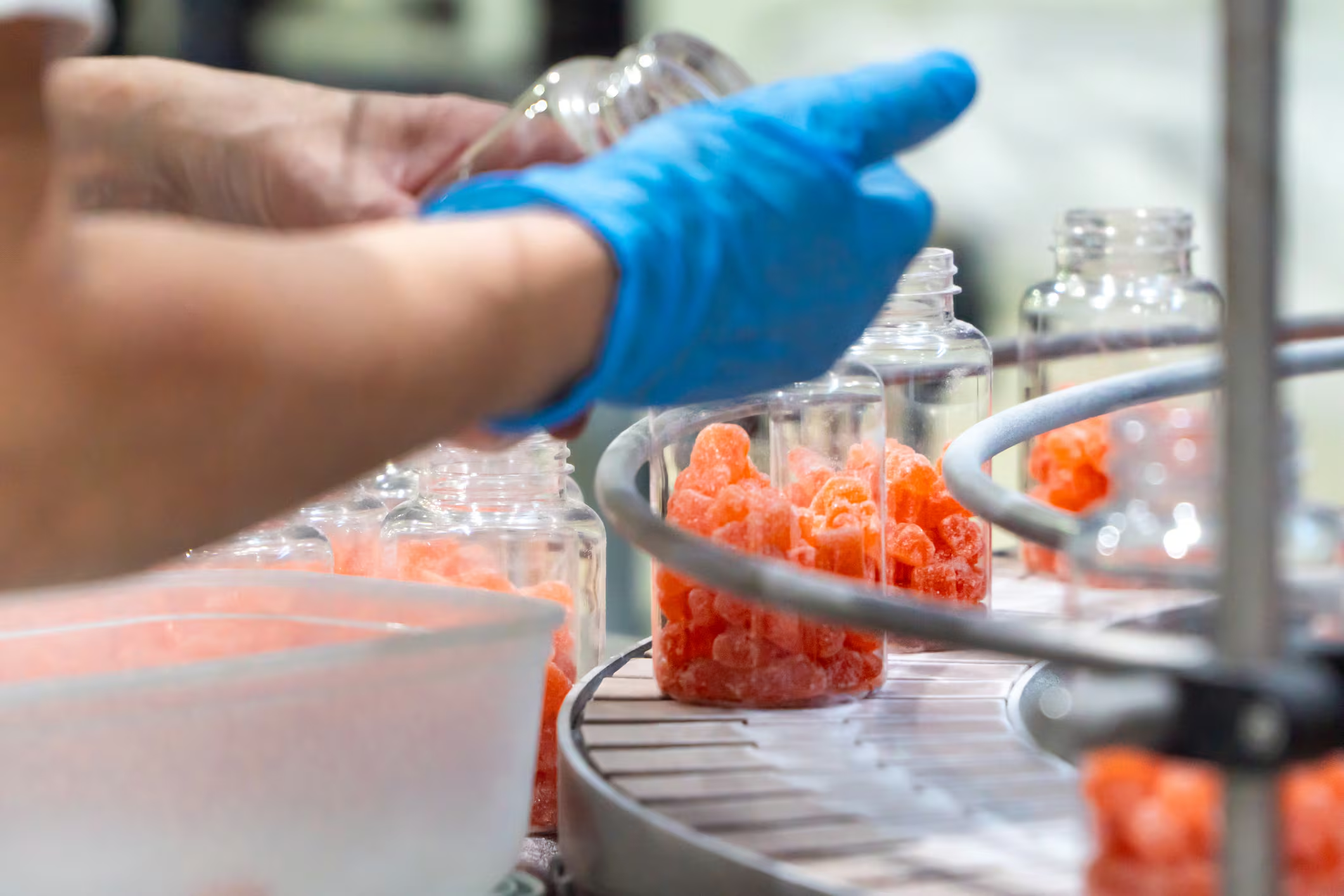
Gummy manufacturing is the industrial version of gel-set candy making: a sweetener syrup is cooked to a target solids level, a gelling agent is hydrated and blended in, heat-sensitive ingredients are dosed in at lower temperature, and the still-liquid mass is deposited into molds where it gels, cures and dries into a stable, chewable piece. What separates a commercial process from a kitchen batch is control — of temperature, timing, dosing accuracy and humidity — and that control lives in the equipment.
The 8 stages at a glance
| Stage | What happens | Core equipment | Output of the stage |
|---|---|---|---|
| 1. Compounding | Weigh, dissolve and hydrate ingredients | Mixing tanks, gelatin blooming vessels | Uniform slurry |
| 2. Cooking | Evaporate water to target solids | Batch cooker or jet cooker | Syrup at target Brix |
| 3. Dosing | Add acid, flavor, color, actives | Inline dosing and mixing systems | Flavored, dosed gummy mass |
| 4. Depositing | Portion liquid into molds | Starch mogul or starchless depositor | Filled, shaped molds |
| 5. Curing and drying | Gel sets; moisture drops to target | Cooling tunnels, curing/drying rooms | Stable, firm gummies |
| 6. Demolding and finishing | Release, oil or sugar-coat | Demolding units, oiling drums, coaters | Free-flowing finished pieces |
| 7. Quality control | Test parameters and potency | Refractometers, Aw meters, check-weighers | Released batches |
| 8. Counting and packaging | Fill, seal, label | Counting machines, bottling or pouch lines | Sellable packs |
Each stage feeds the next, and a weakness in one shows up downstream: a syrup cooked to the wrong solids becomes sticky finished product; a curing room running too humid undoes a perfect deposit. The sections below walk the line in order.
Stages 1–3: Cooking the Base — Compounding, Cooking and Dosing
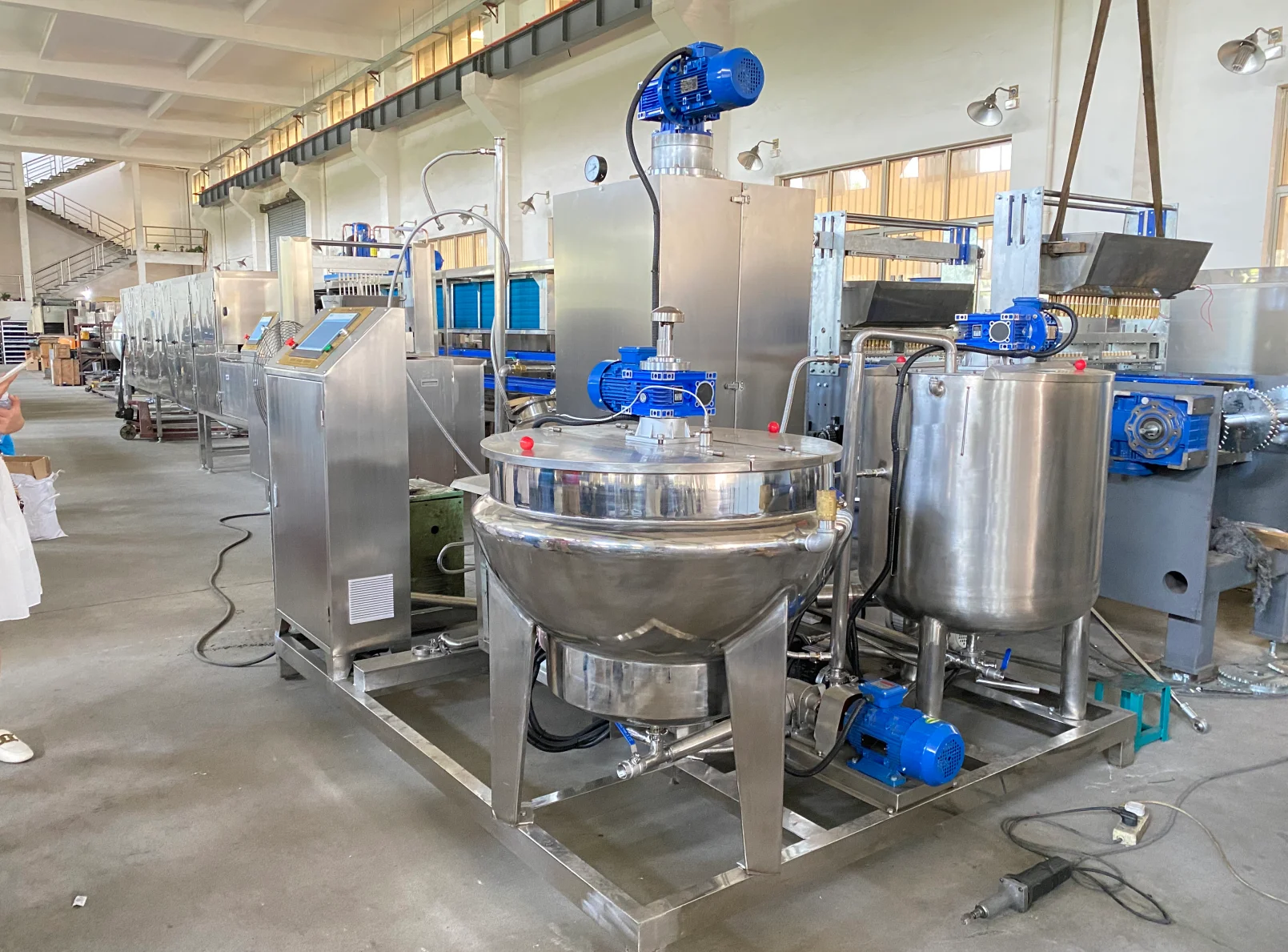
The first three stages happen upstream of any mold, and they set the ceiling on everything the line can achieve.
Compounding and gelatin blooming
Dry and liquid ingredients are combined in a defined order. Gelling agents are dispersed in water first — gelatin blooms in cold water for 30–60 minutes before it meets hot syrup — because full hydration before heating is what prevents clumps later. Sugar and glucose syrup are added and dissolved as the mass is gently heated in pre-cook tanks. Skipping the hydration discipline shows up hours later as fish-eyes or grainy pockets in finished gummies.
Cooking to final solids
The slurry is pumped to the cooker, where water is evaporated until the mass reaches its target dissolved solids, measured in degrees Brix. Industrial lines take two routes: jet cookers using direct steam injection reach final solids in seconds, minimizing heat exposure; jacketed batch kettles cook longer at 115–120°C. Cooked syrup for gummy depositing commonly lands between roughly 75 and 82 Brix in jet-cooked systems, while traditional batch lines blend to a slightly lower depositing slurry — the exact target depends on the gelling system and the depositor.
Whatever the number is, it is checked batch by batch with a calibrated refractometer, because a few points of Brix translate directly into texture and shelf stability.
Dosing acid, flavor, color and actives
Heat-sensitive ingredients go in last, after cooking, at lower temperature. Acids deserve particular respect: acid added too early at high temperature hydrolyzes gelatin and permanently cuts gel strength, while pectin systems need acid to trigger the gel at exactly the right moment. Vitamins and functional actives are dosed through inline injection and mixing systems so distribution is uniform — a gummy that delivers 100% of label claim on average but ±40% piece to piece is a compliance failure. This is the stage where automated dosing pays for itself in audit results.
Stage 4: Depositing — Starch Mogul vs Starchless
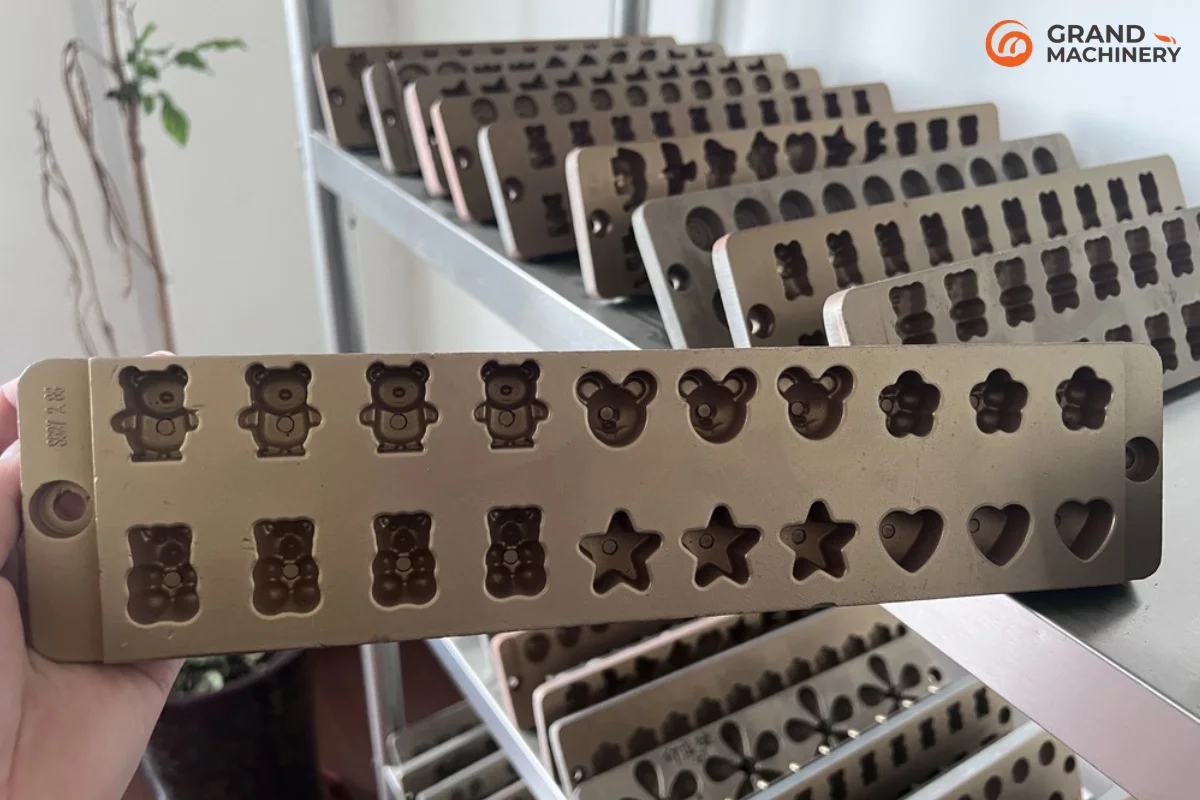
Depositing is the heart of forming: the liquid mass is portioned into molds at controlled temperature and pressure, and the filling weight tolerance it holds becomes your dosage accuracy. Two molding technologies dominate, and the choice shapes the whole line around them.
How each molding line works
A starch mogul line stamps shapes into trays of conditioned food-grade starch, deposits into those impressions, and lets the starch hold the shape while drawing surface moisture to form a skin. It handles long, complex and highly detailed shapes, runs at very high cavity counts, and remains the majority technology for high-volume confectionery. The trade-offs are starch handling — conditioning, drying, recycling — and hygiene complexity, because reused starch can carry moisture and contaminants into the next batch. Our GM1250 starch mogul gummy depositing line is built for exactly this high-volume regime, and mold design flexibility is covered separately in our gummy mold guide.
A starchless depositor fills rigid silicone, metal or polycarbonate molds directly, spraying a release agent for clean demolding. There is no starch dust, no cross-contamination vector, and no starch conditioning stage — which is why functional gummy producers making vitamin and supplement products predominantly choose it. Depositing happens at final solids, cooling can be faster, and changeovers are as simple as swapping mold sets.
Which molding line fits your product
| Factor | Starch mogul | Starchless depositing |
|---|---|---|
| Production volume | Very high | Moderate |
| Shape complexity | Best for long, detailed shapes | Limited by mold rigidity |
| Hygiene for functional gummies | Starch reuse adds risk | Cleanest option |
| Changeover | Slower, starch reconditioning | Fast mold swap |
| Footprint and auxiliaries | Large, starch handling | Compact |
| Startup investment | Higher | Lower to mid |
If you are producing vitamin or supplement gummies under GMP expectations, starchless is usually the defensible default; mogul lines justify themselves at volumes and shape complexity that starchless molds cannot serve. Both routes end at the same place — a gummy depositing machine sized to your cavities and output — and our gummy depositing line overview maps the full line around either choice.
Stage 5: Curing and Drying — Where Texture Is Actually Made
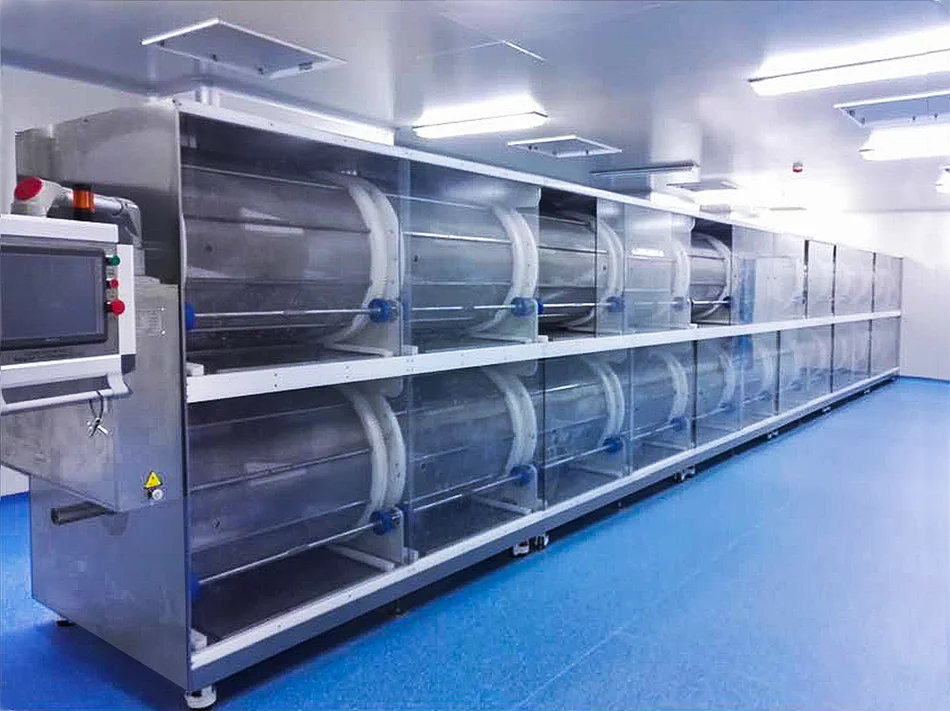
Freshly deposited gummies are not finished gummies. The gel network needs time to mature, and free moisture needs to leave the piece until texture and shelf stability lock in. Rushed curing is the most common shortcut in commercial gummy production — and the most expensive one, because it surfaces weeks later as sticky packs and short shelf life.
Commercial curing rooms and drying cabinets hold the trays under controlled temperature and humidity while the gel sets and moisture migrates out. Typical industrial schedules run 12 to 72 hours depending on gelling agent, piece size and target texture, with most lines landing between 24 and 48 hours. The environment matters as much as the clock:
| Parameter | Typical target | Why it matters |
|---|---|---|
| Room temperature | 18–25°C | Fluctuations cause cracking and case hardening |
| Relative humidity | 55–65% | Below 50% dries the surface too fast; above 70% invites stickiness |
| Final moisture | ~2–5% by weight | Sets chew and shelf stability |
| Air circulation | Gentle, uniform | Prevents microbial niches and uneven drying |
Gelatin systems set by cooling and need the room cold enough for the network to form; pectin systems set chemically and often cure faster. Dedicated drying equipment — from forced-air cabinets to a tumble dryer — keeps the schedule repeatable instead of weather-dependent.
Stage 6: Demolding, Oiling and Coating
Cured gummies leave their molds by vibration, air or mechanical release. Starch-molded pieces are brushed or washed to remove starch residue; starchless pieces release clean. Most then pass through an oiling drum, where a fine mist of release agent — carnauba wax or fractionated coconut oil — gives gloss and prevents the pieces from welding together in bulk.
Where the product calls for it, a sugar or sour-sand coating is applied in a coating pan or drum: sanding sugar for classic candy, citric-acid blends for sour formats. Coating is a process of its own, with its own moisture and adhesion rules — our guide to gummy candy with sugar coating covers the recipe side, and the equipment side runs through a coating machine sized to the batch. Done right, finishing adds shelf life and shelf appeal; done carelessly, it adds a second sticking problem.
Stage 7: Quality Control — The Numbers That Decide Shelf Life
Commercial QC is not a final glance at a tray — it is a set of instrumented checkpoints with acceptance ranges, and food safety expectations under frameworks such as FDA cGMP for food apply to the whole line. The parameters below decide whether a batch ships:
| Parameter | Typical acceptance range | Instrument |
|---|---|---|
| Brix at deposit | Formula-specific, checked every batch | Refractometer |
| Water activity (Aw) | 0.55–0.70 for ambient stability | Aw meter |
| Final moisture | 2–5% by weight | Karl Fischer / loss on drying |
| Cooking temperature | Per recipe (e.g., 115–120°C batch cook) | Calibrated thermocouples |
| pH | Per gelling system (pectin especially) | pH meter |
| Piece weight | ±2–5% of target | Check-weigher |
| Potency (functional actives) | 90–110% of label claim | HPLC per batch |
| Microbial counts | Within food-safety limits | Plate counting |
Two of these deserve emphasis. Water activity is the single best predictor of shelf stability — below roughly 0.65, most spoilage organisms cannot grow, which is why Aw targets sit at the center of every serious gummy spec. And potency tolerance is where functional gummies live or die commercially: consistent dosing depends on upstream mixing homogeneity and depositing accuracy, not on downstream inspection.
Stage 8: Counting and Packaging
Finished gummies are counted — not weighed — into bottles and jars in most retail formats, because piece count is what the label promises. A dedicated gummy counter fills by optical or vibratory count, and at small scale a semi-automatic station is usually enough; as SKUs and volumes grow, connecting counting, capping, labeling and pouching into a flow is the standard path, laid out in our guide to packaging automation for small batch production.
Format selection — bottle, pouch, sachet — should be settled before equipment is bought, and our gummy packaging guide walks that choice. Packaging is also a moisture barrier: whatever the curing room achieved, a poor barrier film can undo in transit.
Gummy Production Line Cost by Capacity Tier
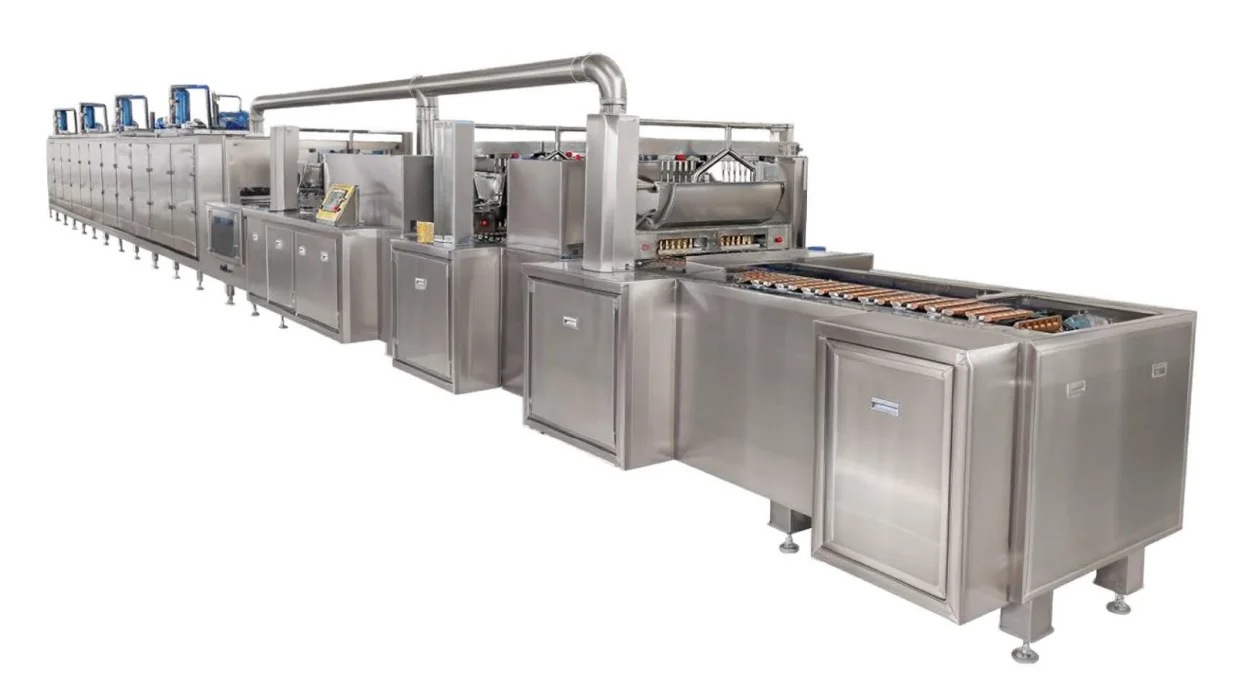
Published price claims for gummy lines range wildly — from under $10,000 to $5 million — because sellers are quoting different capacity tiers, automation levels and country cost structures. The honest way to budget is by capacity tier:
| Capacity tier | Typical equipment | Indicative price range | Fits |
|---|---|---|---|
| R&D / pilot, <50 kg/h | Jacketed kettle, semi-auto depositor, drying cabinet | ~$10,000–50,000 | Formulation trials, sampling |
| Entry commercial, 100–200 kg/h | Batch cooker, depositor, drying room, semi-auto packing | ~$30,000–80,000 | New brands, first retail runs |
| Mid-scale turnkey, 300–500 kg/h | Integrated cooking, dosing, depositing, cooling, packing | ~$80,000–150,000 | Growing labels, co-man start-ups |
| Industrial mogul / high-speed, 500+ kg/h | Full mogul line, automated curing and packing | ~$150,000 to $2M+ | Established brands, contract manufacturers |
These bands combine our own project quotes with the published price tables we track, and they vary with automation level, country of manufacture and format; treat them as budgeting bands, not quotations. Budget the project, not just the machine: on the projects we have quoted, installation, format parts for every SKU, operator training and spares add 20–35% on top of equipment cost. When you are ready to price a real configuration, our gummy depositing line page is the starting point — tell us capacity and gelling system and we will quote the stage you are actually at.
Common Gummy Defects and the Machine Parameter That Fixes Them
Most gummy complaints are not mysteries; they are traceable to a stage and a setting. The table maps the five most common defects to their usual root causes and the machine parameter that fixes them:
| Defect | Usual root cause | Where to fix it |
|---|---|---|
| Sweating / wet packs | Final Brix too low, or acid added too early | Cooking solids target; acid dosing timing |
| Sticky after packaging | Curing incomplete, or packaging barrier too weak | Curing time/humidity; film specification |
| Grainy, crystalline texture | Sucrose crystallizing — glucose ratio off, or undissolved sugar | Sugar system ratio; cooking dissolution |
| Air bubbles and foam | Agitation whipping air at mixing; no de-aeration | Mixer speed; vacuum de-aeration |
| Deformed or torn pieces at demolding | Curing too short, or mold/release mismatch | Curing schedule; release agent and mold condition |
Sticky finished product has one more downstream layer — storage and handling — which we cover specifically in our article on keeping gummy vitamins from sticking together.
Gelatin vs Pectin: How the Gelling Agent Changes the Process
The gelling agent is the single biggest fork in the manufacturing road. Gelatin sets thermally: it blooms, dissolves, and gels as the mass cools, giving a forgiving processing window and the classic elastic chew — but it must never be boiled together with acid, and finished pieces can soften in heat. Pectin sets chemically: high-methoxyl pectin needs sugar and a precisely timed acid addition at low pH to snap into a gel, which means depositing must be fast and synchronized, while low-methoxyl pectin gels on calcium ions with a wider window. Pectin brings plant-based positioning and heat stability; gelatin brings texture familiarity and simpler process control.
The practical consequences reach every stage: cook targets, depositing temperature and speed, curing time and even mold choice all shift with the gelling system. We compare the two systems in depth in our gelatin vs pectin guide, and if pectin is your direction, the line is configured differently from day one — see our pectin gummy depositing machine.
How the Full Process Fits Together: A Vitamin Gummy Example
For a vitamin gummy, the eight stages look like this in practice: gelatin blooms while syrup cooks to target solids; the cooled base receives vitamins through inline dosing; a starchless depositor fills silicone molds at 65–75°C; trays cure 24–48 hours at 18–25°C and controlled humidity; pieces release clean, pass an oiling drum, and are counted into bottles with a desiccant. Every step above exists to protect two numbers — the potency on the label and the texture in the hand.
If you want the product-level walk-through of that journey, our step-by-step guide to how vitamin gummies are made follows one batch from kitchen-scale recipe to retail pack, and a production-ready line for the format is shown on our GM150 gelatin gummy depositing line.
Conclusion
The gummy manufacturing process rewards producers who treat it as one connected system: cooking solids feed depositing accuracy, curing discipline feeds shelf life, and dosing precision feeds every label claim you print. Decide the gelling system and molding route first, size the line to honest volume, and hold the QC numbers every batch.
Tell us your product format, target capacity and gelling system, and our team will map the line for you — configuration, layout and quotation for the stage you are actually at. Contact us to start; if you are earlier in the journey, our guide to how to start a candy business covers the steps before equipment enters the picture.
FAQ
How long does the gummy manufacturing process take from start to finish?
Active processing — cooking, depositing and finishing — takes a few hours per batch. The schedule is dominated by curing and drying, which typically run 12 to 72 hours depending on the gelling agent, piece size and target texture; most commercial lines plan on 24 to 48 hours before packaging.
How much does a gummy manufacturing line cost?
Entry commercial capacity (100–200 kg/h) lands around $30,000–80,000; mid-scale turnkey lines (300–500 kg/h) run roughly $80,000–150,000; and high-speed mogul lines run from roughly $150,000 at the low end to $1 million and beyond at the top. On the projects we have quoted, installation, format parts and training add 20–35% to the equipment price.
What equipment do I need to start manufacturing gummies?
At minimum: a cooking kettle with temperature control, a gelatin blooming vessel, a depositor with molds, a controlled curing or drying space, and a counting or weighing packing station. Refractometers and an Aw meter come early in the QC plan, not late.
Is a starch mogul or starchless depositor better for functional gummies?
For vitamin and supplement gummies, starchless depositing is usually the better choice: no starch dust, no cross-contamination vector from reused starch, faster changeovers, and lower startup cost. Mogul lines win at very high volumes and complex, long shapes.
What Brix and water activity should finished gummies hit?
Deposit slurries are commonly cooked to the mid-to-high 70s Brix in jet-cooked systems, verified batch by batch with a refractometer. Finished gummies target a water activity of roughly 0.55–0.70 — the single best predictor of ambient shelf stability — and final moisture around 2–5% by weight.
Why are my gummies sticky after packaging?
Usually one of three things: curing was cut short so free moisture remained, the cooking solids were under target, or the packaging film is a weak moisture barrier and the pieces reabsorb water in transit. Fix the upstream parameters first; storage and film choice second.