Quick Answer: Effervescent tablet manufacturing turns a carefully controlled blend of acid and carbonate or bicarbonate ingredients into compressed tablets that release carbon dioxide when added to water. A typical industrial route involves formulation assessment, controlled blending or granulation, tablet compression, in-process testing, gentle handling, and moisture-protective packaging. The exact route depends on the formulation, environmental conditions, and validated product requirements.
Key Takeaways
- Moisture control is a process-wide requirement: hygroscopic ingredients can react or deteriorate if exposed to unsuitable conditions during preparation, compression, transfer, or packaging.
- A tablet press is only one part of the line: feeding, compression, extraction, tablet transfer, quality checks, and primary packaging must work together.
- Compression settings are formulation-specific: higher force alone does not guarantee stronger, faster-dissolving, or more stable effervescent tablets.
- Equipment compatibility requires trials: a press that handles ordinary nutritional tablets cannot automatically be assumed suitable for a particular effervescent blend.
What Are Effervescent Tablets?
Effervescent tablets are compressed products designed to be placed in a suitable liquid before use. Their formulation typically contains an acid component and a carbonate or bicarbonate component. Contact with water enables a reaction that releases carbon dioxide, producing the familiar bubbling action. Vitamins, electrolytes, and certain pharmaceutical ingredients may be presented in this dosage form, subject to relevant product and market requirements.
Unlike gummies, which are formed through a gel-setting process, effervescent tablets rely on powder or granule compaction and a controlled reaction during use. Unlike conventional swallow tablets, their stability and performance can be especially sensitive to moisture exposure before use. That difference affects both machinery selection and packaging design.
Effervescent Tablet Manufacturing Process: From Ingredients to Packaged Tablets
The process below is an illustrative manufacturing framework rather than a universal, validated batch recipe. Some formulations may be suitable for direct compression; others require a carefully designed granulation process.
- Define the product requirements: specify tablet dimensions and weight, target breaking force, acceptable friability, dissolution or dispersion performance, shelf-life objectives, and the applicable testing criteria.
- Assess the raw materials: review particle size, flow properties, compactability, hygroscopicity, reactivity, and compatibility of acids, bases, active ingredients, flavors, and lubricants.
- Prepare the blend or granules: use an appropriate validated route with measures to control unintended reaction, segregation, and moisture pickup.
- Feed the tablet press: maintain consistent die filling without exposing the mixture to unnecessarily humid conditions.
- Compress the tablets: select a suitable punch-and-die configuration and develop settings for filling, pre-compression if available, main compression, and ejection.
- Inspect and test: verify relevant physical properties and investigate process trends, not merely the appearance of isolated tablets.
- Transfer and package: minimize mechanical damage and moisture exposure before sealing into an appropriate protective packaging system.
The stages above describe a general route. If quality checks fail, the appropriate response is to document the observation and investigate the formulation, process conditions, and equipment under approved procedures before attempting another batch.
Why Moisture Control Matters
Moisture is an unusually important process variable for effervescent products. If exposed to unsuitable humidity, reactive ingredients may begin to interact prematurely, while powder flow, sticking tendency, and finished-product stability may also change. The correct environmental limits cannot be set from a generic online article: they must be established for the actual formulation, facility, equipment, and packaging system.
Production teams should consider the incoming material condition, the time materials spend in open containers, the exposure at the blender discharge and press hopper, the atmosphere around the compression zone, and the delay between ejection and sealing. Environmental monitoring and a documented response plan are as important as the nominal capability of a press.
Some manufacturers use dry processing or specialized granulation approaches to reduce moisture-related risk. Whether a particular route is appropriate should be determined by qualified formulation and process-development personnel.
How Tablet Compression Works for Effervescent Products
During rotary tableting, a metered quantity of formulation enters each die cavity and is compacted between upper and lower punches. Compression force, available dwell time, punch geometry, feed behavior, and ejection conditions can influence the resulting tablet. A pre-compression stage, where fitted, may help with consolidation and air release, but its presence and control range depend on the machine configuration.
Effervescent formulations can present challenges associated with poor flow, sticking, air entrapment, and fragile finished tablets. It is therefore important to evaluate the whole sequence from hopper and feed frame to tablet discharge. Tooling choice should consider the desired tablet geometry, production volume, material behavior, and compatibility with the press.
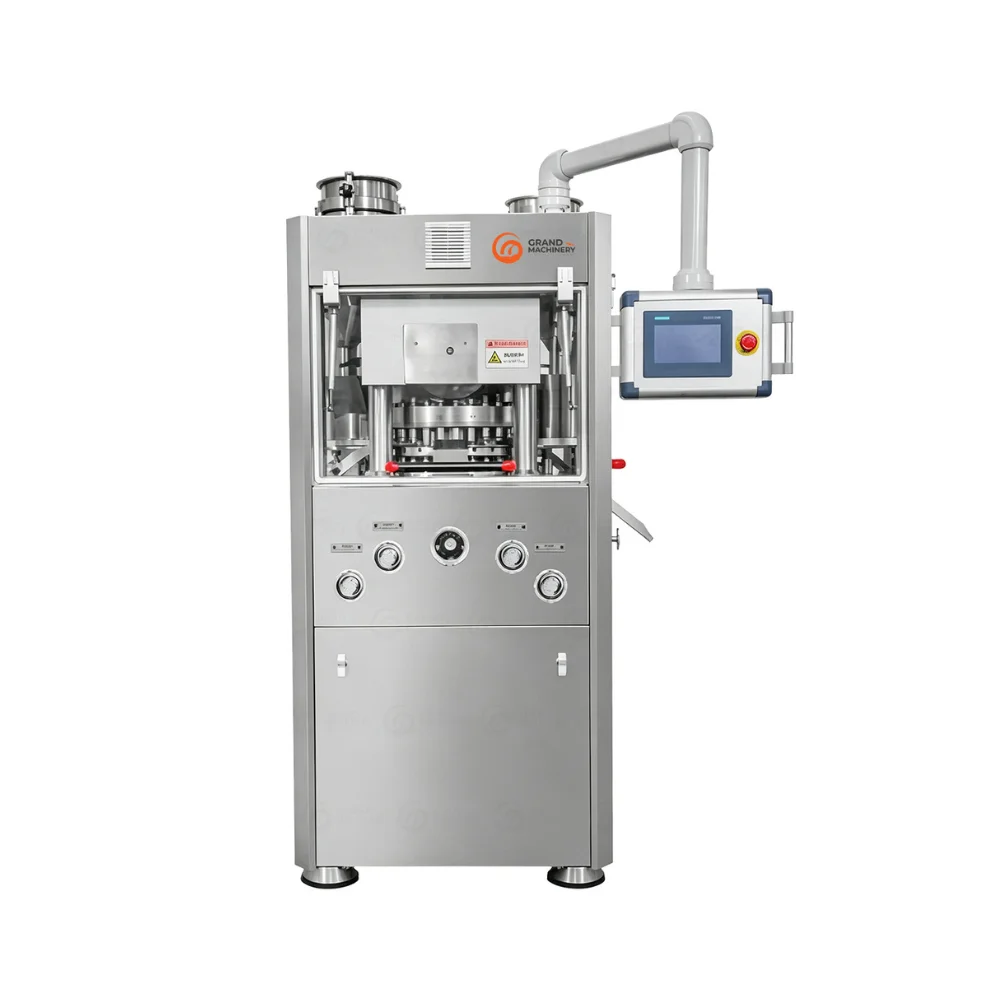
Published equipment examples show how specialized systems address some of these challenges. For instance, Romaco describes an effervescent tableting and packaging approach using controlled compression and gentle downstream transfer. These features describe Romaco equipment, not GRAND Machinery configurations. For a separate reference to an actual GRAND model, see the ZPT420 rotary tablet press pictured below. Suitability for a specific effervescent formulation must be established through technical assessment and trials.
Common Production Challenges and What to Check
| Observation | Areas to investigate | Why it matters |
|---|---|---|
| Inconsistent tablet weight | Powder flow, segregation, die filling, feeder behavior, and sampling method | Variation may indicate unstable feeding or blend properties. |
| Capping or lamination | Air entrapment, elastic recovery, compression profile, tooling, and material properties | Structural failure can occur during ejection or later handling. |
| Sticking or picking | Moisture, lubricant suitability, punch-face condition, and formulation behavior | Material adhesion can damage tablet surfaces and interrupt production. |
| Breakage during transfer | Tablet mechanical strength, discharge geometry, transfer speed, and impact points | Fragile tablets may pass the press but fail before sealing. |
| Stability problems after packing | Package barrier performance, seal integrity, residual moisture, and storage conditions | Compression success does not guarantee shelf-life performance. |
These observations are diagnostic starting points, not instructions to change validated setpoints without investigation. For a dedicated explanation of capping, lamination, sticking, and related mechanical issues, see our guide to tablet defects and remedies.
Quality Control: What Should Manufacturers Measure?
A suitable control strategy begins with product specifications and an appropriate sampling plan. Depending on the product, in-process and finished-product checks may include:
- Tablet mass and dimensions: weight, thickness, and diameter help reveal changes in filling or compaction.
- Breaking force: often referred to as tablet hardness, this assesses mechanical integrity using a defined test method. USP General Chapter <1217> discusses why acceptable values depend on dosage-form design and intended use.
- Friability: measures resistance to abrasion or chipping under defined test conditions. USP <1216> provides general guidance, with special considerations possible for effervescent formulations.
- Disintegration or dispersion performance: the test conditions and acceptance criteria should match the product’s intended use and applicable requirements.
- Moisture and stability: assess the formulation and packaging as an integrated system throughout the proposed shelf life.
No single numerical hardness, friability, humidity, or dissolution target should be presented as universally correct for all effervescent tablets. Relevant pharmacopoeial, food, or supplement requirements vary with the product and intended market.
Gentle Handling and Moisture-Protective Packaging
The manufacturing process is not complete when tablets leave the compression station. Ejection, dedusting, inspection, transfer, and primary packaging may expose tablets to impact and environmental moisture. Equipment layout should therefore minimize avoidable handling and waiting time.
Protective options may include appropriately designed tubes or sealed flexible packaging, selected through compatibility and barrier-performance testing. Seal integrity, moisture ingress, desiccant strategy where applicable, and transport conditions must be evaluated as part of shelf-life development. The correct packaging choice depends on the formulation and distribution environment, not on a generalized promise that one package format is always best.
Romaco’s published effervescent processing solutions explicitly address fragile-tablet handling and transfer to packaging equipment, illustrating why downstream interfaces deserve attention early in line planning.
How to Select a Tablet Press for Effervescent Tablets
Start with the proposed formulation and process requirements, not a claimed maximum tablets-per-hour figure. A useful technical inquiry to an equipment supplier should include the following:
- Tablet diameter, shape, target mass, and expected production volume.
- Blend or granule flowability, compactability, moisture sensitivity, and any available trial data.
- Required tooling standard and the need for pre-compression or other pressure-profile capabilities.
- Feeding arrangement, press enclosure, dust management, and environmental controls.
- Expected tablet-discharge characteristics and transfer or packaging interfaces.
- Cleaning, changeover, material-contact construction, documentation, and applicable quality-system needs.
- Sample testing, proposed acceptance criteria, and evidence required before commercial-scale operation.
For an overview of available equipment types and configurations, explore GRAND Machinery’s rotary tablet press range. A category page is a starting point for comparing options, not proof that a listed machine has been validated for a particular effervescent formulation.
Frequently Asked Questions
Can effervescent tablets be made by direct compression?
Some formulations may be developed for direct compression if their powder properties, stability, and quality attributes allow it. Other products need a suitable granulation route. Selection requires formulation studies and process validation.
Why do effervescent tablets crack or cap during production?
Potential contributors include trapped air, elastic recovery, unsuitable material properties, an inappropriate compression profile, tooling condition, or moisture-related effects. A systematic investigation should examine material, machine, and environmental evidence together.
Is a high-speed rotary tablet press always the best choice?
No. Scale, dwell-time requirements, feeding stability, tablet fragility, tooling, cleaning, and packaging integration can matter more than a nominal maximum output rate. A trial using the intended formulation is preferable to selecting purely on speed.
What is the difference between tablet hardness and friability?
Breaking-force testing evaluates how much force is needed to fracture a tablet under defined conditions. Friability testing evaluates its resistance to abrasion and chipping during controlled tumbling. The measurements provide related but different information.
Why is packaging important for effervescent tablets?
Exposure to moisture can compromise performance or stability. Packaging must provide appropriate protection and seal integrity throughout the intended distribution and storage period, as demonstrated by product-specific stability evidence.
Conclusion
Successful effervescent tablet manufacturing requires coordinated formulation development, moisture management, stable compression, meaningful quality testing, gentle downstream handling, and protective packaging. The press should be selected as part of that integrated process. For a productive equipment discussion, prepare formulation properties, target tablet specifications, expected throughput, facility conditions, and trial criteria before requesting a machine recommendation.
Discuss Your Formula & Capacity: If you are evaluating equipment for effervescent tablets, prepare your proposed tablet dimensions, output target, moisture-handling requirements, and packaging format. Contact GRAND Machinery to discuss configuration options and trial requirements. A successful assessment depends on the actual formulation and machine specification.
Technical References
- KORSCH — Effervescent Tablets: The Tempest in a Tumbler.
- Romaco — Tableting and heat-seal packaging for effervescent products.
- Romaco — Tableting and tube packaging for fragile products.
- United States Pharmacopeia — General Chapter <1217> Tablet Breaking Force.
- United States Pharmacopeia — General Chapter <1216> Tablet Friability.