By Bruce Fu
Last updated: November 16, 2026.
Quick answer:
Creatine gummies and tablets use different forming processes. A gummy production line prepares and deposits a gel-forming mass, while a tablet press machine compresses a suitable powder blend or granulate. A tablet press does not form gel-based gummies. For either format, product development must establish ingredient distribution, forming consistency, creatine content and packaged stability.
For manufacturers developing creatine products: Choose the forming route around the formulation, then confirm the equipment configuration and operating conditions through product trials. This guide compares gummy depositing, tablet compression and the quality controls needed for each format.
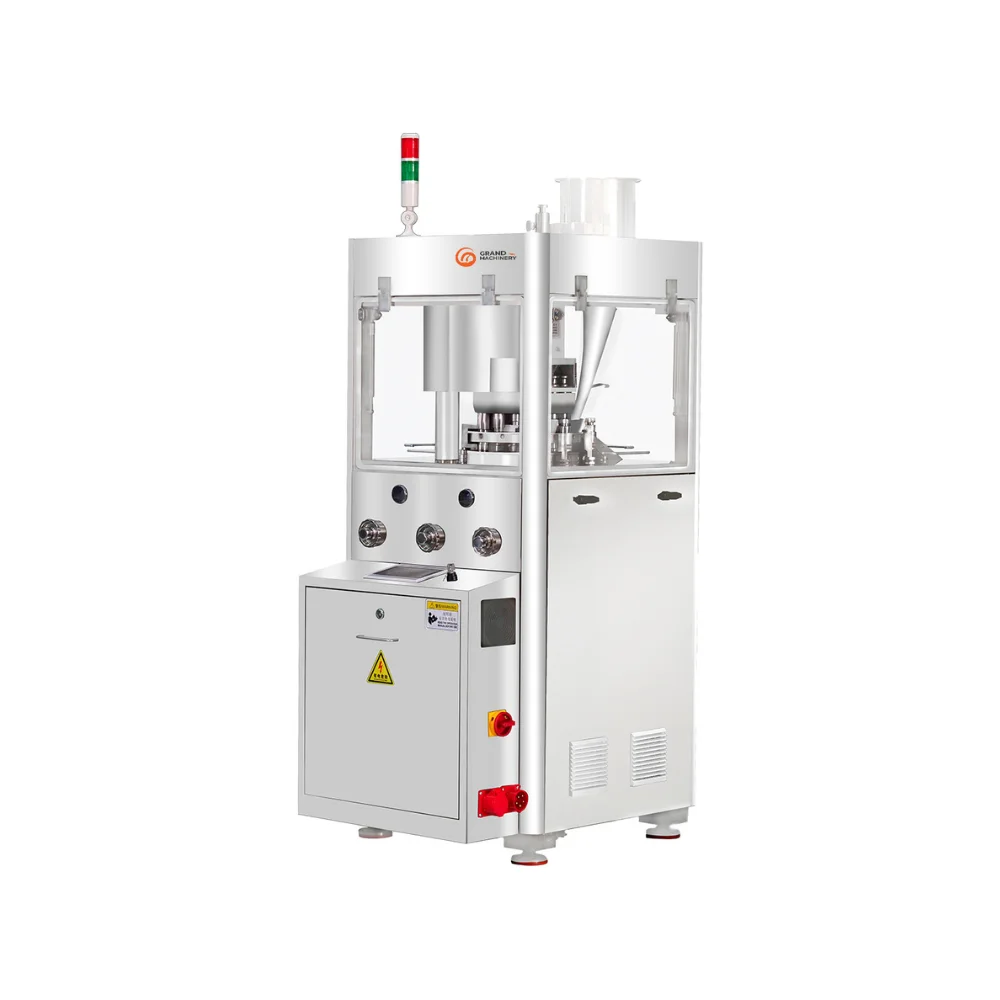
ZP200 rotary tablet press for compressed-tablet production.
Key Takeaways
- Gummies form through depositing and gel setting; tablets form through compression.
- Creatine-gummy development connects ingredient mixing, controlled transfer and depositing with finished-product testing.
- GRAND’s GM150 and GM300 provide gelatin and pectin equipment references; ZP200 provides the compressed-tablet reference.
- Consistent piece weight is not the same as consistent creatine content.
- US creatine gummy sales data is more format-specific than the UK and Brazilian growth evidence discussed here.
- Automation and published machine specifications do not replace finished-product testing.
Two Product Formats, Two Forming Processes
Creatine gummies and compressed creatine tablets share an ingredient category, not a manufacturing method. The equipment works on different material states and creates structure in different ways.
| Process question | Deposited creatine gummy | Compressed creatine tablet |
|---|---|---|
| What enters the forming stage? | A prepared gel-forming mass containing the ingredient system | A blend or granulate with suitable flow and compression behavior |
| How is the shape formed? | The mass is portioned into molds and sets | Material is compacted between punches inside a die |
| What equipment performs the forming step? | A gummy depositor and associated preparation and conditioning equipment | A tablet press with suitable feeding and tooling |
| What needs development attention? | Ingredient distribution, viscosity, hold time, depositing and gel formation | Blend uniformity, flow, die filling, compression and ejection |
| What must be verified after forming? | Creatine content, physical quality and stability | Creatine content, physical quality and stability |
A chewable compressed tablet is still a tablet. Chewability alone does not identify a gummy, and changing tablet tooling does not convert compression into gel depositing.
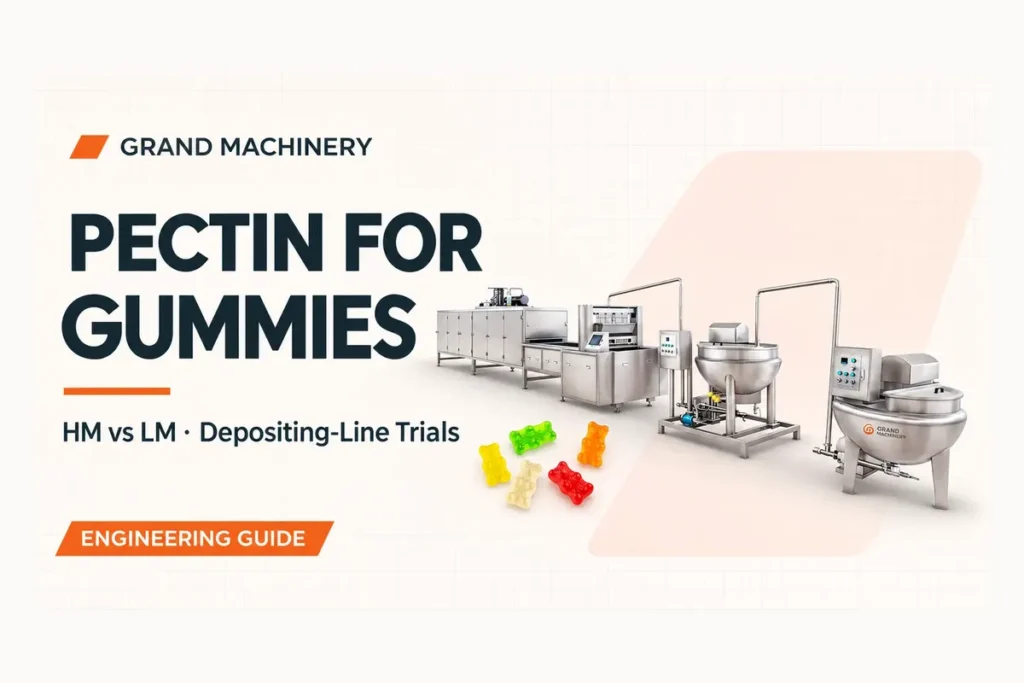
For the gummy equipment route, see GRAND’s gummy depositing lines.
How Creatine Gummies Are Manufactured
Creatine can be incorporated into a gummy product through a process designed around its formulation. The production sequence is recognizable—prepare the base, incorporate ingredients, transfer, deposit, set and finish—but ingredient distribution and finished-product performance need attention throughout the line.
Define the Finished Product First
Begin with the creatine ingredient form, target content per piece, piece weight, serving format and gelatin or pectin system. The responsible formulation and regulatory teams should define these product-development inputs.
The intended formula determines what must be mixed, transferred and deposited. Establishing these requirements first makes it possible to evaluate the process as a connected system rather than concentrating only on the depositor.
Prepare the Gel Base
The gelling system determines how the base is prepared and how it sets. Gelatin and different pectin systems cannot be assumed to share the same hydration, heating, pH or solids requirements.
The process team establishes a workable base, then checks how the intended creatine formulation affects flow and finished texture. Temperature, soluble-solids measurements and viscosity are useful process observations, but none is a direct measurement of creatine concentration.
Establish the Creatine-Addition Stage
The formulation team determines whether creatine is dissolved, dispersed or present in a mixed state, then evaluates a suitable addition sequence and mixing approach. If a premix is proposed, its composition and handling behavior need evaluation before selecting the delivery method.
An ingredient system suitable for dosing liquid flavors or acid should not automatically be assigned to a creatine dispersion. The actual material must be evaluated for metering and mixing performance.
Trials establish the workable addition temperature, mixing conditions and time before depositing. There is no single temperature or mixing duration suitable for every creatine-gummy formulation.
Maintain Consistency During Holding and Transfer
The period between mixing and depositing is part of the process, not an idle interval. A development study should record the relevant temperature history and residence time and examine whether the material remains suitably distributed along the transfer path.
Representative samples from the beginning, middle and end of a trial run can help investigate changes over time. Sampling locations, sample numbers and acceptance limits should be defined by the quality team for the actual process.
Deposit and Set the Product
A depositor portions the prepared mass into molds. The formulation and production route determine the subsequent setting, cooling, conditioning, demolding and finishing stages.
Evaluate portioning, stringing or dripping where relevant, mold filling and demolding behavior. Mechanical repeatability supports consistent piece weight; analytical testing establishes whether the ingredient distribution is also acceptable. Equal-size pieces can contain different amounts of creatine if the incoming mass is unevenly distributed.
Evaluate the Product in Its Intended Package
Packaging belongs in the development study. A finished product should be assessed in the package and storage conditions intended for sale, including relevant physical changes and analytically measured creatine retention.
A Practical Creatine-Gummy Application Design
| Development stage | Proposed work for the creatine application | Evidence to obtain |
|---|---|---|
| Product and gel system | Define the ingredient form, target composition, piece format and gelling system | Approved product brief and formulation specification |
| Incorporation and mixing | Evaluate addition sequence, a premix if needed, and distribution in the actual base | Trial method and representative content measurements |
| Holding and transfer | Assess temperature history, residence time and material consistency through the transfer path | Recorded conditions and time-based sampling results |
| Depositing | Evaluate metering, mold filling, piece weight and ingredient distribution | Physical measurements plus separate creatine assays |
| Setting and finishing | Assess gel formation, demolding, texture and surface behavior | Defined physical-quality results |
| Packaging and storage | Assess the actual product in its intended package | Finished-product and stability evidence supporting the intended claims |
GRAND’s gummy vitamin manufacturing guide provides related background on ingredient dosing and production controls. That general framework does not replace creatine-specific testing.
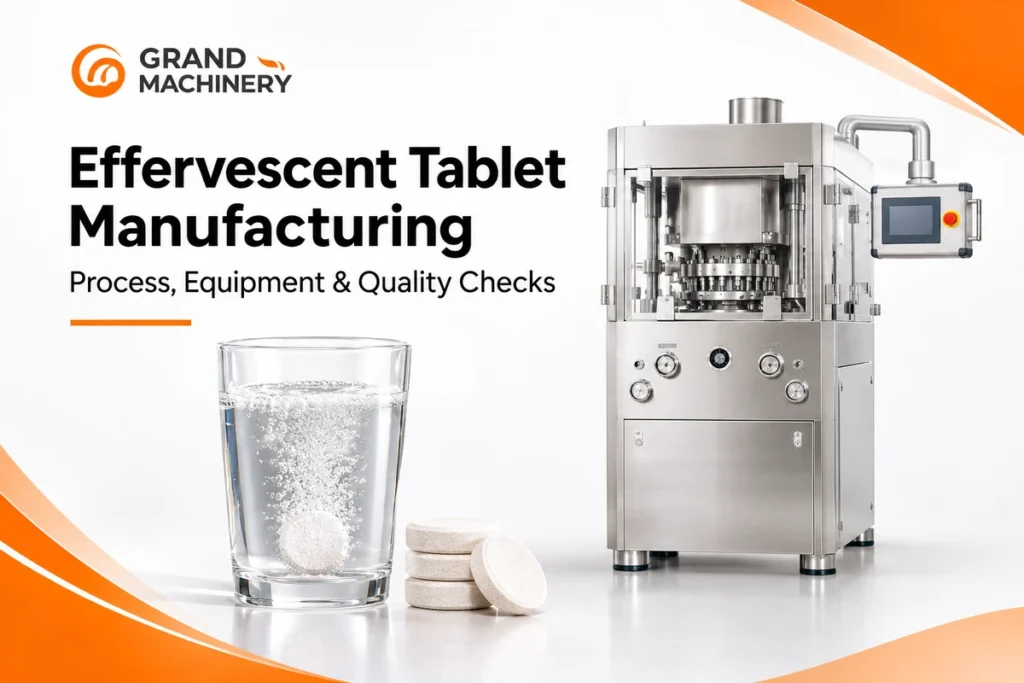
How a Tablet Press Machine Makes Compressed Tablets
A rotary press carries punches and dies through a repeated forming cycle. In the general process, material fills the die cavity, excess material is metered away, the punches compact the material, and the formed tablet is ejected.
Where a pre-compression stage is fitted, it applies an earlier compression step before main compression. That feature may support a suitable formulation’s compression process; it does not make every powder blend suitable for tableting.
For creatine-tablet development, the relevant questions include:
- Does the blend feed consistently without unacceptable segregation?
- Can the material form tablets with suitable mechanical properties?
- Does the product stick to the tooling, chip or fracture during ejection?
- Do representative finished tablets meet the agreed composition and physical specifications?
Direct compression should therefore be treated as a formulation-dependent route. A tablet press is not a substitute for necessary upstream material preparation.
The ZP200 Example
The ZP200 Rotary Tablet Press product page identifies a PLC touchscreen and pre-compression. It lists forced feeding as an optional feature.
Evaluate feeding behavior and output using the actual blend and selected machine configuration.
Equipment Options for Gummies and Tablets
The equipment below covers gelatin gummy depositing, pectin gummy depositing and tablet compression.
| Model | Production route | Published features |
|---|---|---|
| GM150 Gelatin Gummy Depositing Line | Gelatin gummy depositing | PLC control, syrup preparation, vacuum cooling, servo-driven depositing and air-conditioned cooling |
| GM300 Pectin Gummy Depositing Line | Pectin gummy depositing | Cooking, dosing, depositing, cooling and demolding |
| ZP200 Rotary Tablet Press | Compressed-tablet production | PLC touchscreen and pre-compression; forced feeding is optional |
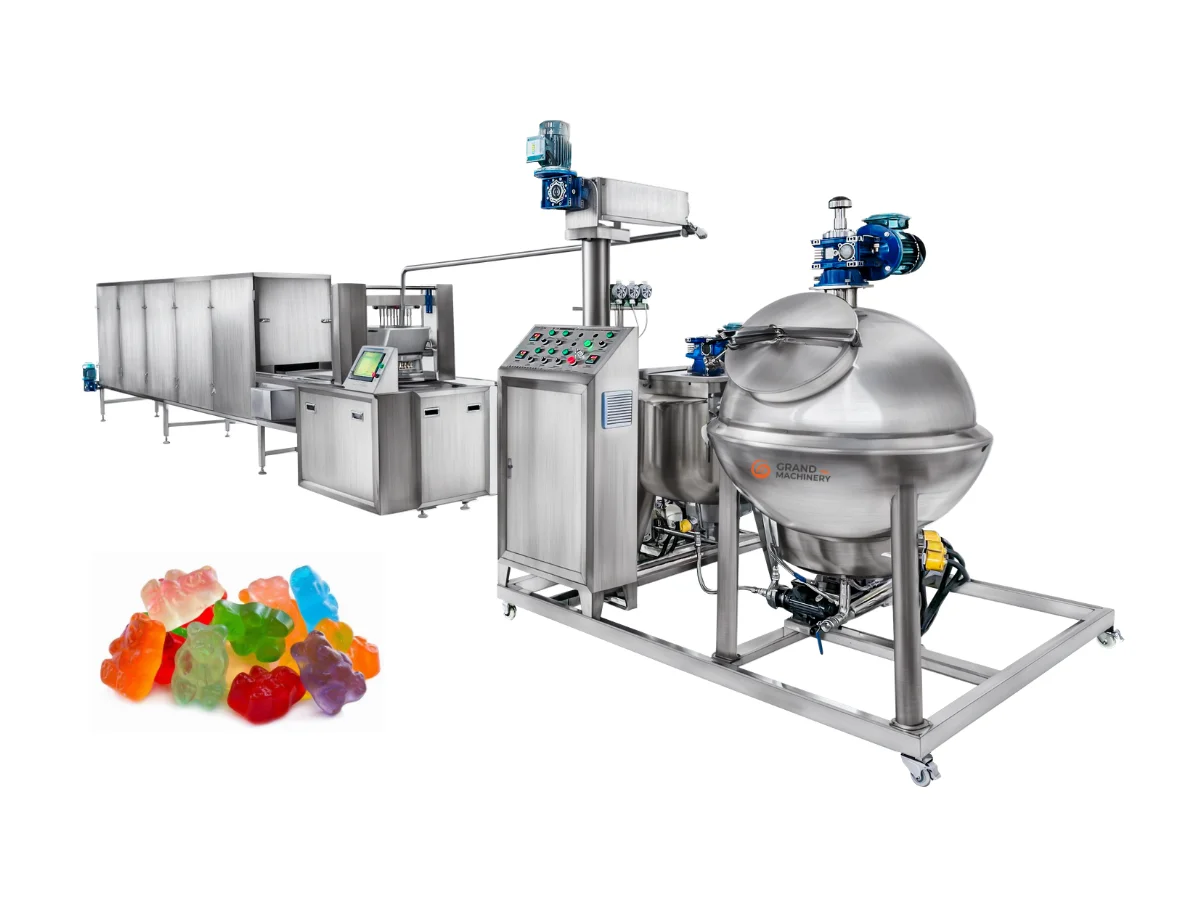
Use the current model specification and agreed configuration for capacity, power requirements, dimensions and supplied options.
Select the machine configuration using the intended formulation and product requirements. Confirm process suitability, output and finished-product quality through trials with the actual material.
Quality Control Beyond Piece Weight
Physical Portioning and Ingredient Content Are Different Measurements
At the same finished-product stage:
Creatine per piece = piece mass × creatine mass fraction in that piece.
A scale measures the entire gummy or tablet. It does not distinguish creatine from the other ingredients. Controlling piece mass therefore does not, by itself, establish uniform creatine content.
A practical development study should investigate both the distribution of ingredients and the consistency of forming. Sampling locations, timing and acceptance criteria should be established by the responsible quality team.
Stability Evidence Must Match the Formulation
Ganguly and colleagues studied aqueous solutions prepared from effervescent formulations containing di-creatine citrate. They observed changes in creatine content and crystallization under the conditions tested. [1]
This study is not a finished-gummy shelf-life study. Its results should not be converted into a universal expiry period for gummies, nor used to claim that every creatine gummy is unstable.
The engineering implication is to test the actual formulation through processing and storage. Recipe-specific pH, temperature history, holding conditions and packaging need evaluation rather than a borrowed universal setting.
Analytical Testing Must Work in the Finished Matrix
A gummy matrix is different from a powder or compressed tablet. The laboratory must use a scientifically suitable method and sample preparation for the material being tested.
The review should address reliable extraction, specificity for the intended analyte, repeatable measurement and relevant degradation products. A raw-material certificate does not alone establish the composition or stability of every finished batch.
FDA’s dietary supplement manufacturing guidance discusses specifications, scientifically valid testing and quality records for the US regulatory context. [2] Other destination markets require their own assessment; a machinery description is not product registration or market authorization.
What PLCs, Servo Systems and Sensors Can—and Cannot—Show
The GM150 product page identifies PLC control and servo-driven depositing. The ZP200 product page identifies a PLC touchscreen and pressure-overload shutdown.
| Control or measurement | Relevant role | What it cannot establish on its own |
|---|---|---|
| PLC and operator interface | Execute configured machine logic and expose specified settings or status | Ingredient identity, chemical stability or finished-product compliance |
| Servo-controlled depositing movement | Repeat a programmed mechanical motion | Identical creatine concentration in every portion |
| Temperature measurement, where installed | Measure temperature at the sensor location | Complete temperature history throughout the batch or creatine content |
| Compression/overload monitoring, where specified | Monitor a mechanical loading condition | Direct measurement of tablet composition |
Review the supplied control specification before selecting additional monitoring or data-recording functions.
A Focused Quality Review
| Stage | Question to resolve | Evidence to retain |
|---|---|---|
| Incoming material | Does the material meet its established identity and quality specifications? | Supplier documentation and appropriate verification records |
| Mixing and holding | Is distribution acceptable throughout the proposed process? | Trial conditions and representative sampling results |
| Forming | Are the required physical properties maintained? | Piece-weight and applicable physical-test results |
| Finished product | Is creatine content demonstrated by a suitable method? | Laboratory results, method suitability and batch traceability |
| Packaged storage | Does the product meet its specification over the claimed period? | Product–package stability evidence |
| Batch disposition | Are deviations and results reviewed before release? | Documented quality decision |
Creatine Growth Signals in Three Countries
Market evidence needs a defined geography, period, metric and product scope. These examples are useful, but they are not directly comparable growth rates.
United States: A Gummy-Specific Signal
SPINS reported 360% year-over-year growth in creatine gummy dollar sales in its tracked channels for the 52 weeks ending December 29, 2024. The reported coverage includes Natural Channel, Amazon, multi-outlet and convenience channels. [3]
This is a format-specific sales signal. It is not a 2026 growth figure, a unit-volume increase or an equipment-order forecast.
United Kingdom: Broader Creatine Business Growth
Glanbia’s 2025 annual report describes double-digit revenue growth in the US and UK within its Optimum Nutrition creatine discussion and mentions gummies among newer formats. [4]
The disclosure does not isolate the entire UK creatine gummy market. It supports investigating the category, not assigning a gummy-specific national growth rate.
Brazil: Creatine Category Volume Growth
Scanntech and McKinsey’s analysis reported 89% creatine volume growth in monitored Brazilian grocery retail during January–October 2025 against the comparable 2024 period. The figure does not separate gummies, powders or tablets. [5]
For manufacturers, this is a reason to investigate local product-format opportunities—not evidence that creatine gummy demand, or machinery demand, increased by the same percentage.
These signals suggest a practical research sequence: assess gummy-specific opportunities in the US, then investigate format demand separately in the UK and Brazil. The figures use different scopes and should not be treated as a national market-size ranking.
Manufacturing Activity Flow
The simplified manufacturing flow separates the two forming routes and retains a quality hold when specifications or release requirements are not met.

Formula qualification and packaged stability studies should support the product’s shelf-life claim.
Frequently Asked Questions
Can a tablet press machine make creatine gummies?
No. A conventional press compresses a suitable blend or granulate. Deposited gummies use a gel-forming process. The press can be relevant to a creatine-tablet project after formulation and equipment evaluation.
Can a gummy depositing line be used in a creatine gummy project?
Yes. A suitably configured gummy production line can be used for a creatine-gummy process that has been developed for its formulation. The relevant work includes ingredient incorporation, distribution during holding and transfer, depositing, setting and finished-product testing. GM150 and GM300 are published equipment references for evaluating the gelatin and pectin routes; their suitability for the specific project must be established through that evaluation.
Does a constant gummy weight establish a constant creatine amount?
No. Total piece weight and ingredient concentration are different quantities. Both need an appropriate control and verification strategy.
Must every creatine tablet use a forced feeder?
Feeding requirements depend on the formulation and machine arrangement. For ZP200, the published product page describes forced feeding as optional.
Does country-level creatine growth prove gummy demand?
Not necessarily. The US example specifically concerns creatine gummies. The UK and Brazilian examples have broader scopes and should not be relabeled as gummy-specific growth.
Does a PLC-controlled line guarantee a compliant product?
No. Equipment supports defined operations. Product quality and compliance also depend on materials, formulation, procedures, testing, records and the applicable destination-market requirements.
Which format works better for consumers?
This manufacturing comparison does not establish clinical superiority or recommend supplement use. Sales growth and equipment specifications do not answer that question.
Conclusion
Creatine tablets and gummies can be discussed within the same product-development landscape, but they require different forming processes. A tablet press machine compresses suitable material; a gummy line deposits a gel-forming mass and supports the required setting process.
A useful development program connects formulation, process control and finished-product testing to repeatable production.
For a project-specific discussion, share the intended format, formulation brief, quality requirements and packaging conditions with GRAND’s technical team. Equipment feasibility should be established before application or performance commitments are made.
References
- Ganguly et al. — Evaluation of the stability of creatine in solution prepared from effervescent creatine formulations (2003).
- FDA — Small Entity Compliance Guide for Dietary Supplement CGMP.
- SPINS — State of Industries, March 2025, creatine gummy data.
- Glanbia Annual Report 2025 — Creatine case study.
- McKinsey and Scanntech — Brazilian consumer trends in 2025.