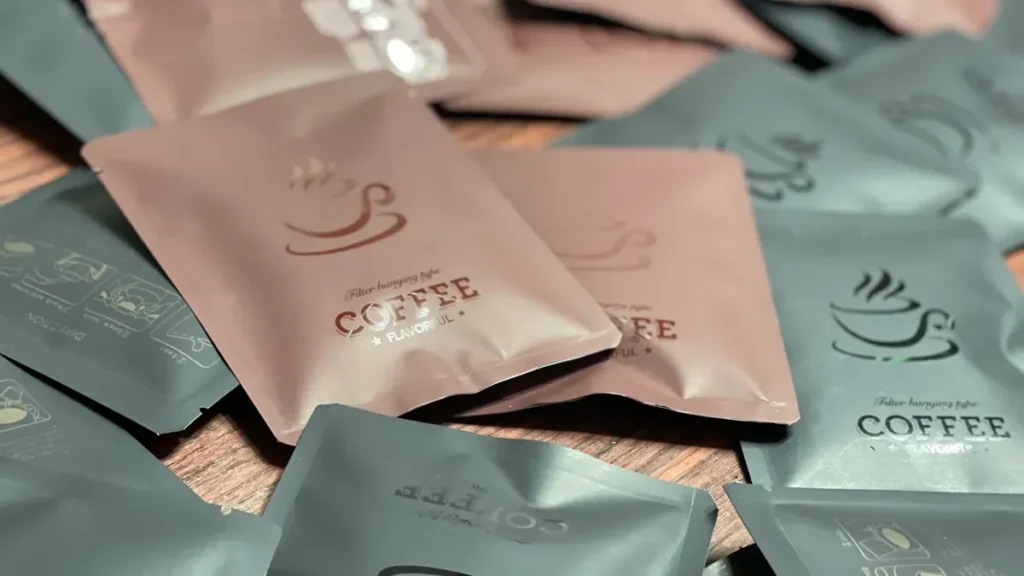
A doy bag packaging machine forms, fills, and seals stand-up pouches for liquids, powders, and granules. The doy pack has become a leading flexible packaging format. Its bottom gusset lets a stand-up pouch sit upright on shelves. Global demand reflects this shift. According to Verified Market Reports, the global Doypack Machine Market size was valued at USD 1.9 billion in 2024. Selecting the right machine directly affects efficiency, product quality, and shelf life. This guide examines how doypack machines work, the main types available, their benefits, and key selection criteria.
Key Takeaways
- Doy bag packaging machines automate filling and sealing for stand-up pouches.
- These machines handle powders, liquids, and granules with different filling systems.
- Rotary machines use pre-made pouches and run at 30-70 bags per minute.
- VFFS machines form pouches from film rolls and save 36% on materials.
- Choose a machine based on your product, speed needs, and budget for quick payback.
What Is Doy Bag Packaging?
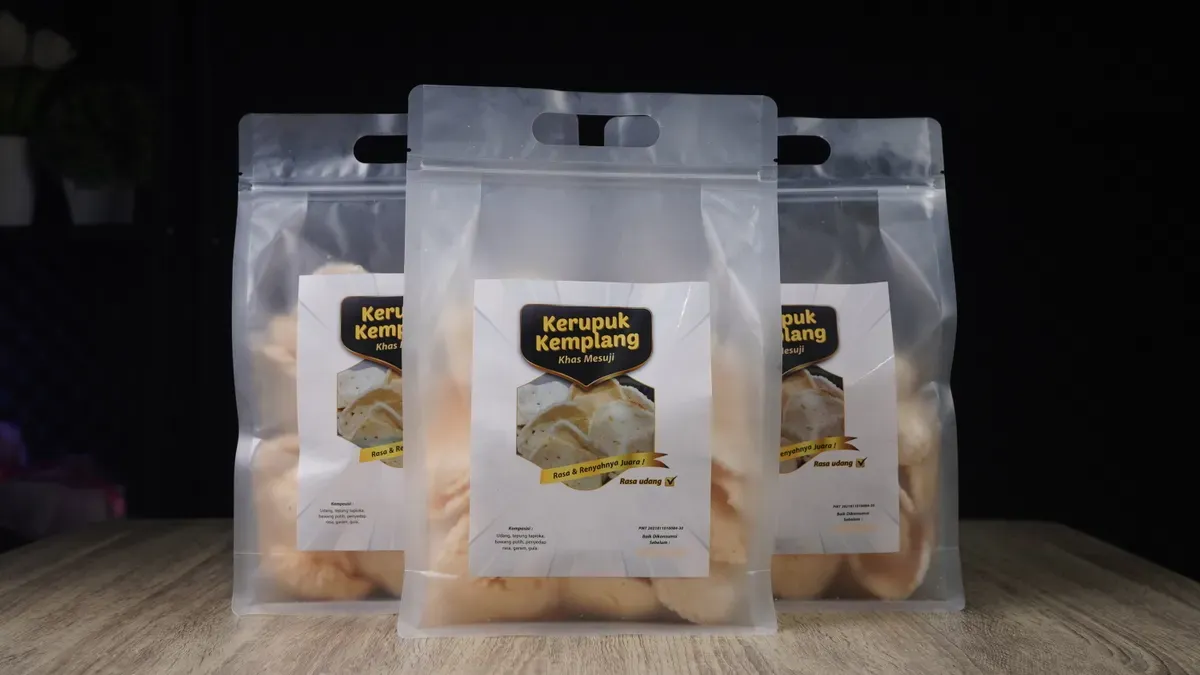
Doy bag packaging describes a flexible format widely known as the stand-up pouch. A bottom gusset creates the stable base that allows the pouch to stand upright. Side seals run along both vertical edges. A top seal closes the package after filling. Packaging engineers express dimensions as width, height, and gusset depth. The gusset measurement may represent half or the full distance from front to back. Common stock sizes for a stand-up pouch range from 6 x 8 inches to 14 x 24 inches. This doy pack design originated from flexible packaging innovations aimed at shelf efficiency.
A doypack serves multiple industries. The food sector uses doypack pouches for coffee, spices, and snacks. Pharmaceutical companies package vitamins and powdered supplements in doypack containers. Cosmetic brands choose doy pack designs for lotions and serums. This doy style bag provides resealable options that keep granular contents dry and free-flowing. The format works well for household chemicals like detergents and fertilizers.
Pouch dimensions directly affect doypack filling and machine compatibility. Small pouches measuring 4 x 6 x 2 inches hold 50 to 250 grams. These suit sample products or spices. Medium sizes at 5 x 9.25 x 2.875 inches accommodate 250 to 500 grams for snack items or protein powders. Large formats reaching 8 x 12 x 4 inches handle 1 to 5 kilograms for pet food or bulk powders. Each size requires a specific machine for efficient production. The quality of packaging materials must preserve product freshness. A doypack machine handles varied pouch dimensions with quick changeovers.
A doypack filling line integrates pouch opening, product dosing, and sealing. A complete pouch packaging line can combine these processes into an automated packaging workflow. The filling process accounts for product type and viscosity. Powder filling uses volumetric or auger systems. Liquid filling relies on piston or pump mechanisms. Stand-up pouches offer packaging flexibility across these categories. The doypack format, also called a doy pack, continues to grow in popularity due to its functional design and retail appeal.
How Does a Doypack Machine Work?
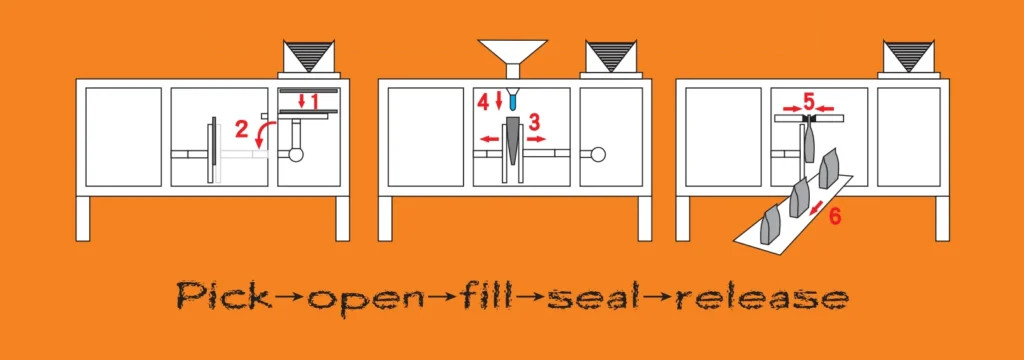
A doypack machine automates the packaging process from pouch feeding to final discharge. This system integrates multiple stations that work in sequence. Each station performs a specific task. Sensors monitor every step. This automation ensures consistent output and reduces human error. Modern doypack machines combine bag-making, shearing, filling, sealing, and output in one continuous cycle. This integration maintains speed on a production line.
Pouch Feeding and Opening
The process begins with pouch feeding. A magazine holds a stack of pre-made pouches for a doy pack. Mechanical grippers pick one pouch at a time. Vacuum suction cups pull the pouch walls apart. Air blowing devices direct air into the pouch. This combination creates a stable opening for product entry. For a doy pack with zipper features, a separate mechanism opens the zipper track. Mechanical fingers ensure full opening before the operation starts. Sensors verify correct opening. High-end systems achieve error rates below 0.009%. Anti-stacking systems prevent double-feeds. This precision is critical for maintaining efficiency in a high-speed doypack filling machine. The entire sequence takes less time than manual handling. This doypack design supports fast changeovers.
Product Filling
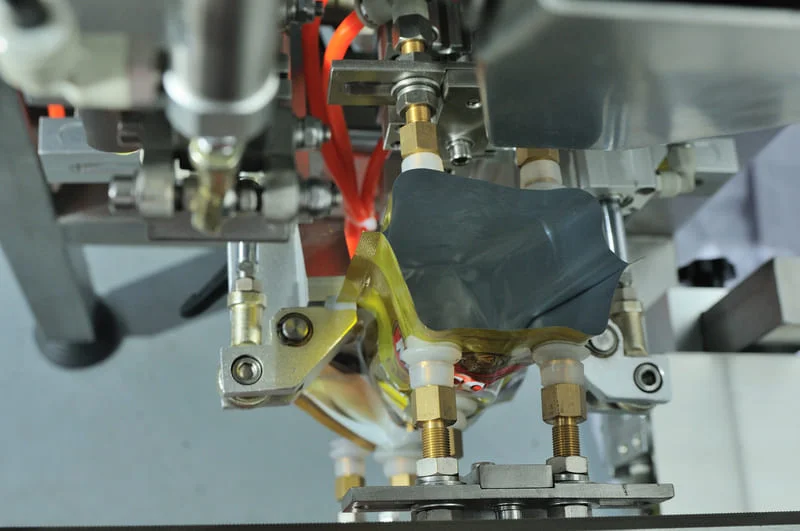
Once the pouch is open, the doypack filling machine moves it to the filling station. The machine selects a dosing system based on product type. Volumetric filling uses pistons or pumps to dispense a predetermined volume. This method suits liquid and semi-liquid products. Weighing filling uses load cells to fill based on weight. This method suits granular or powder products. Both technologies minimize waste by ensuring uniform levels. Maintaining accurate dosing is essential. Overfilled packages increase costs. Underfilled packages cause dissatisfaction. The process accounts for product characteristics. Dust collection systems manage powder. Splash prevention controls liquids. After filling, an optional station vibrates the pouch gently. This settles the product at the bottom and keeps the seal area clean.
The pouch then moves through additional stations. Deflator plates remove excess air. Optional gas flushing injects nitrogen to displace oxygen. This extends shelf life for sensitive products. A dust suction nozzle cleans the inner seal area. Heated seal bars clamp the top edge. They fuse the sealant layers with controlled heat, pressure, and time. This creates a hermetic seal. Cooling bars then set the seal for strength and appearance. The finished pouch releases onto an output conveyor.
These stations work as one synchronized system. This system uses programmable logic controllers to manage each cycle. Automated packaging reduces manual labor and increases output. The process runs with minimal intervention. Advanced sensors deliver consistent quality across every doy pack. This packaging solution offers flexibility for various products.
Main Types of Doypack Packaging Machines
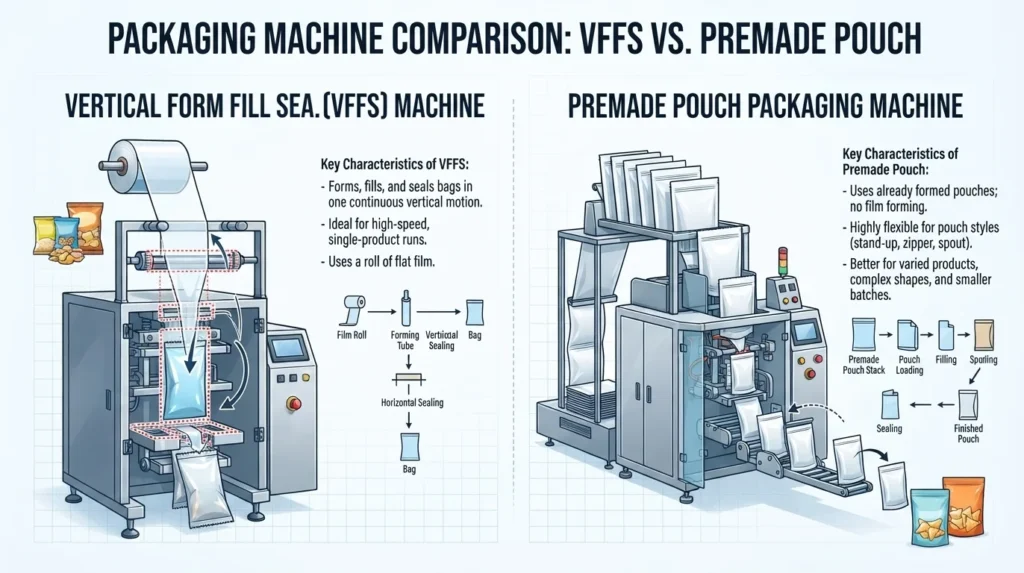
The market offers two primary architectures for doy bag packaging. Each design serves different production goals. A premade pouch doy pack machine handles pre-formed bags. A VFFS system forms bags from roll stock. Both handle the doy pack format. Buyers must understand these differences before selecting equipment.
Premade Pouch (Rotary) Doy Bag Machines
A premade pouch packaging machine works with pre-formed doy pouches. The operator loads a magazine with finished bags. The machine then opens, fills, and seals each one. This approach suits doy pouches with complex features. Spouts, zippers, and shaped corners come pre-made. The machine simply handles the filling and sealing steps.
Rotary and linear systems represent two automation paths. Rotary machines use a circular platform. Multiple stations operate at once. Linear machines move pouches in a straight line. Each station completes its task in sequence. This difference affects throughput significantly.
| Machine Type | Production Speed (bags/min) |
|---|---|
| Linear premade pouch | 20–40 |
| Rotary premade pouch | 30–70 |
Rotary doy pack machines achieve higher production speeds. Their continuous rotating motion enables multiple stations to operate simultaneously. Linear machines must complete each station sequentially. This inherently limits their throughput to roughly half that of rotary machines. High-end dual-lane linear machines can reach 40–50 bags/min. This comes at significantly greater cost and complexity.
Some machines accommodate both flat and stand-up pouches. This flexibility helps manufacturers test different formats. A stand-up pouch with a spout suits liquids. A flat pouch works for single-serve powders. The same doypack filling machine can run both. This reduces capital investment for growing operations.
VFFS Doy Pack Machines
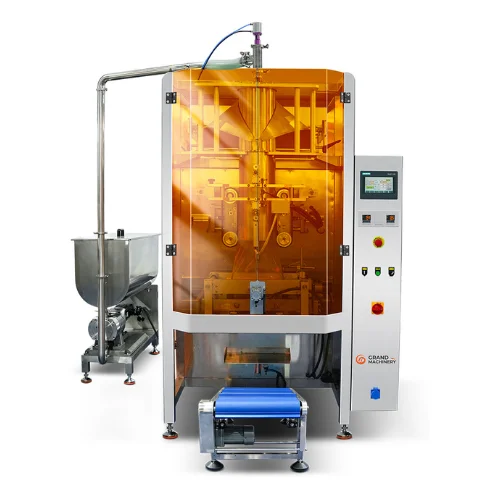
Vertical form fill seal (VFFS) machines create bags from a roll of film. The machine forms the pouch, fills it, and seals it in one pass. This eliminates the need for pre-made bags. Material waste drops from 5–10% to 2–5%. Cost per unit falls from $0.05 to $0.02 for bulk runs. A VFFS doypack filling machine achieves 36% material savings. An initial $150,000 outlay recoups in 18 months through this savings.
A flat bottom VFFS packaging machine produces flat bottom bags. This supports the flat bottom option for VFFS pouch styles. The system also handles pillow bags, gusseted bags, gusseted flat bottom bags, vertically made stand-up pouches, and recloseable zipper stand-up pouches. The zipper is closed during VFFS filling and sealing.
Servo motor technology marks the biggest factor in achieving high packaging line efficiency. Older machinery relies on pneumatic components. These consume significant energy. Servo-driven machines yield long-term savings through lower energy consumption and superior reliability. This matters for high-volume production.
The doypack packaging process differs between these two types. Premade systems offer flexibility for complex pouch designs. VFFS systems deliver speed and material savings. Both support automated packaging goals. The right choice depends on product type, volume, and budget.
Key Benefits of Doy Bag Packaging
Efficiency and Cost Savings
Automated operation delivers high efficiency and flexibility for doy bag packaging. For manufacturers looking to connect pouch filling with downstream processes, an automated packaging line can integrate multiple packaging stages into one workflow. A doypack filling machine reduces manual labor and increases output significantly. One mid-sized pet treat manufacturer replaced three semi-automatic manual pouch filling stations with a single rotary doypack machine running at 50 bags per minute. Labor dropped from six operators to one supervisor. Monthly labor savings reached $12,500. Pouch seal defect scrap fell by 85%. The full capital investment was completely amortized within 8.4 months of continuous production.
The payback period for a typical rotary doypack system falls between 8 and 14 months. Precision weighing technology pays for itself through raw material savings alone. A Single ROI formula is: (Monthly Labor Savings + Monthly Waste Reduction) − Maintenance Cost = Monthly Profit Increase. Many operations recoup their investment within 12 to 18 months through labor savings and reduced material waste. A typical packaging machine investment ranges from $60,000 to $180,000, with a payback period of 8 to 18 months. This doypack filling machine efficiency makes automated packaging a sound financial decision for most operations.
Versatility and Shelf Appeal
A doypack filling machine handles liquids, granules, and powders with equal precision. This versatility extends across food, pharmaceutical, and household chemical applications. A pet food brand switched its packaging to retort doy packs. Storage costs dropped by 75%. Shipping costs fell by 62%. Damage rates decreased from 4% to 0.3%. Overall costs were reduced by 28%. For 1,000 liters of tomato sauce, transporting it in glass bottles requires three 5-ton trucks, whereas using retort pouches requires only one truck.
Stand-up pouches offer superior shelf appeal and branding potential. Vibrant printing and unique designs attract attention quickly. The upright structure faces buyers directly, keeping packaging artwork and product details visible. Windowed stand-up pouches show the product through a transparent section, building trust instantly. A Japanese home care brand introduced a spouted stand-up pouch for dishwashing liquid. The pouch weighed 70% less than a rigid bottle and used 80% less plastic. Unit production cost dropped 23%. Retailer shelf allocation doubled. Over 60% of the brand’s dishwashing liquid sales came from the pouch refill SKU. This doypack packaging approach demonstrates how a doy pack can transform product presentation and market performance.
Applications of Doy Bag Packaging
Doy bag packaging serves a wide range of industries. The food sector represents the largest user. Coffee, spices, nuts, and dried fruits all ship in doy pouches. Snack manufacturers favor doy bags for chips and candies, and gummy brands increasingly use flexible pouch formats for confectionery and functional gummy products. Pet food brands use doybag formats for treats and kibble. These applications benefit from the resealable design and extended shelf life.
Beverage companies adopt doypack packaging for liquid concentrates and juices. A stand-up pouch with a spout allows easy pouring. Personal care brands package lotions, serums, and shampoos in doy style bag formats. Household chemical producers rely on doy-pack designs for detergents and fertilizers. The doypack pouch protects contents from moisture and contamination. This flexible packaging approach suits many product types.
Quick changeovers let one machine switch between these formats while maintaining fill accuracy, and filling methods—auger for powders, piston pumps for liquids, volumetric cups for granules—are matched to each product.
The doypack machine also manages different filling methods. Powder filling uses auger systems. Liquid filling relies on piston pumps. Granule filling employs volumetric cups. Each method ensures consistent quality. The doypack filling machine integrates these systems into one line. A doy pack produced on this equipment meets strict standards. The doypack filling machine delivers reliable performance for any application. This packaging line handles high volumes with ease.
How to Choose the Right Doy Bag Packaging Machine?
Assess Product Type and Filling Method
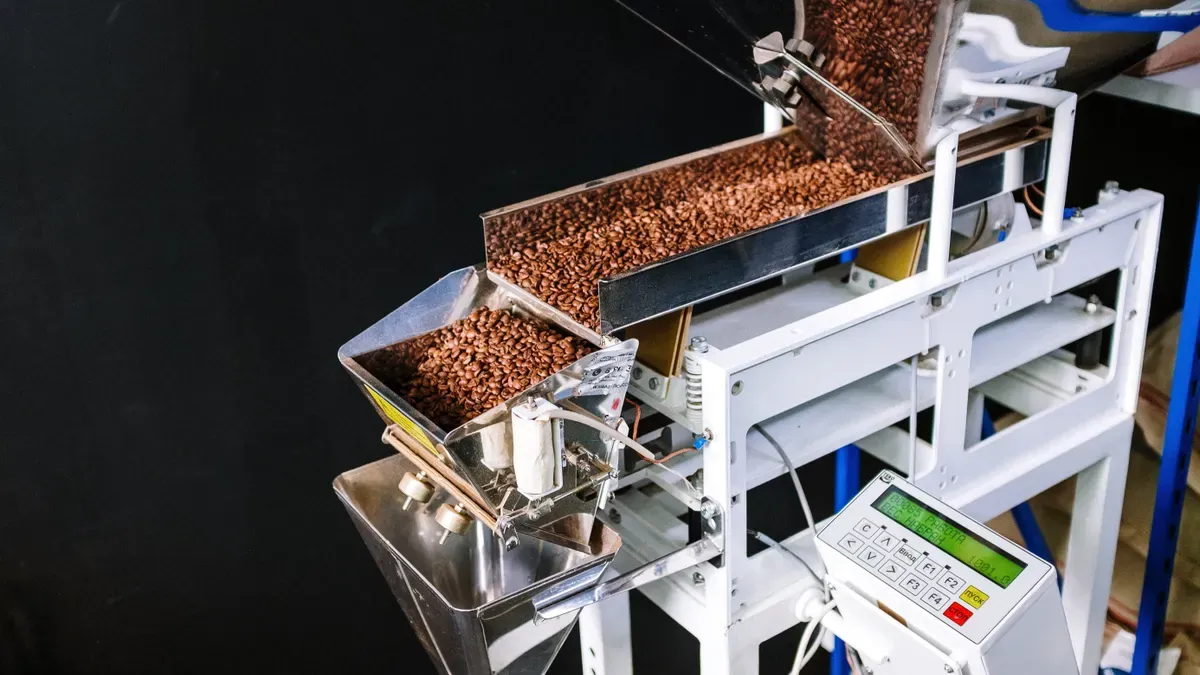
Product type dictates the filling system. Powder products need an auger filler for fine, dusty, non-free-flowing substances. Granules work best with a multi-head weigher for high accuracy by weight. Liquids and sauces require a liquid pump or piston filler. Piston fillers handle a usable viscosity range from roughly 1,000 cP to over 500,000 cP. Honey sits at 2,000–20,000 cP, ketchup at 50,000–100,000 cP, and mayonnaise at 100,000–300,000 cP. All three suit piston filling in a doy pack machine.
Sticky pastes demand extra care. An anti-drip filling nozzle keeps the bag mouth clean, because clean filling and strong sealing prevent leakage. For sticky products, choose specialized hoppers or anti-bridging systems. A doypack filling machine for paste may need heating or mixing. Match the doypack filling machine to the product first, then confirm pouch compatibility. The machine must handle the required width, height, and multi-layer laminates like PET/AL/PE. Sealing technology must match the film.
Balance Production Speed, Pouch Size, and Budget
Speed and budget move together. A doypack filling machine for high-volume production costs more upfront but lowers unit cost. Powder lines show the trade-off clearly. Premium machines reach ±0.5% dosing accuracy and up to 99.9% seal integrity, with changeover times as low as 15 minutes. Pharmaceutical work needs ±1% dosing, 99% seal integrity, and 30-minute changeovers. Material grade matters too. Premium and pharma-grade units use 316L stainless steel, while standard food lines often use 304 SS.
Budget also covers automation level. Semi-automatic equipment needs an operator; fully automatic doypack equipment runs with minimal intervention. Integration with checkweighers and vision inspection adds cost but protects quality. A doypack filling machine that supports zippers, spouts, or degassing valves costs more than a plain sealer. For a doy pack line, weigh the payback against labor and waste savings. Then consult suppliers with your product samples, pouch sizes, and target output. A supplier can confirm the right doypack filling machine for your doy pouches, doy bags, or doypack bags before you commit capital.
Conclusion
Choosing the right doy bag packaging machine is essential for achieving consistent filling accuracy, reliable sealing, efficient production, and lower operating costs. The ideal solution depends on your product characteristics, pouch format, production capacity, and automation requirements. Whether you need a pre-made pouch system or a VFFS solution, the machine configuration should be matched carefully to your specific production needs.
If you are planning to upgrade your packaging operation or purchase a new doypack machine, contact Grand Machinery for a tailored equipment recommendation. Send us your product information, pouch specifications, and required production capacity, and our technical team can help you develop a suitable doypack packaging solution for your business.
Contact Grand Machinery today to discuss your project and find the right packaging equipment for your production line.
FAQ
What is the difference between rotary and VFFS machines?
A rotary machine handles pre-formed pouches at 30–70 bags per minute. A VFFS system creates bags from film rolls. Rotary suits complex pouches with spouts or zippers. VFFS delivers material savings.
What products work best with a doypack machine?
A doypack filling machine handles liquids, granules, and powders. Food items like coffee and spices work well. The doypack filling machine adapts its methods—auger for powder, piston for liquids.
How quickly does a machine pay for itself?
Payback for a doypack filling machine typically falls between 8 and 14 months. One pet food manufacturer saved $12,500 monthly in labor. The food industry shows strong returns with automated packaging.
Can one machine handle different doy pack sizes?
Yes. A doypack filling machine supports sizes from 4 x 6 inches to 14 x 24 inches. Quick changeovers allow fast transitions between formats. Seal quality remains consistent across all sizes.
What sealing technology does a doypack machine use?
Heated seal bars fuse the pouch top with heat and pressure. This packaging process creates a hermetic closure. The design ensures strong seals for food products.