
Choosing between a single punch tablet press and a rotary press is the first — and most expensive — decision in any tablet project. Pick a machine that is too small and you will bottleneck within a year. Pick one that is too large and you will pay for capacity you never use, in floor space, validation, and tooling.
This guide compares the two press types across output, tablet uniformity, compression physics, and total cost of ownership. It then gives you volume thresholds, a defect-to-machine troubleshooting map, and a scale-up path — so you can match the machine to your actual production volume instead of a supplier’s headline number.
Key Takeaways
- A single punch tablet press produces one tablet per cycle, typically 1,200–6,000 tablets per hour, and is the standard tool for R&D, formulation trials, and small specialty batches.
- A rotary tablet press compresses many tablets in parallel on a rotating turret, from roughly 5,000 up to 1,000,000+ tablets per hour.
- Single punch presses cost less upfront ($375–$5,000 typical FOB range for Chinese-made units) but have a higher cost per tablet at volume.
- Volume is the deciding factor: below ~10,000 tablets per shift, a single punch press is usually the right call; above that, evaluate rotary.
- The most common buying mistake is sizing the press to a theoretical maximum instead of your granulation line’s real output.
What Is a Single Punch Tablet Press?
A single punch tablet press — also called a single station or eccentric press — compresses powder into tablets using one die and one set of upper and lower punches. Each compression cycle produces exactly one tablet. The design is mechanically simple, compact enough for a benchtop, and easy to clean and change over between formulations.
Because only one tablet is formed at a time, the operator can watch every parameter closely: fill depth, compression force, tablet thickness, and ejection. That visibility is why formulation scientists and pilot-plant managers still choose this press type even when budgets allow more.
How the Single Punch Compression Cycle Works
The cycle has four repeating stages. First, filling: the lower punch drops to create a cavity, and the feed shoe swings across, filling it with granulation. Second, metering: the lower punch rises to a preset depth, and the feed shoe scrapes off excess powder — this position determines the tablet weight.
Third, compression: the feed shoe retracts, and the upper punch descends into the die, compressing the powder against the stationary lower punch at a set force. Fourth, ejection: the upper punch withdraws and the lower punch rises, pushing the finished tablet level with the die table, where the next sweep of the feed shoe pushes it into collection.
Single Punch Tablet Press Specifications at a Glance
Specifications vary by model class. The output, tablet diameter and compression-force figures below are manufacturers’ rated mechanical specifications for Chinese-made entry-level equipment; the price column is a market transaction band we track across supplier quotes, not a Grand Machinery quotation:
| Machine class | Output (tablets/h) | Max tablet diameter | Max compression force | Typical FOB price* |
|---|---|---|---|---|
| Manual (TDP-0 / TDP-1.5 class) | 800–2,400 | ~12 mm | ~15 kN | $375–$900 |
| Semi-auto (TDP-5 class) | 3,000–4,500 | ~20 mm | ~50 kN | $1,200–$2,500 |
| Heavy electric (TDP-6 class) | 3,000–4,500 | 20–25 mm | 50–60 kN | $2,000–$5,000 |
* Price band reflects market transaction ranges we track across Chinese supplier quotes and trade listings; it varies with configuration, tooling and order volume and is not a Grand Machinery quotation.
Three things to note in this table. Compression force tops out around 60 kN — sufficient for most supplement and confectionery formulations, but below the 100–400 kN envelope that effervescent and large-format tablets demand. Max tablet diameter is capped near 25 mm. And output, no matter the model, never escapes the one-tablet-per-cycle limit.
What Is a Rotary Tablet Press?
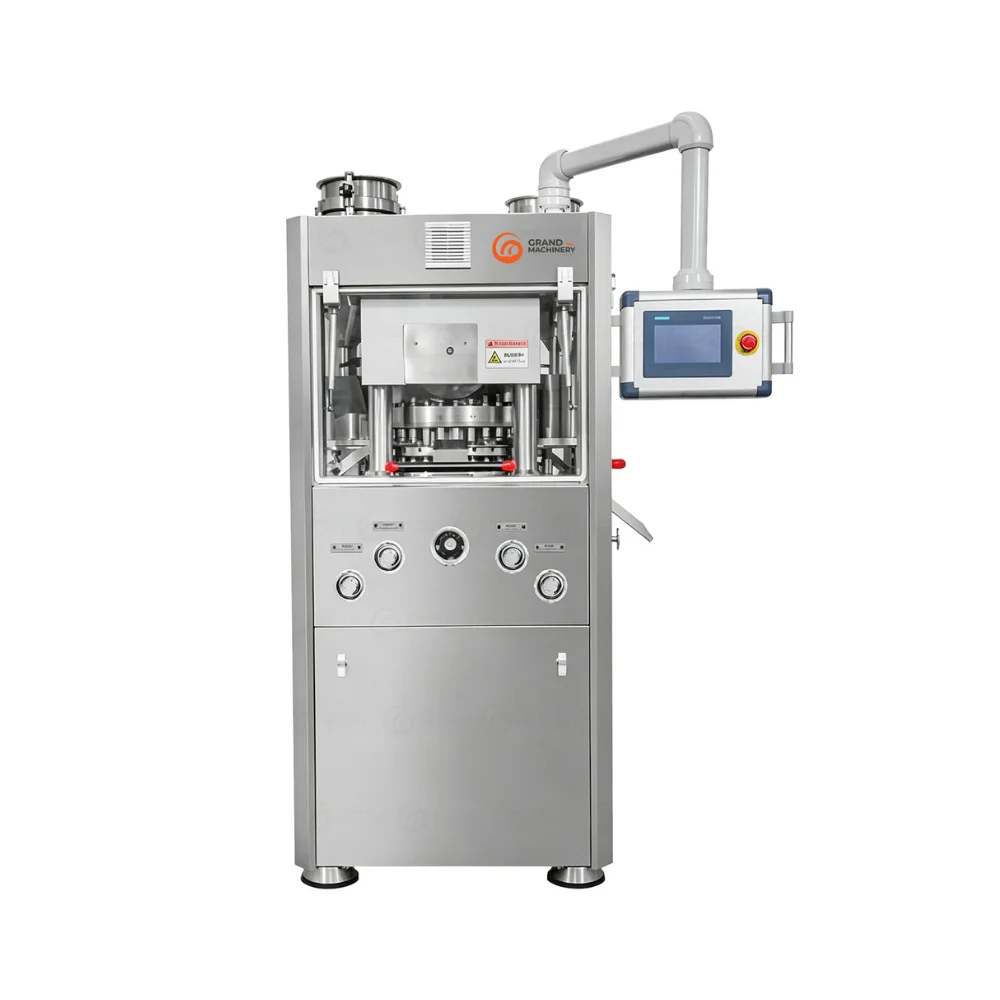
A rotary tablet press replaces the single station with a rotating turret that carries multiple punch-and-die sets — from 8 stations on lab machines to more than 100 on production presses. As the turret turns, each station passes filling, compression, and ejection in a continuous cycle, so dozens of tablets are formed in parallel.
The output math is simple and worth memorizing: tablets per hour = number of stations × RPM × 60. On a 35-station press we recently commissioned for a supplement contract manufacturer, running at 40 RPM, that works out to about 84,000 tablets per hour. Rotary presses also compress from both punches at once through pre-compression and main compression rollers, which produces more symmetric density than the upper-punch-only stroke of a single station press. For a full breakdown of rotary platforms and tooling, see our guide to rotary tablet press platforms.
Single Punch vs Rotary Tablet Press: Side-by-Side Comparison
| Feature | Single Punch Tablet Press | Rotary Tablet Press |
|---|---|---|
| Working principle | One die, one tablet per cycle | Multi-station turret, parallel compression |
| Output | 1,200–6,000 tablets/h | 5,000–1,000,000+ tablets/h |
| Compression | Upper punch only (or bidirectional on newer units) | Both punches, via compression rollers |
| Weight/hardness uniformity | Good in careful hands; drifts at speed | High consistency, closed-loop control |
| Compression force | Up to ~60 kN | 60–100 kN standard; up to 400 kN special |
| Changeover | Minutes; one tooling set | Longer; turret and tooling planning |
| Automation | Manual to semi-auto | PLC/HMI, force feeding, auto weight control |
| Footprint | Benchtop | Dedicated floor space |
| Initial investment | $375–$5,000 (typical China FOB) | $6,000–$200,000+ |
| Cost per tablet at volume | High | Low |
| Best for | R&D, trials, small specialty batches | Pilot to full commercial production |
Output and Production Capacity
The output gap is not a tuning problem — it is structural. A single punch press completes one full cycle per stroke, and even at a brisk 60–100 cycles per minute it tops out near 6,000 tablets per hour. A rotary press multiplies output by its station count: double the stations and you double the throughput at the same turret speed.
The practical crossover sits near 10,000 tablets per shift. Below that line, a single punch press covers your volume with time to spare. Above it, you will either run the machine all day with no margin for rejects and cleaning, or add a second shift to compensate for capacity a small rotary would give you outright.
Tablet Uniformity and Compression Symmetry
In a classic single punch press, only the upper punch moves during compression, so force enters from the top while the powder bed sits against a stationary base. This asymmetric stroke consolidates the tablet unevenly — the top face is denser than the bottom — which is why single-punch tablets are slightly more prone to capping and lamination on difficult blends.
Rotary presses compress from both ends simultaneously, and their longer, roller-driven dwell time gives air more opportunity to escape the die. Combined with force monitoring and automatic weight control on modern machines, this is why rotary production runs hold weight variation near 1% while an unattended single punch press drifts as the operator’s attention moves on.
Initial Cost vs Cost per Tablet
A single punch press wins the purchase-order comparison every time: $375–$5,000 against $6,000–$200,000+ for rotary. But the per-tablet math inverts at volume. Once you exceed a few hundred thousand tablets per month, the rotary press’s throughput advantage repays its higher price — fewer machine hours, less labor per tablet, and lower energy per unit.
The right way to frame it: a single punch press is the cheapest way to make your first 10,000 good tablets, and an expensive way to make your first 10 million. If you already know your commercial volumes, buy for the volume you will actually run, not the budget you have today.
Which Tablet Press Fits Your Production Volume?
Map your demand to the table below before you shortlist suppliers. Convert annual volume into tablets per shift, then add the 15–25% headroom we typically build in for changeovers, cleaning, rejects and future growth on the projects we have quoted — sizing without headroom is the single most common cause of late-stage capacity crises. At the top of the range, roughly above 300,000 tablets per hour, standard rotaries give way to dedicated high speed tablet press platforms engineered for continuous, high-volume output.
| Production volume | Recommended machine class | Typical configuration |
|---|---|---|
| Under 10,000 tablets/shift | Single punch press | Electric TDP-5/TDP-6 class |
| 10,000–40,000 tablets/shift | Small rotary (8–19 stations) | Entry rotary, 5,000–40,000 t/h |
| 40,000–120,000 tablets/shift | Standard rotary (20–35 stations) | Mid-scale GMP production |
| Above 120,000 tablets/shift | Large or high-speed rotary (36+ stations) | 100,000–1,000,000+ t/h |
Choose a Single Punch Tablet Press If…
- You are validating a formulation and expect the recipe to change weekly.
- Your batches are small, specialty, or made from expensive APIs where waste is costly.
- You need benchtop mobility, minimal training, and tooling changes in minutes.
- Your products include candy tablets, mints, or custom shapes produced in short runs.
- Capital budget is limited and volume is genuinely below ~10,000 tablets per shift.
Choose a Rotary Tablet Press If…
- Your tablets feed a commercial product with predictable, repeatable demand.
- You need consistent weight and hardness with minimal operator intervention.
- Your formulation requires pre-compression, forced feeding, or high compression force.
- You plan to integrate dedusting, metal detection, or coating downstream.
- Scale-up within 12–24 months is likely, and re-purchasing later would cost more.
The Scale-Up Path: From Single Punch to Rotary
Most tablet projects should still start on a single punch press, even when rotary is the destination. The economics of formulation development favor it: you consume grams of powder per trial instead of kilograms, change tooling in minutes, and debug compressibility before committing to a turret configuration.
Scale-up is a parameter transfer, not a replay. Our rotary tablet press machine guide walks through turret selection in detail; the short version of what changes is below.
What Changes When You Move to a Rotary Press
- Feeding: gravity-fed single shoe becomes a forced feeder (paddle or auger) — die filling at speed depends on it.
- Compression profile: a pre-compression stage (typically 1–5 kN) appears before main compression, removing trapped air and reducing lamination.
- Dwell time: roller-driven compression is faster per tablet, so marginal blends that held up on the single punch can start capping — extended-dwell turrets exist for this.
- Control logic: fill depth, turret speed, and main force must be re-validated; values from the single punch are starting points, not setpoints.
- Documentation: IQ/OQ/PQ protocols, FAT runs, and in-process controls move from optional to expected for GMP production.
When a Single Punch Tablet Press Is the Right Production Machine
Here is what most comparison articles skip: for certain products, a single punch press is not a stepping stone — it is the correct production machine. Confectionery and nutraceutical makers run single punch presses commercially every day for milk tablets, mints, candy tablets, and effervescent-style products where runs are short, shapes change often, and recipes rotate seasonally.
The same logic applies to high-value actives. If your API costs hundreds of dollars per kilogram, the single punch press’s low holdup volume — grams per cycle instead of kilograms in a hopper — makes small commercial batches affordable. A specialty manufacturer producing 5,000 premium tablets per hour does not need a 35-station turret idling at 5% utilization. Match the machine to the economics of the product, not to the prestige of the platform.
Matching Common Tablet Defects to the Right Press Type
Defects are diagnostic. When tablets fail consistently, the failure mode often points not to the formulation but to a mismatch between the product and the press class running it. Use this table before you blame the recipe — or re-order tooling you don’t need.
| Defect pattern | Likely press-related cause | Machine-side answer |
|---|---|---|
| Weight variation grows with line speed | Single station fill cannot keep pace | Move to a small rotary with forced feeder |
| Capping and lamination on hard blends | Unidirectional stroke traps air | Rotary with pre-compression stage |
| Hardness drifts over a long run | No closed-loop force control | Rotary with force monitoring + auto weight control |
| Hardness fine but output far below plan | One-tablet-per-cycle ceiling | Accept it, or step up turret class |
If your current tablets show the left-column symptoms at commercial speed, that is the market telling you the press class — not the formula — is the constraint. Our industrial tablet press range covers the mid-scale classes where most of these transitions land.
What Comparison Tables Don’t Show: Total Cost of Ownership
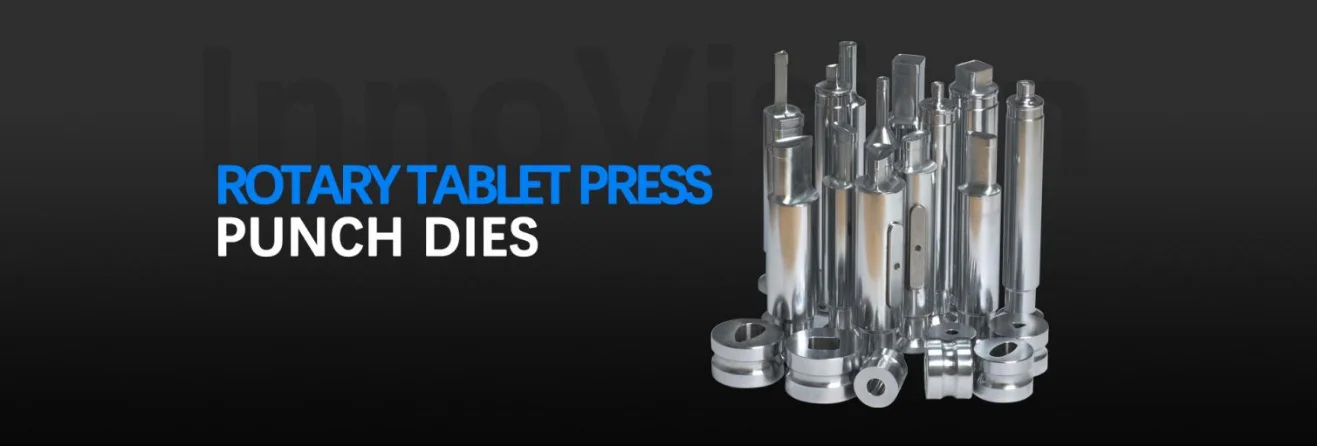
The sticker price is the smallest line in a press’s ten-year cost. Tooling comes first: punches are consumables, and a press built on standard B-tooling or D-tooling accepts replacement punches from any compliant supplier, while proprietary formats lock you into one source at 3–5× the lifetime price. Specify the standard, not the machine, when the two diverge.
Then there is documentation. Regulators evaluate equipment qualification — design, installation, operational, and performance qualifications — not just the hardware; the requirements for finished pharmaceuticals in 21 CFR Part 211 make that expectation explicit. Buying a press without IQ/OQ/PQ documentation in the sales scope means paying a consultant to reconstruct it later. Add spare-parts availability, FAT trial options, and remote support to the comparison, and the “cheaper” quote often is not.
How Grand Machinery Can Help
We build tablet press equipment for buyers at every stage of this decision: single punch presses for laboratories and specialty production, small rotaries for pilot scale — including models like the ZPT420 rotary tablet press — and industrial rotary lines for commercial output. Tell us your target tablets per shift, your formulation, and your tablet size — our engineers will tell you which class actually fits, and what your scale-up path should look like.
Request a quote with your production volume, and we will respond with a machine recommendation, tooling options, and the validation documentation your market requires.
FAQ
What is a single punch tablet press used for?
A single punch tablet press is used for formulation development, compressibility testing, and small-batch production of tablets. It is the standard machine in R&D laboratories and pilot plants, and it also serves as a production machine for specialty products such as candy tablets, mints, milk tablets, and short runs made from expensive active ingredients.
How many tablets per hour does a single punch tablet press make?
Typical output ranges from about 1,200 tablets per hour for manual models to roughly 6,000 tablets per hour for heavy electric models, because the machine forms exactly one tablet per cycle. Rotary presses, by comparison, start around 5,000 tablets per hour and scale past 1,000,000 depending on turret station count and speed.
What is the difference between a single punch tablet press and a rotary tablet press?
A single punch press uses one die and one punch set, producing one tablet per cycle with upper-punch compression. A rotary press carries multiple punch sets on a rotating turret, compressing many tablets in parallel from both punches at once. The rotary delivers far higher output and tighter uniformity; the single punch costs far less and changes over faster.
Can a single punch tablet press be used for commercial production?
Yes — but only for the right products. Below roughly 10,000 tablets per shift, or for specialty items like confectionery tablets and premium small-batch supplements, a single punch press is a legitimate production machine. For mainstream commercial volumes above that threshold, output economics favor a rotary press.
How much does a single punch tablet press cost?
Chinese-made single punch presses typically range from $375 to $900 for manual benchtop models, $1,200 to $2,500 for semi-automatic units, and $2,000 to $5,000 for heavier electric models with larger force and diameter capacity. These bands match the machine-class and price table in the ‘Single Punch Tablet Press Specifications at a Glance’ section above, and they reflect market transaction ranges we track across supplier quotes rather than a fixed list price. Instrumented laboratory presses with force-displacement recording sit higher, in the $8,000–$40,000 range.
Can one machine make different tablet shapes and sizes?
Yes. Tablet shape and size are determined by the punch and die set, so changing tooling changes the tablet — round, oval, capsule-shaped, square, or custom embossed. On a single punch press the changeover takes minutes and requires one tooling set, which is exactly why it remains the preferred machine for frequent shape and formulation changes.