Packaging automation for small batch production pays off sooner than most producers expect — but only when the automation level matches the batch size, the number of SKUs, and the changeover load that comes with them. This guide sets out the volume thresholds, the semi-automatic versus fully automatic decision, and a staged buying path so you can automate the bottleneck first instead of buying capacity that sits idle.
Key Takeaways
- “Small batch” spans roughly 100 to 500,000 units per run — and the right equipment differs completely across that range.
- Published planning benchmarks put full-line automation break-even between roughly 300,000 and 1,000,000 units per year depending on the packaging task; high-margin products justify automating earlier.
- Semi-automatic packaging cuts cost per unit from about $0.24 to about $0.127 on commonly published estimates — a gap that widens with every unit you run, and one you should recheck against your own labour rate.
- Changeover time, not machine speed, decides small batch economics: published plant data puts best-in-class lines at about 17 minutes against 50 minutes for laggards.
- Automate in stages. Buy the bottleneck machine first, connect stations into a small line second, and move to a recipe-driven full line only when volume and SKUs justify it.
What Counts as “Small Batch” Production?
Small batch production covers far more ground than the term suggests. In packaging terms it typically runs from about 100 units — clinical lots, influencer sampling, market tests — up to roughly 500,000 units for a regional commercial launch. Below that upper boundary, a line built for millions of identical units spends more time in changeover and cleaning than it does packaging.
Batch size ranges by production stage
Three working bands fit most of the projects we have quoted. Up to about 5,000 units per batch, manual workstations or tabletop machines are usually the honest answer. From 5,000 to 100,000 units, semi-automatic machines start to earn their keep. Above roughly 100,000 units per run — with recurring demand — fully automatic modular lines become defensible. The boundaries are not exact, and the next section shows why margin shifts them, but the bands are a better starting point than any brochure.
Where gummy and supplement brands typically sit
A startup supplement brand launching three SKUs often lives in the 5,000–50,000 unit band; a growing gummy brand with seasonal flavours and retail listings moves through the upper half of it. The packaging decisions are the same either way: which format — bottle, pouch, sachet — and which automation level. We cover format selection for these categories in our gummy packaging guide and our notes on packaging for supplements. If you are still planning the business itself, our guide to how to start a candy business walks through equipment and layout before automation enters the picture.
When Does Packaging Automation Pay Off?
The honest test is arithmetic, not enthusiasm. Two numbers decide it: the volume threshold for your packaging task, and the per-unit cost gap between manual and automated filling.
Volume thresholds by equipment type
One published planning benchmark puts the minimum efficient scale — the volume where automation beats manual packing per unit — roughly here. These are published planning thresholds, not measured values: use them as a starting point, then check them against your own labour rate and changeover time:
| Packaging task | Approximate annual volume where automation wins |
|---|---|
| Labeling and capping | ~300,000 units |
| VFFS bag making (snacks, powders) | ~500,000 units |
| Horizontal fill and seal (cartons, trays) | ~800,000 units |
| Liquid bottle filling | ~1,000,000 units |
Below those thresholds the machine’s fixed costs — depreciation, maintenance, the capital charge — exceed the labour it saves. Two exceptions move the line down: multi-product factories can pool volume across SKUs, and high-margin products can justify automation at lower volumes because consistency and presentation carry commercial value beyond the labour saving.
Per-unit cost: manual versus semi-automatic versus automatic
The per-unit cost worth trusting is the one you can reproduce yourself: cost per unit = (labour hours per 1,000 units × your fully loaded hourly rate) ÷ 1,000, plus material and scrap. Commonly published estimates land near $0.24 per unit for manual packing, $0.127 for semi-automatic and $0.107 for fully automatic, but those figures come from equipment vendors and assume US labour rates, so treat them as orientation rather than as your business case. On those figures the gap between manual and fully automatic is roughly $66,500 a year at 500,000 units — which is why a well-matched machine commonly pays for itself in one to two years. At 50,000 units the same gap is about $6,650 a year, and a $60,000 line stops making sense. Run the formula with your own rate: the per-unit figures, not the price tag, are what belong in the business case.
When high-margin products justify automating earlier
Supplements and functional gummies sit on the high-margin side of that exception. A mis-counted bottle or a wrinkled seal costs a retail listing, not just a unit. When the cost of inconsistency is high, semi-automatic automation can clear its payback test at volumes well below the printed thresholds — provided the rest of this guide’s conditions hold.
Matching the Automation Level to Your Batch Size
| Factor | Manual | Semi-automatic | Fully automatic |
|---|---|---|---|
| Typical output | Operator-limited | ~10–30 packs/min | ~40–150 packs/min |
| Operators per machine | 2–4 | 2–3 | 0.5–1 |
| Cost per unit | Highest | ~$0.13 | ~$0.11 |
| Reject rate | Variable | ~2–5% | ~0.5–1% |
| Changeover | None (retraining) | Fast | Slower without recipe storage |
| Typical investment | Minimal | Low–moderate | Moderate–high |
| Best fit | Under ~5,000/batch | 5,000–100,000/batch, high-mix | 100,000+/batch, stable SKUs |
What “semi-automatic” means on a real line
Semi-automatic does not mean incomplete. It means an operator loads or positions the product and the machine does the repeatable part: counting a fixed number of pieces, capping to a set torque, sealing at a controlled temperature. For a small batch producer the benefits are consistency and traceability rather than raw speed — every bottle sealed the same way is a compliance and brand asset.
When full automation is the wrong buy
The most expensive mistake in this category is buying a high-speed line and forcing small batches through it. Buyers who run 8,000–12,000 unit batches on equipment designed for 200,000-unit runs spend more time in changeover and cleaning than producing; the standard fix costs more upfront but pays back through recovered capacity. If your batch profile is high-mix, buy flexibility first and speed second.
The Staged Automation Path: What to Buy First, Second and Third
No producer should jump from hand packing to a full line in one purchase. The staged path below maps business signals to equipment, and it is the single most useful table in this guide:
| Stage | Trigger to move here | Typical equipment combination | Upgrade signal |
|---|---|---|---|
| 0 — Manual | — | Workstations, hand tools | Labor cost rising; quality complaints |
| 1 — One machine | 1 bottleneck step; recurring batches | One machine for the constraint: counting, sealing or labeling | The step moves elsewhere |
| 2 — Small line | Stable batches; 2+ manual steps left | Counting + capping + labeling, or a pouch line with manual infeed | Changeover load; operator overtime |
| 3 — Full line | Volume + SKU count justify it | Integrated, recipe-driven line with downstream automation | Capacity ceiling; new format demand |
Stage 1 — automate the bottleneck with one machine
Find the step where product waits longest. For bottled supplements that is usually counting; for pouch formats it is usually filling and sealing. A single automatic counting machine or a pre-made pouch machine at this stage converts the weakest step into the strongest one without a line rebuild. If bottles are the format, a counting bottling line configured for low volumes gives you the counting step with room to add stations later.
Stage 2 — connect stations into a small line
Once one machine pays back, the next constraint is usually hand-off: counted bottles waiting for caps, capped bottles waiting for labels. Adding a ZSG80 automatic capping machine and a sticker labeling machine turns three islands into a flow. Pouch-led producers do the same with a pouch packaging line or, at the smaller end, machines built for pre-made pouch packaging such as the DB300, with sachet formats covered separately in our sachet packaging guide.
Stage 3 — recipe-driven changeover on a full line
The final stage is not “a bigger machine”. It is an integrated, recipe-driven automated packaging line where format changes are stored as recipes: counting channels, filling volumes, sealing temperatures and label positions recalled from a screen. For producers running many SKUs, recipe storage is the difference between a full line that is an asset and one that is a very expensive single-SKU machine. Compact servo platforms such as the GM280T6 show how far miniaturised automation now reaches at the small end of this stage.
Changeover: The Cost That Decides Small Batch Economics
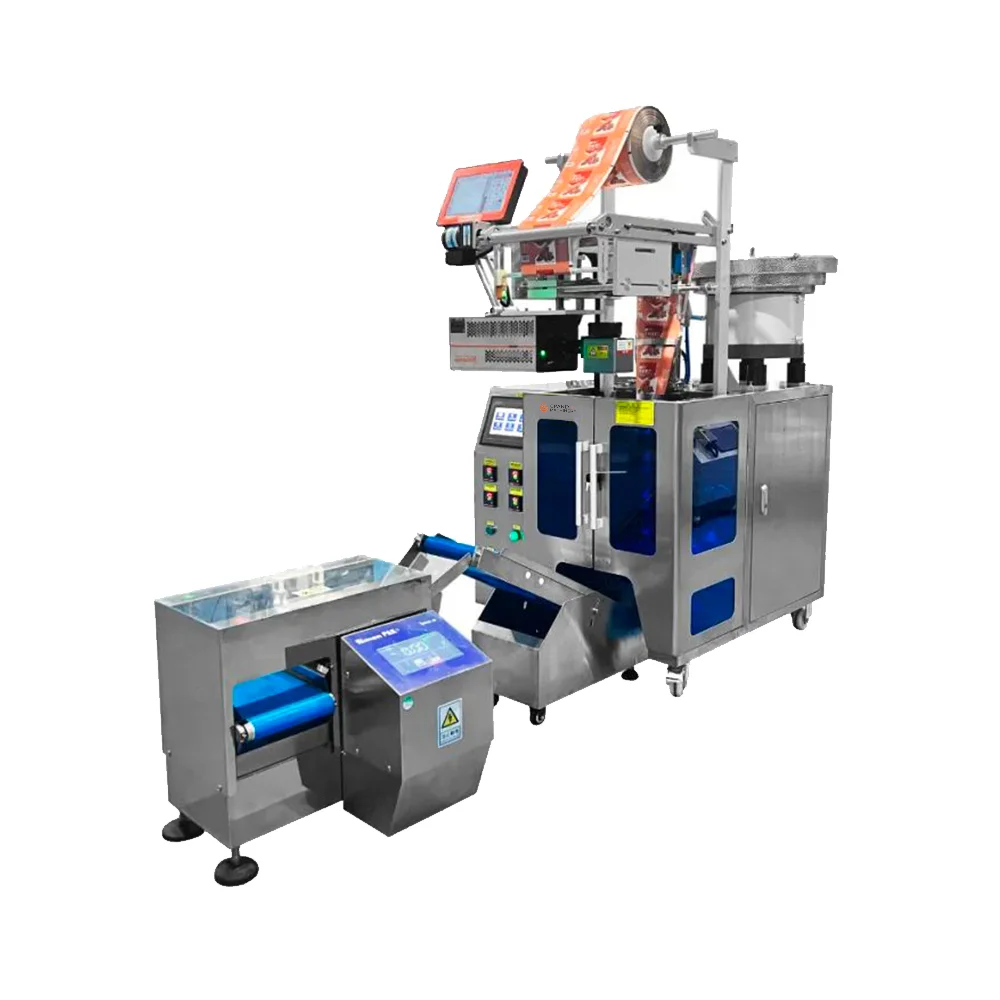
Changeover is the hidden tax on small batch production. Published plant data puts best-in-class packaging changeovers at about 17 minutes against 50 minutes for laggards (Shoplogix); traditional high-speed lines can take four to six hours. The gap is rarely the machine — it is whether format parts, film and settings are staged before the line stops. Across a month, that gap compounds fast:
| Changeovers per month | Time per changeover | Hours lost per month |
|---|---|---|
| 10 | 4 h | 40 h |
| 10 | 50 min | ~8.3 h |
| 10 | 17 min | ~2.8 h |
| 30 | 50 min | ~25 h |
A producer running ten changeovers a month saves roughly 5.5 productive hours per month by cutting changeover time from 50 minutes to 17 — before counting the scrap and re-start waste that long changeovers generate. Across a year that is about 66 hours of recovered capacity — close to a week and a half.
What to specify for fast changeover
Four features matter more than nameplate speed: tool-less or quick-release format parts, recipe storage on the controller, scale-free adjustment (dials and memory, not trial and error), and honest documentation of the cleaning procedure. Ask every supplier to state changeover time in minutes for your bottle sizes and your count range — and to demonstrate it.
Changeover versus buying a bigger machine
If changeover load is the constraint, a faster machine makes it worse: more capacity lost per changeover. Buying changeover capability — recipes, quick-change parts, a supplier who will run a changeover demo — is usually cheaper than buying speed, and it is the only purchase that helps every SKU you run.
Budgeting: Machine Price Is Not Project Cost
Machine price is the visible number; project cost is the real one. Comparing quotes at project level rather than machine level is the discipline that keeps small batch automation affordable.
Price bands by task and automation level
Typical market pricing puts entry-level sealing, labeling and carton-sealing machines in the hundreds to a few thousand dollars; flow wraps, counting machines and pouch machines sit mid-range; and fully automatic integrated lines start around $75,000–$80,000. Commonly published estimates put manual packaging at about $0.24 per unit, semi-automatic at $0.127 and fully automatic at $0.107, though those are vendor figures built on US labour rates — so the band you choose should come from your own per-unit arithmetic, not from the catalogue.
Installation, tooling, training and spare parts
On the projects we have quoted, installation, line integration, electrical work and operator training typically add 20–35% on top of the machine price, so a $120,000 line is realistically a $144,000–$162,000 project. Four adders decide whether a quote is complete: installation and commissioning, format parts for each SKU, operator training, and spare parts for wear components such as sealing jaws and drive belts. Ask what is included, ask for two reference customers with a similar product, and ask for a factory acceptance test you can attend. A supplier who will run a product trial with your own material before quoting is telling you something important — so is one who will not.
Automating Bottles, Pouches and Sachets at Small Batch Scale
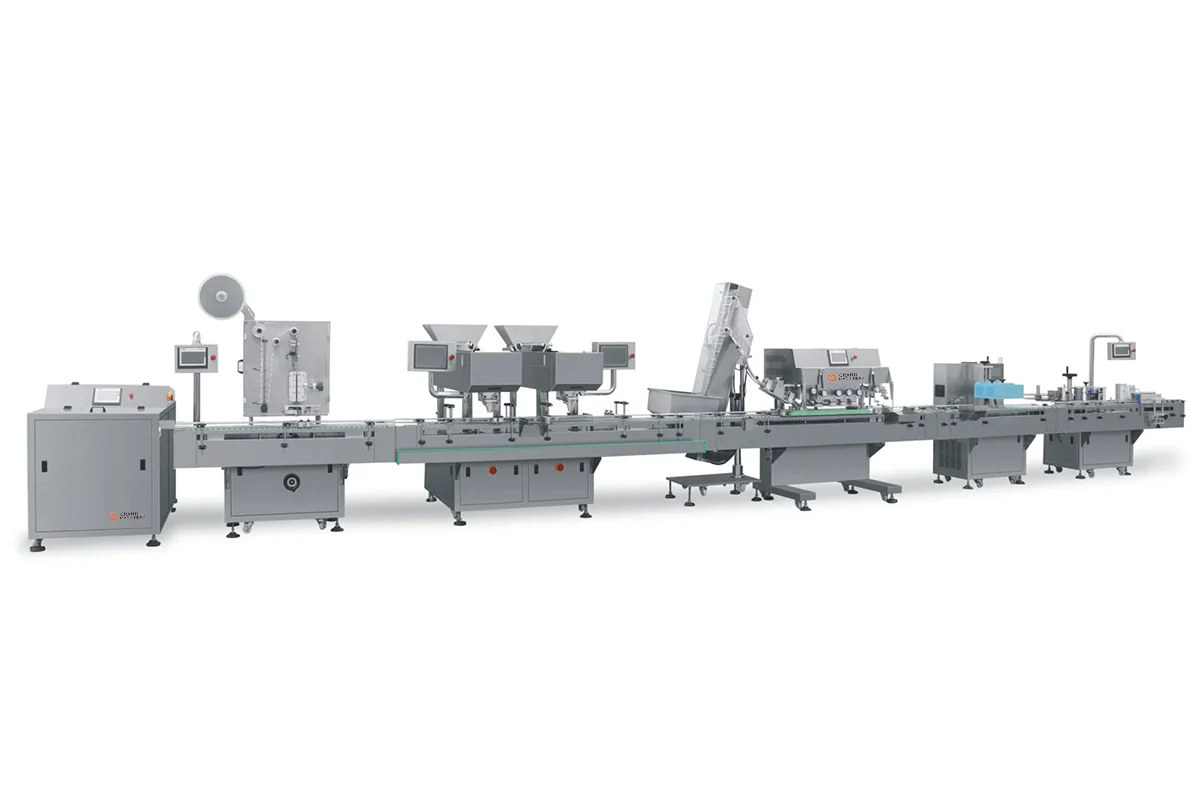
The format decides the machine before the budget does. Three formats cover most small batch supplement and confectionery work, and each maps to a different automation path.
Bottle lines: counting, capping, sealing and labeling
Bottled formats run on the same station sequence at every scale: unscramble, count, cap, seal, label, check. Counting is where small batch producers start, because it is the step where errors are most visible — a compact unit such as the GM16AE fills exactly that role. At small batch scale the sequence is identical to a full line — only the throughput changes — which is why a staged bottle line works: the counting station you buy first is the one you keep.
Pouch and sachet formats for small runs
Pouches and sachets dominate sampling, e-commerce and resealable retail formats. Pre-made pouch machines handle short runs well because the bag is already formed; VFFS bag making is more economical at higher volumes. Sachets sit at the small end and suit single-dose and sample formats.
Choose the format before the machine
A machine that runs pouches does not run bottles, and re-tooling mid-growth is expensive. Confirm the format your retail or e-commerce channel needs first, then buy the automation path that matches it — and confirm dosing accuracy against the metrology rules that apply in your market: in the United States, NIST Handbook 133 governs how the net contents of packaged goods are checked, and OIML R 87 sets the equivalent international requirements for the quantity of product in prepackages. Ask which of the two your market enforces before you sign.
Common Mistakes Small Producers Make
Buying speed you cannot fill
Rated speed is a test-cell figure. A machine rated at 1,200 units per hour rarely delivers it on a mixed-SKU small batch line once feeding, changeover and checks are real. Match the machine to your volume plus moderate growth, not to the number on the quotation.
Skipping the product trial with your own material
Product behaviour — stickiness, dust, shape variance — decides whether a machine runs or jams. Any supplier can demonstrate with their own product; insist on a trial with yours before the contract, and put the observed changeover time in writing.
New versus used equipment at small scale
Used machines save capital but can carry obsolete format parts and no validation history. If you buy used, buy only with documented maintenance records and confirm format parts are still manufactured. At small batch scale, a new semi-automatic machine with support usually beats an old automatic line on total cost of ownership.
Conclusion
Packaging automation for small batch production is not a single decision between manual and automatic — it is a sequence. Read your volume thresholds honestly, buy the bottleneck first, add stations when hand-offs become the constraint, and treat changeover capability as a purchase criterion equal to speed. Done in that order, each stage pays for the next.
Tell us your monthly volume, SKU count and packaging format, and we will map a staged automation path for your product — with a configuration and quotation for the stage you are actually at. Contact us to start with your current batch profile, not the one you hope to have in five years.
Where These Numbers Come From
We would rather show where each figure comes from than cite “industry benchmarks” without a source. The split is:
- Minimum efficient scale by packaging task — published planning thresholds from Lintyco’s packaging cost guide (2026).
- Changeover time, best-in-class versus laggard — plant data published by Shoplogix.
- Per-unit cost figures — vendor-published estimates that assume US labour rates. Calculate your own using the formula above.
- Batch-size bands and the 20–35% installation adder — drawn from our own project quotes, not from published benchmarks.
FAQ
How much does packaging automation cost for a small batch producer?
Semi-automatic single machines commonly sit in the low-to-mid five figures, and fully automatic integrated lines typically start around $75,000–$80,000. Installation, format parts and training usually add 20–35% on top of the machine price, so budget at project level.
What batch size justifies packaging automation?
Published planning benchmarks put break-even for full automation between roughly 300,000 and 1,000,000 units per year depending on the task, while semi-automatic machines can pay back well below that — especially for high-margin products where consistency carries commercial value.
Is semi-automatic or fully automatic better for small batch production?
For batches of roughly 5,000–100,000 units with changing SKUs, semi-automatic is usually the better fit: lower investment, faster changeover, and most of the consistency benefit. Fully automatic lines suit stable SKUs above roughly 100,000 units per run.
How long does payback take on packaging automation?
Most semi-automatic installations pay back in one to two years through labour savings; fully automatic lines typically take longer and depend on shift utilisation. The calculation is your current manual cost per unit versus the machine’s, at your real volume.
What hidden costs should I budget for besides the machine?
Installation and commissioning, format parts for every SKU, operator training, spare parts for wear components, and the downtime cost of changeovers. Together these commonly add 20–35% to the machine price.
Can I automate in stages instead of buying a full line?
Yes, and for small batch producers it is usually the better path. Buy the bottleneck machine first, connect stations into a small line second, and move to a recipe-driven full line only when volume and SKU count justify it — each stage should pay for the next.