
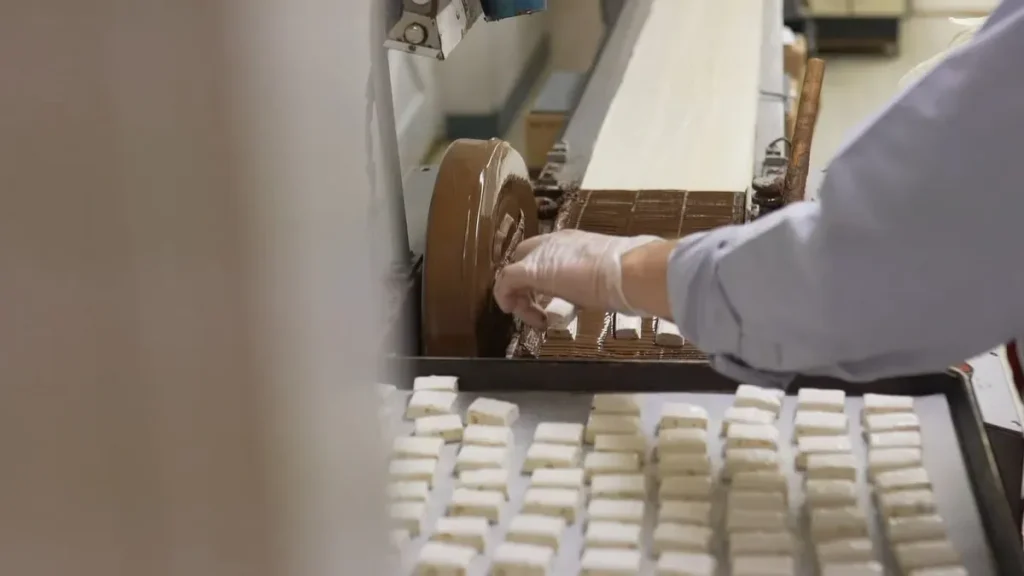
Turning a love of sweets into profit feels thrilling. Startup numbers shift with scale and product type. A home kitchen needs far less than a retail shop. A typical candy store still demands roughly $75,000 in startup capital. That figure covers rent, fixtures and initial inventory. A cotton candy business can begin leaner. Basic machine rentals run $75 to $150 per day. This guide walks through equipment, layout and a full cost breakdown. Readers learn how to start a candy business without hidden surprises. Each step builds on the last. The path stays clear from first idea to opening day.
Key Takeaways
- Start small to reduce risk and grow your candy business step by step.
- Buy essential equipment like a digital thermometer and electric cooker first.
- Plan your production layout with separate zones for cooking, forming, cooling, and packing.
- Calculate your costs carefully to set a profitable price for each candy.
- Get expert help for equipment setup to save time and avoid mistakes.
How to Start a Candy Business: Planning and Research
Planning and research come first for anyone learning how to start a candy business. This phase decides whether the venture succeeds or stalls. Two questions matter most. What will you make? How big will you start?
What Product Will You Make?
Candy covers a wide range. Hard candy, gummies, and specialty chocolates each need different skills and ingredients. A cotton candy business needs sugar and a machine. A chocolate shop needs tempering equipment and cool storage. Pick one product line first. Then study raw material costs. Sugar, corn syrup, chocolate, and flavorings drive your unit cost. Track every ingredient price before you set a retail price.
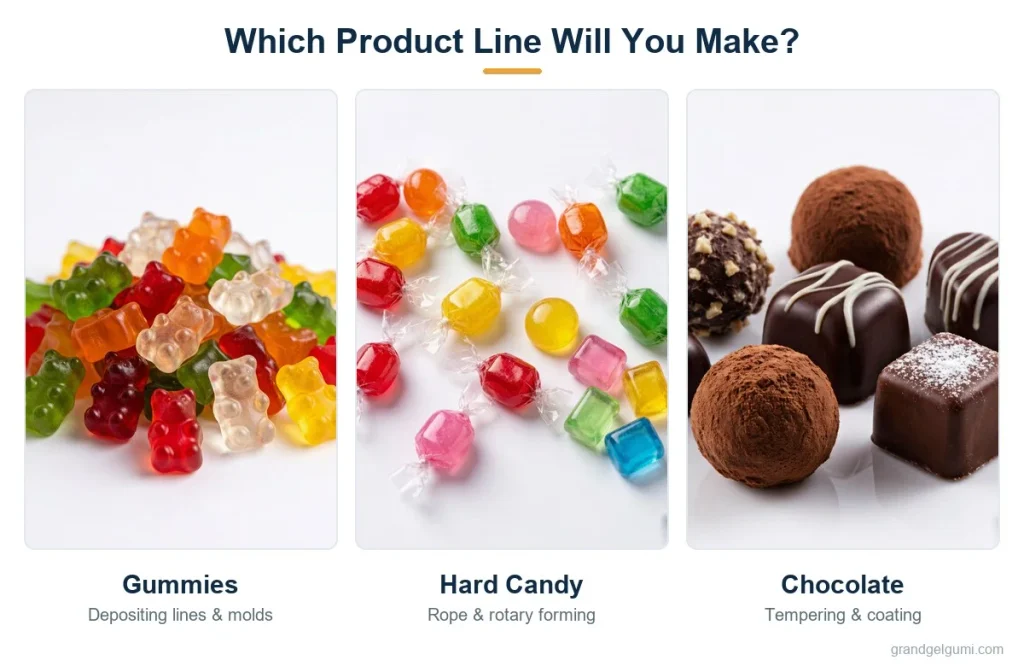
Local demand deserves equal attention. The U.S. candy market was valued at USD 16.95 billion in 2024. It should grow at 4% CAGR through 2033. National growth does not guarantee local sales. Study your area with real data. Several tools help:
- Bizminer provides industry financial averages, ratios, failure rates, and local market statistics by state, city, county, or zip. Search under “Confectionery Stores.”
- Mergent Intellect finds competitors by location and industry, such as SIC 5441 Candy stores.
- Simply Analytics offers demographic, business, and marketing data at the local level.
Visit a competing candy store. Note prices, traffic, and best sellers. Every candy store needs a clear product focus. This research shapes your candy business plan. Test recipes before opening.
Choosing Your Starting Scale
Scale decides your costs and your risk. A home kitchen suits small batches. A shopfront needs rent, fixtures, and staff. A physical candy store carries higher risk. Most beginners underestimate the gap between these two paths. Write a business plan that matches your chosen scale. An effective business plan lists your products, target customers, and startup costs. It also projects revenue for the first year.
Funding follows the plan. Personal savings, small business loans, and crowdfunding all work. Lenders want numbers, not enthusiasm. Show them your cost per piece and your break-even point. A small candy business can grow step by step. Start smaller than you think you should. You can expand after opening day proves demand.
Equipment You Need to Start a Candy Business
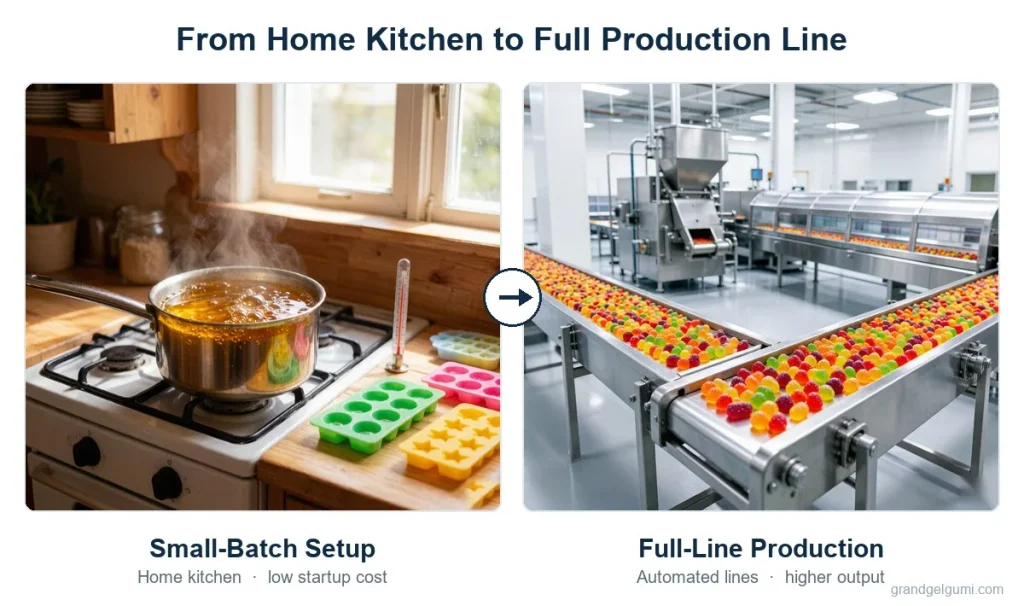
The right equipment depends on your scale. A home-based candy business needs far less than a full production line. Start with the essentials, then upgrade as demand grows.
The Minimum Equipment Set for Small-Batch Production
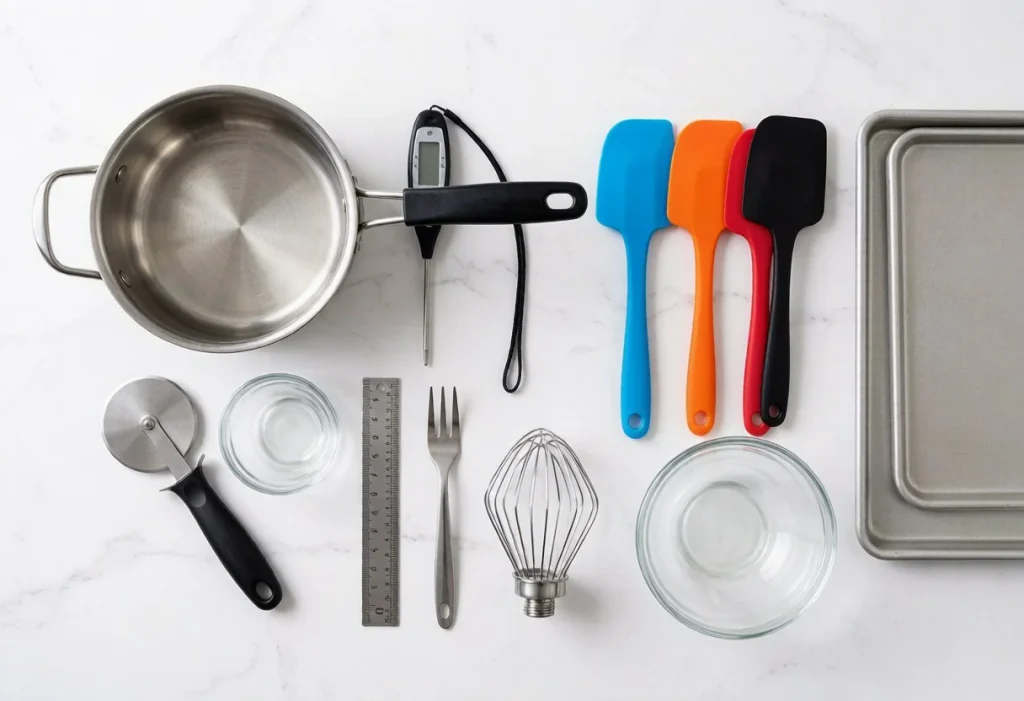
A scientific long-stem digital thermometer is non-negotiable. Hard candies require readings up to 310°F. Buy one from a scientific supplier for accuracy. An electric cooker with its own heating element gives consistent results without stovetop limits. Add high-heat spatulas with long handles, a planetary mixer for aerating marshmallows and nougat, and an 18-inch pizza cutter for sheet pans. A metal ruler ensures precise sizing. A three-pronged chocolate dipping fork, a scraper, and glass bowls round out the basics. Sheet pans in 9×13, 12×17, and 8×6 sizes replace expensive metal frames. Basic items like pots, gummy molds, and thermometers can be affordable.
What Changes When You Move to Full-Line Production
Scaling up transforms every stage. Cooking moves to jacketed cookers or dissolving tanks with steam or electric heating. Forming shifts to a gummy depositor and molds for gummies, or rope and rotary forming machines for hard candy. Cooling tunnels sized for line speed replace countertop cooling, with panning drums for surface finish. Packaging adds count or weight-based fillers, flow wrappers, and vertical form fill seal machines. A commercial chocolate tempering machine runs $25,000 to $30,000, while a home-use unit starts near $4,000.
Permits apply at every scale. You need a business license, health department permit, and sales tax permit. A home kitchen falls under cottage food laws; a commercial storefront faces stricter rules. Check local zoning before opening. Many residential zones limit home-based businesses.
| Zoning Consideration | Requirement |
|---|---|
| Home business allowed | Local codes decide; many prohibit it |
| Permit vs. as-of-right | Code specifies which applies |
| On-site sales | Some codes ban customers at home |
Retail Residential Kitchens must also comply with all applicable municipal laws and zoning ordinances. Please consult the Building Department prior to applying for your Cottage Kitchen permit.
Planning Your Production Layout
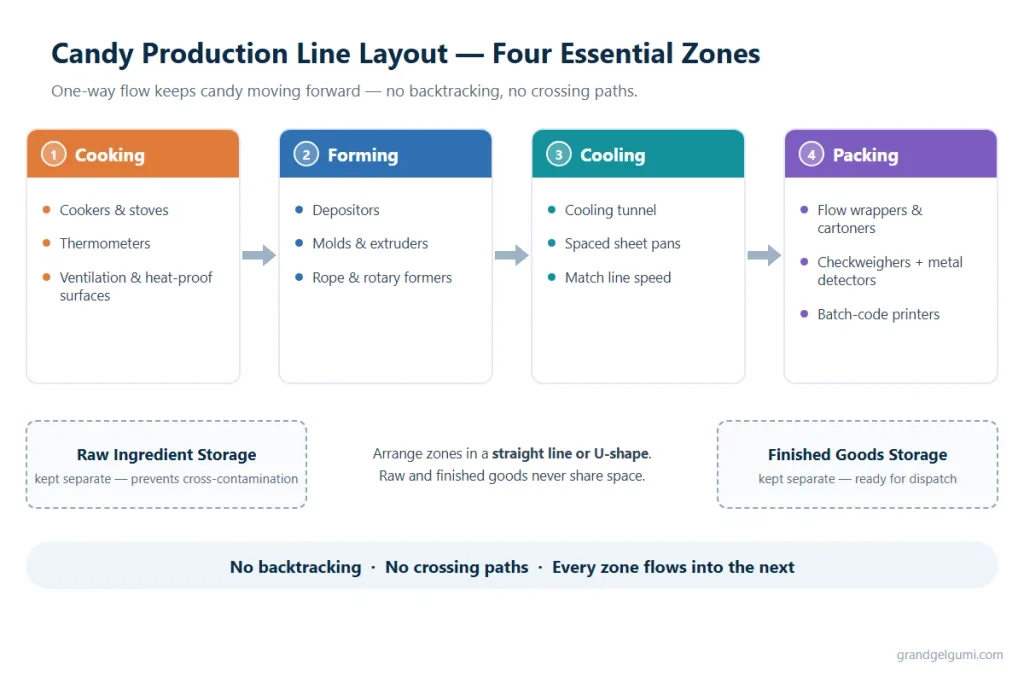
A well-planned layout makes a candy business run smoothly. Poor layout wastes time and money. Every square foot should serve a clear purpose. For those learning how to start a candy business, the production floor needs careful thought before a single machine arrives. For larger operations, complete production line solutions should be planned around the product flow, equipment capacity, and available floor space.
A small candy store can start with a basic layout. A full production line demands more zones. The $75,000 benchmark for a retail store includes layout design. A cotton candy business can operate with a simpler setup. Equipment rental at $75 per day keeps the initial cost low. Planning before opening saves money. Layout matters at every scale. Every candy business benefits from organized zones and clear traffic patterns.
Key Zones: Cooking, Forming, Cooling and Packing
Every candy production area needs four distinct zones. The cooking zone holds stoves, cookers, and thermometers. This area needs heat-resistant surfaces and good ventilation. The forming zone shapes the candy. Depositors, molds, and extruders sit here. The cooling zone allows candy to set before packaging. A cooling tunnel or spaced sheet pans work. The packing zone handles all wrapping and boxing.
The packing zone holds the most equipment. Flow wrappers seal individual pieces. Pouch packaging machines handle bagged products. Cartoners prepare boxes for display. Inline printers stamp batch codes and expiration dates onto wrappers. Checkweighers confirm each package meets weight requirements. Metal detectors scan for contamination. Some lines include X-ray systems that find glass fragments, dense plastic, and stones. Vision systems verify seal integrity, label position, and barcode readability. These machines catch problems before products leave the candy store.
Each zone must flow into the next. Candy moves from cooking to forming to cooling to packing. No backtracking. No crossing paths. A straight line or U-shape works best. This reduces labor and increases output. A chocolate tempering machine sits in the cooking zone. The $25,000 to $30,000 unit needs space and power. Cooling equipment must match production speed. A bottleneck in one zone slows the entire line.
Separate areas for raw ingredients and finished goods prevent cross-contamination. Raw sugar and corn syrup should never share space with packaged candy. Color-coded PPE keeps allergens from spreading between zones. This layout choice protects product quality and customer safety.
The Most Common Layout Mistakes
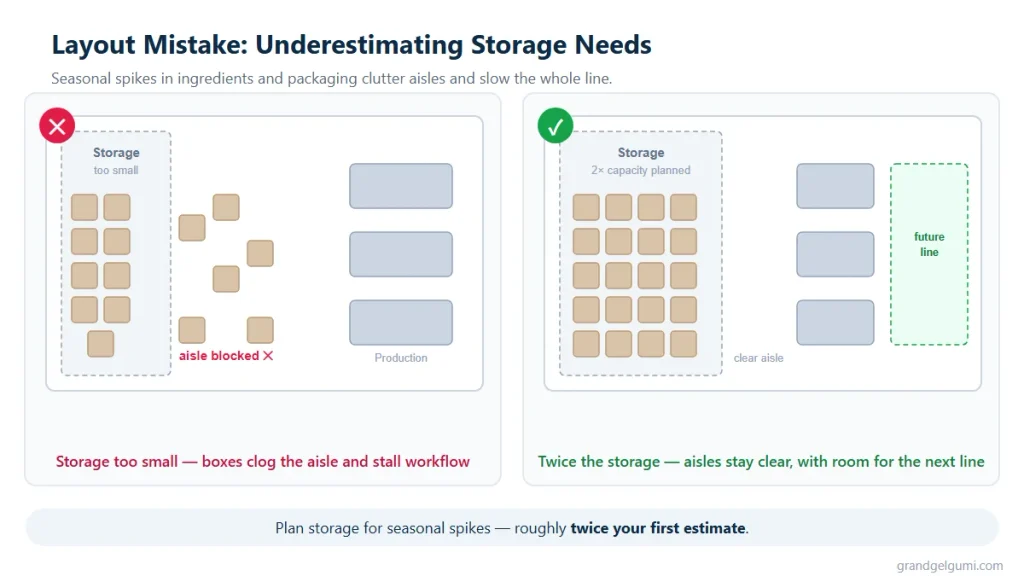
Small candy businesses make predictable errors. Underestimating storage needs tops the list. Seasonal spikes in ingredients and packaging clutter aisles. A cramped storage area slows workflow and frustrates staff. Plan for twice the storage space you think you need.
Neglecting ventilation and temperature control causes quality problems. Improper airflow affects candy texture and creates safety hazards. Hard candy needs low humidity. Chocolate needs cool temperatures. A poorly ventilated cooking zone reduces productivity.
Failing to plan for future growth forces costly renovations later. A layout that fits today may not fit next year. Reserve space for additional equipment or expanded production lines. A candy store can add display shelves and a checkout counter as sales grow. The production area must leave room for more machines.
Layout mistakes also create contamination risks. Shared equipment lines without verified cleaning transfer residue between product runs. Operator movement between allergen and non-allergen zones spreads cross-contamination. A well-designed layout controls these risks. Designate separate areas for processing raw ingredients and ready-to-eat foods. This separation prevents pathogens or allergens from contaminating finished goods.
Every candy store should review its layout before a grand opening. A smooth flow reduces labor, speeds production, and increases sales. The right equipment matters. The right arrangement matters more.
Cost Breakdown: What It Really Takes to Start
Equipment, Facility and Operating Costs
Every candy business requires investment in three areas. Equipment, facility, and operating expenses each need attention. A clear breakdown helps anyone learning how to start a candy business avoid surprises.
Equipment expenses vary by scale. A cotton candy business can begin with a $75 per day machine rental. A commercial chocolate tempering machine runs $25,000 to $30,000. The cost of opening a candy store typically reaches $75,000. This figure includes shelving, counters, and initial stock. Small home operations need much less.
Facility expenses include rent, utilities, and insurance. A candy store in a high-traffic area attracts more customers but demands higher rent. Home kitchens reduce facility spending greatly. Check local zoning before signing a lease.
Operating expenses require precise tracking. Calculate total ingredient cost for a batch first. Add packaging fees, labor fees, and overhead. Compute total expense per batch. Then compute expense per unit. Set a profit margin and calculate selling price. For example, a batch of 24 candies with ingredient expense $9.87, packaging $0.50, labor $29.25, and overhead $1.97 totals $41.59. Expense per candy becomes $1.73. With a 50% profit margin, selling price equals $1.73 divided by (1 minus 0.50), or $3.46. Round up to the nearest $0.50 or $1.00.
Funding options include personal savings, small business loans, and crowdfunding. Lenders expect a solid business plan with financials. Secure funding before purchasing equipment or signing a lease. Seek funding from multiple sources to reduce risk.
What Most Beginners Underestimate
Most beginners underestimate packaging expenses. Custom packaging involves many hidden fees. New candy store owners often overlook these charges.
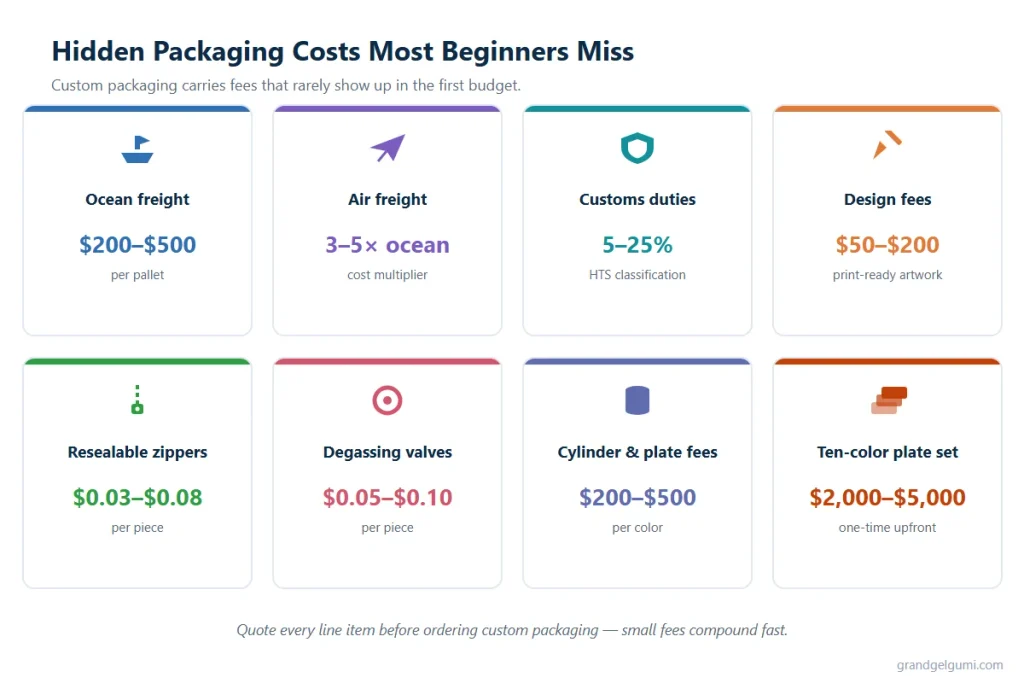
| Hidden Cost Category | Estimated Amount |
|---|---|
| Ocean freight | $200–$500 per pallet |
| Air freight | 3–5x more than ocean |
| Customs duties | 5–25% depending on HTS classification |
| Design fees (print-ready artwork) | $50–$200 |
| Resealable zippers | $0.03–$0.08 per piece |
| Degassing valves | $0.05–$0.10 per piece |
| One-time cylinder/plate fees | $200–$500 per color |
| Ten-color design plate fees | $2,000–$5,000 upfront |
Labor expenses also surprise new owners. Paying yourself a fair wage prevents burnout. Track every hour spent on prep, cooking, and packaging. A business plan should include these figures.
Marketing expenses add up quickly. Budget for a grand opening event. Plan a grand opening promotion. Use the grand opening to build buzz. Offer free samples. Use social media for launch announcements. Partner with local businesses. Marketing strategies should begin before opening day.
Every beginner must calculate unit economics. A candy store that ignores these numbers will struggle. Another business can start lean and grow. A cotton candy business with proper planning can succeed on a smaller budget. Opening a second location requires proven profitability. Packaging costs often catch beginners off guard. This plan keeps spending in check.
How to Start a Candy Business: Key Takeaways and Next Step
Your First Three Moves
The research phase ends with action. Three moves turn a candy business idea into a real operation. First, validate the concept and write a basic business plan. Outline the product, target market, and initial financial projections. This plan becomes the foundation for every later decision. Second, register the business and apply for permits. Choose a name, select a structure such as a sole proprietorship or LLC, and apply for an EIN from the IRS. Research local health department rules, seller’s permits, and zoning codes. A home kitchen follows cottage food laws. A retail store faces stricter commercial requirements. Third, source equipment and plan the first marketing push. Create social media accounts and line up the first event or location.
These moves apply to every scale. A cotton candy business can finish them in weeks. A full candy store may take months. The cost of each step varies, but the sequence stays the same. Secure funding before signing a lease or buying machines. Lenders want to see a complete business plan with real numbers. Personal savings, small business loans, and crowdfunding all remain viable options.
Getting a Configuration Recommendation
Equipment configuration confuses many new owners. Professional guidance removes the guesswork. Grand Machinery offers consultation for candy production equipment configuration. Our team provides tailored guidance via email, phone, or WhatsApp. Services include custom equipment design, formula creation, layout planning, SOPs, installation, training, and after-sales care. We bring over 20 years of confectionery machinery expertise.
Basic depositors suit small-batch production and cost $5,000 to $20,000. Automated production lines serve large-scale operations and start above $20,000. Compare brands, read reviews, and evaluate materials before buying. Invest in high-quality essential equipment and choose budget-friendly options for secondary tools. Consider gently used machines from online marketplaces or candy-making forums. Stay flexible with brands and materials. Multi-use tools maximize value. A well-configured candy store runs efficiently from the grand opening onward.
Four phases carry a new candy business from idea to opening day. Planning comes first. Legal setup follows. Equipment and cost analysis come next. Funding and launch complete the path. The $75,000 figure is a benchmark, not a rule. A cotton candy business can start smaller by renting equipment and working from a home kitchen. Finish your market research. Then take one concrete step, such as writing a business plan or calling the health department. A candy store grows from steady effort. A second candy store follows proven demand. Every grand opening begins with a single decision. Every candy empire started with a single sweet idea. Your journey begins now.
FAQ
What license do you need to open a candy store?
You need a business license, a health department permit, and a sales tax permit. A home kitchen falls under cottage food laws. A commercial storefront faces stricter rules. Check local zoning before opening. Requirements vary by state and city.
How much does it cost to start a small candy business?
A home-based candy business costs far less than a retail shop. A typical candy store needs about $75,000 in startup capital. A cotton candy business can rent a machine for $75 per day. Scale decides your total investment.
Can I start a candy business at home?
Yes. Cottage food laws allow home kitchens to produce certain candies. Check your local zoning rules first. Many residential zones limit home-based businesses. A home setup reduces facility costs. You can upgrade to a commercial space later.
How do I sell candy online?
Build an online store with clear product photos and prices. Calculate your cost per piece before setting prices. Use social media to promote your opening. Ship products in sturdy packaging. Online sales expand your reach beyond a local store.
What equipment do I need first?
Start with a digital thermometer, an electric cooker, and high-heat spatulas. Add a planetary mixer and sheet pans. A chocolate tempering machine costs $25,000 to $30,000 for commercial use. Rent equipment when possible to lower your opening costs.