
간단한 답변: An angle of repose test measures the slope of a powder pile relative to a horizontal surface. Calculate the angle from the pile height and base radius. Pharmaceutical and nutraceutical manufacturers use this measurement to screen powder flow before tablet pressing and investigate feeding problems. Combine the result with other material tests and actual press observations.
주요 내용
- Measurement: A smaller angle generally indicates easier powder movement in comparable tests.
- Calculation: Use the height and radius of a symmetrical powder cone in the same units.
- 방법: Control the funnel, base, sample handling and vibration; record repeated determinations.
- Tableting: Relate the laboratory result to feeding, die filling and individual tablet weights.
- Limitation: The angle is a relative screening result, not a universal acceptance limit for a press trial.
What Is the Angle of Repose?
The angle of repose is the slope of a cone-like powder pile relative to a horizontal surface. Particles falling onto a pile can roll, slide or remain where they land. Their resistance to movement influences the slope formed under a particular test method.
Powders that spread readily usually form shallower piles; cohesive materials may produce steeper ones. In pharmaceutical and nutraceutical production, the test can help characterize excipients, vitamin and mineral blends, granules, direct-compression mixtures and effervescent tablet formulations.
Use it to compare batches of a known material or investigate changes in handling behavior. The selected measurement procedure must stay consistent. USP General Chapter ⟨1174⟩ includes angle of repose among multiple techniques for assessing powder flow. [1]
Angle of Repose Formula and Calculation
For a symmetrical cone on a level base, the angle is calculated from the ratio of its vertical height to its base radius. The diameter is twice the radius.
| Symbol | Meaning |
|---|---|
| θ | Angle of repose (degrees) |
| h | Vertical powder pile height |
| r | Base radius |
| D | Base diameter |
Worked example
A hypothetical sample forms a pile 5 cm high with a diameter of 16 cm. Its radius is 8 cm. Calculate arctan(5/8), which gives approximately 32.0°. Keep both dimensions in the same unit and ensure the calculator returns degrees rather than radians.
Angle of Repose Calculator
Enter the pile height and base diameter in the same unit.
Illustrative geometric calculation only. If either dimension is invalid, or a symmetrical cone cannot be formed, do not interpret the output as a measured flow result.
Compare three illustrative powder samples
| Sample | Height | Radius | Angle |
|---|---|---|---|
| A | 4 cm | 8 cm | 26.6° |
| B | 5 cm | 8 cm | 32.0° |
| C | 8 cm | 8 cm | 45.0° |
All three values are mathematical examples rather than GRAND test results. Sample C has a steeper slope than A and B, which may prompt further flow investigation if comparable laboratory measurements were obtained.
How to Perform an Angle of Repose Test
A common static method uses a funnel and level base to produce a measurable powder cone. Select the apparatus dimensions and sample conditions according to the laboratory's established procedure. The setup can include an adjustable funnel, fixed base, height gauge and representative sample.
1. Prepare the sample
Identify the batch and sampling location. Record conditioning and handling history, including relevant environmental conditions. Avoid changes to the powder during collection and transfer.
2. Set up the apparatus
Align the funnel over a stable, level base. For the recommended arrangement in USP ⟨1174⟩, the fixed base has a raised rim to retain a layer of material. Keep vibration away from the apparatus.
3. Form a symmetrical cone
Discharge the powder carefully. In this arrangement, adjust the funnel height during deposition so the outlet remains about 2–4 cm from the cone's growing peak. This reduces disturbance from incoming particles. [1]
4. Measure the pile
Record the vertical pile height and base diameter. Check the shape before using the geometric formula. If the sample repeatedly forms an irregular pile, record that observation and choose another appropriate flow characterization method.
5. Record and repeat
Calculate the angle and repeat the determination under the same procedure. Retain individual readings, relevant deviations and the laboratory's chosen summary statistics. A single numerical result cannot show repeatability.
How to Interpret Angle of Repose Results
The Carr-based relative ranking reproduced in USP ⟨1174⟩ provides a descriptive comparison for powder flow. The categories are not validated process specifications for a tablet press. [1]
| Angle (degrees) | Relative flow character |
|---|---|
| 25–30 | 훌륭합니다 |
| 31–35 | 좋아요 |
| 36–40 | Fair |
| 41–45 | Passable |
| 46–55 | 가난한 |
| 56–65 | Very poor |
| Above 66 | Very, very poor |
Ranges are presented as printed in the reference, including its boundary gaps. Apply established reporting and rounding rules and do not assign a category outside the stated ranges without a documented rationale. For example, the illustrative 32.0° result is described as good under this ranking.
What does a high angle mean for production?
A steep cone can signal increased resistance to particle movement. The production question is whether powder reaches the feed system and dies consistently at the intended settings. Some blends with relatively poor laboratory flow can be processed under suitable conditions; the angle alone cannot determine tablet quality or attainable speed.
Factors Affecting the Angle of Repose of Powder
Material characteristics and test conditions can both influence the measurement. Investigate changes before assigning them to a formulation.
| 요인 | Potential influence | What to check |
|---|---|---|
| Particle size distribution | Packing and particle interactions | Fines and size distribution |
| Particle shape | Rolling and interlocking | Morphology |
| Moisture | Cohesion or agglomeration | Storage and moisture content |
| Electrostatic effects | Adhesion during handling | Equipment materials and handling |
| Funnel geometry | Discharge and pile formation | Outlet and setup dimensions |
| Vibration | Rearrangement of particles | Apparatus stability |
Keep measurement conditions comparable between batches. Two powders with similar moisture readings can behave differently because of particle shape, composition and other material characteristics.
Why Powder Flow Matters in Tablet Pressing
A rotary tablet press repeatedly fills dies, compresses powder and ejects tablets. Consistent supply to the feeding area helps maintain the intended quantity of material entering each die.
Hopper and feeding system
Cohesive powder may discharge intermittently or adhere to surfaces. Investigate the material and hopper or feeder configuration rather than assuming that an angle measured in a laboratory explains every production event.
Die filling and weight variation
Tang and colleagues studied three grades of microcrystalline cellulose using a model rotary filling system. Their experiments associated poorer powder flow with greater variation in fill weights. This supports examining material handling when tablet weights vary. [2]
Turret speed and feeder conditions
Faster turret movement can shorten the time a die spends below the feeder. Schomberg and colleagues evaluated five formulations and observed incomplete filling and higher weight variability under certain high-speed conditions. They also observed effects related to powder densification and feeder operation. [3]
These findings are research observations, not performance guarantees for GRAND machines. Record operating conditions and compare individual tablet weights with feeding and filling observations. See Tablet Defects: Causes, Types & Remedies for related process investigations.
Angle of Repose vs. Tapped Density
These tests characterize different aspects of a powder. Neither alone fully explains flow through an actual feeding system.
| Measurement | Angle of repose | Tapped density |
|---|---|---|
| Result | Pile slope | Mass per tapped volume |
| Unit | Degrees | g/mL |
| Principle | Powder cone formation | Settling of a powder bed under tapping |
| Use | Relative flow screening | Powder packing assessment |
| Limitation | Sensitive to cone formation | Does not directly measure dynamic feeding |
Compare both results with recorded press observations. When two tests provide different indications, review the procedure and sample before drawing a conclusion. Other methods may include density-derived indices, discharge testing and shear testing. Read 타프 밀도란 무엇인가? 정제 제조 전 이를 측정하는 방법 for the density calculation and sample handling procedure.
Troubleshooting Powder Flow Before Tableting
Use unusual laboratory results or production observations to identify questions for the next investigation. Avoid changing several process variables simultaneously.
| 관찰 | Possible cause | Suggested investigation |
|---|---|---|
| Powder stops at funnel | Cohesion or unsuitable outlet | Confirm sample and procedure suitability |
| Cone is asymmetric | Uneven discharge or unstable setup | Check alignment and vibration |
| Replicate results vary | Sampling or procedural variability | Review preparation and measurements |
| Hopper flow is intermittent | Bridging or wall adhesion | Examine feed behavior and material properties |
| Tablet weight varies | Filling or process conditions | Compare individual weights with recorded settings |
When cone formation is unsuitable, consider another approved method. Formulation changes, including granulation or flow-promoting excipients, require the appropriate development and quality assessment.
Connect laboratory and press records
In a hypothetical investigation, two batches could have similar measured angles but different tablet weight distributions. Compare sampling location, handling history, hopper refill events and press settings before attributing the difference to the material. Define the next trial question and use the approved plan to investigate it.
Powder Flow Checks Before a Tablet Press Trial
Prepare a technical brief linking the material test to the intended tablet and production requirements. The objective is to establish comparable operating and quality records rather than predict compatibility from one flow number.
| Information | 목적 |
|---|---|
| Product and batch identity | Connect lab results to the actual blend |
| Particle size distribution | Characterize relevant material properties |
| Angle of repose and replicate readings | Document relative flow screening |
| Bulk and tapped density | Assess packing behavior |
| Tablet weight, dimensions and shape | Define intended product and tooling |
| Target output | Set trial objectives |
| Required quality attributes | Agree on evaluation criteria |
During the trial, record the proposed configuration, hopper and feed behavior, turret settings and filling conditions. Depending on the product specification, evaluate tablet weights, appearance, dimensions, breaking force and friability. Our tablet hardness testing guide describes another part of the evaluation.
Rotary tablet press selection
그 GRAND ZPT420 Rotary Tablet Press is an example of downstream tableting equipment. A separate laboratory setup performs the angle of repose test. Machine configuration and formulation compatibility should be assessed against target tablet specifications and material trial evidence.
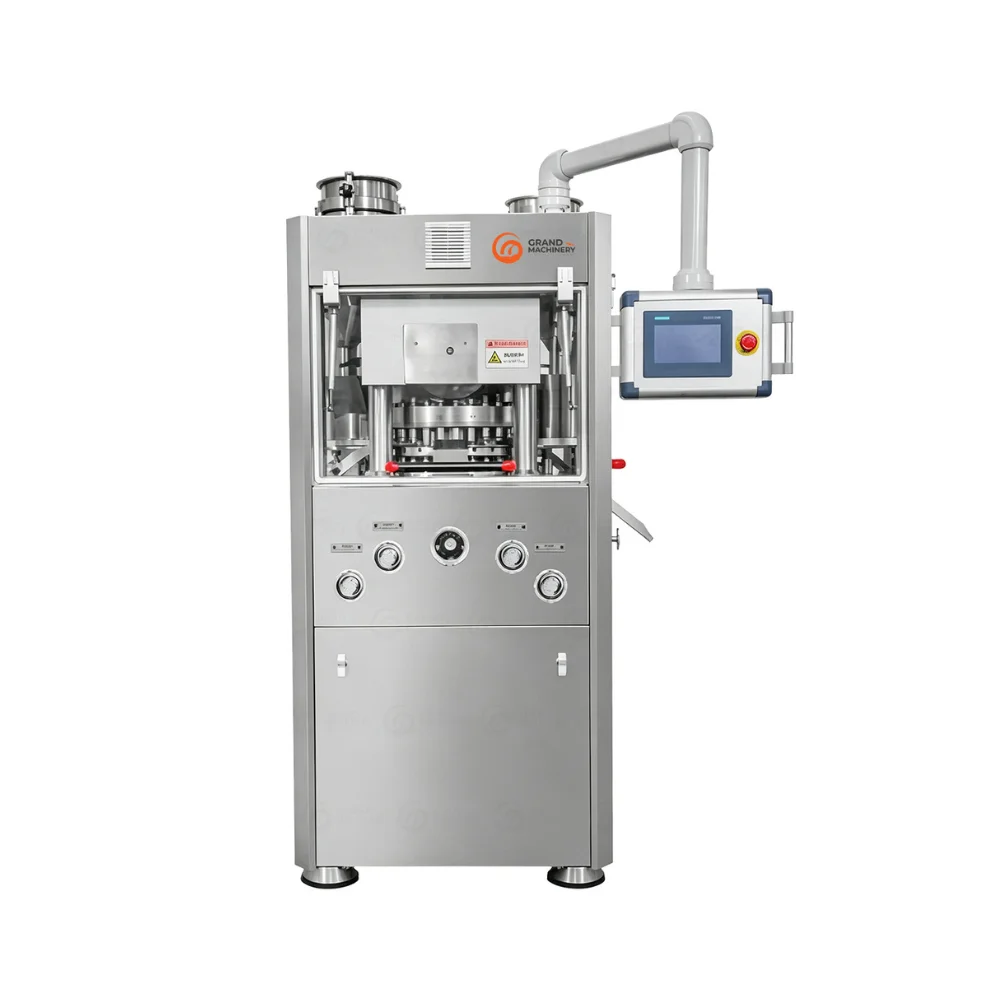
Explore the GRAND rotary tablet press range to discuss a suitable machine configuration.
자주 묻는 질문
What is a good angle of repose for pharmaceutical powder?
The referenced relative ranking describes 31–35° as good flow. Actual acceptance criteria depend on the formulation, approved process requirements and production evidence.
What is the formula for the angle of repose?
Calculate θ = arctan(h/r), or arctan(2h/D), where h is the vertical pile height, r is the base radius and D is the base diameter.
Is a lower angle of repose always better?
A lower angle usually suggests easier flow in comparable tests. Segregation, packing and compression behavior are also important.
Can the angle of repose predict tablet hardness?
It cannot predict breaking force directly. Formulation, tooling geometry and compression conditions are among the relevant variables.
Why do repeated measurements differ?
Sampling, conditioning, apparatus geometry, vibration and pile shape can affect the measured result.
What if the powder cannot form a symmetrical cone?
Record the observation and select a suitable alternative flow characterization method rather than forcing a numerical result.
Is the angle of repose test sufficient for press selection?
No. Consider the target tablet, material characteristics, production requirements and documented trial results.
결론
An angle of repose test helps tableting teams compare powder behavior when sample preparation and test conditions are consistent. Use the measured angle alongside other characterization methods and the intended press trial. The laboratory result is a starting point for investigation, and manufacturing performance must be evaluated using the actual blend and documented process conditions.
기술 참고 자료
- United States Pharmacopeia. General Chapter ⟨1174⟩, Powder Flow, Stage 4 Harmonization. Official May 1, 2024. See also the official USP-NF chapter preview.
- Tang X, Zakhvatayeva A, Zhang L, et al. Flow behaviour of pharmaceutical powders during rotary die filling with a paddle feeder. International Journal of Pharmaceutics. 2020;585:119547.
- Schomberg AK, Kwade A, Finke JH. The Challenge of Die Filling in Rotary Presses—A Systematic Study of Material Properties and Process Parameters. Pharmaceutics. 2020;12(3):248.