Resposta rápida: O softgel drying process removes excess water after encapsulation. Primary tumble drying firms the fragile shell; secondary drying, often on trays in conditioned air, brings the capsule toward its specified final condition. The endpoint depends on the shell, fill and drying history. Confirm product quality before finishing and packaging.
Pontos principais
- Primary tumble drying makes freshly formed capsules easier to transfer without damaging their shape.
- Secondary drying brings the shell and fill toward the product’s specified final condition. Trays are common, but qualified dynamic drying systems are also used.
- Drying time depends on formulation, shell thickness, capsule size, air conditions and loading.
- Use measured moisture and mechanical properties alongside visual and seam checks to determine when the product is ready for the next step.
- Size the drying section for the incoming wet capsule rate and actual time spent in each stage. A drum’s maximum load is not its hourly production rate.
What Is the Softgel Drying Process?
Newly encapsulated soft gelatin capsules contain a flexible, water-rich shell surrounding a liquid or semi-solid fill. Removing excess water gives the shell the strength needed for downstream handling. A capsule may feel dry at the surface while its interior is still changing.
The 2024 review by Naharros-Molinero and colleagues describes a conventional dynamic drying step followed by static drying. Its discussion also shows why oil-based and polyethylene glycol (PEG)-based fills can behave differently as moisture moves through the capsule. [1] For the broader manufacturing sequence, see our softgel capsule manufacturing guide.
The process illustrated here focuses on gelatin softgels. Alternative shell materials require their own qualified conditions. A 2025 review of plant-based and other non-gelatin shells documents differences in material behavior and production requirements. [2]
Primary Tumble Drying
Fresh capsules typically enter perforated rotating baskets from the encapsulation line. The motion changes which surfaces contact the drum and exposes capsules to conditioned air. During this stage, the operator needs to maintain adequate movement without excessive collisions or pressure on the still-soft shells.
Control the incoming material
Record the capsule format, incoming quantity and visible condition at discharge from the encapsulator. A basket containing wet capsules with an existing seam defect cannot be assumed to repair that defect through drying. Inspect the capsule at the upstream handoff and document any leaking or misshapen units.
Match drum loading and residence time
Underloading and overloading can produce different movement patterns and air contact. Track the approved loading range, residence time, rotation settings and actual incoming mass. If the encapsulator runs faster than the drying equipment can accept, coordinate the two operations before additional material accumulates.
Check readiness for transfer
Sample capsules at the primary dryer outlet. Confirm that their surface condition, shape and seam appearance meet the transfer criteria established for the formulation. Record whether handling or transfer creates visible deformation. An approved transfer criterion is an intermediate check; the final drying endpoint is a separate decision.
Secondary Tray Drying
In a conventional tray process, partially dried softgels are distributed over shallow trays and placed on racks in a conditioned room or tunnel. The arrangement should permit air to reach the product consistently. Follow the qualified tray loading pattern rather than assuming every tray can hold the same mass for every capsule shape.
Measure conditions at representative locations, including areas where airflow may differ between upper and lower racks or between the supply and return sides. Sampling only a convenient tray may hide uneven drying. When rack positions are changed under the approved procedure, record the change so the drying history remains traceable.
Some industrial lines use multiple dynamic drying stages in place of a separate tray room for suitable formulations. Technophar, for example, describes continuous drying systems intended for non-hygroscopic oil fills. [4] This is an industry example, not a claim that every GRAND tumbler replaces final tray drying.
Tumble Drying vs. Tray Drying
Tumble Drying
Dynamic drying- Typical role
- Initial shell firming; further drying where qualified
- Capsule movement
- Continuous or controlled rotation
- Material exposure
- Air passes through perforated drums
- Key loading question
- Can capsules move without crowding?
- Transfer needs
- Discharge or transfer between sections
- Evidence to verify
- Transfer condition, residence distribution, outlet quality
Tray Drying
Static drying- Typical role
- Secondary drying and final conditioning
- Capsule movement
- Stationary during the drying period
- Material exposure
- Air circulates around loaded trays and racks
- Key loading question
- Does the tray arrangement allow uniform air exposure?
- Transfer needs
- Tray filling, rack movement and unloading
- Evidence to verify
- Representative moisture and mechanical results across racks
The equipment decision depends on the formulation, floor space, required output and the approved drying endpoint. A continuous system can reduce transfers for a compatible product, while trays allow batches to be held and sampled independently. Neither arrangement is inherently better for every softgel.
Softgel Drying Temperature, Humidity and Time
Drying air conditions must be understood together with the material temperature, product loading and time. The literature provides a useful starting point for process development, rather than a ready-to-run specification.
| Parâmetro | Published example for gelatin softgels | How to use it |
|---|---|---|
| Initial shell water content | 30–40% p/p | Identify the starting condition and measurement basis |
| Primary drying | 1–3 hours; drying air below 35°C | Use only as a development reference |
| Secondary drying | 21–24°C; 20–30% RH | Investigate a qualified conditioned-air setting |
| Secondary drying duration | Hours to days | Measure the actual product endpoint |
| Final shell moisture | Typically 4–10% w/w | Confirm the formulation-specific specification |
These ranges come from the 2024 shell formulation review and apply to the gelatin systems it discusses. [1] Shell moisture means water in the shell on the stated basis; it is different from whole-capsule moisture, ambient RH and water activity. The table does not prescribe settings for a commercial batch.
Why increasing temperature is not always the answer
Excessively aggressive drying can alter shell structure and cause physical defects. [2] Compare a suspected drying delay with the recorded airflow, humidity, product load and formulation before changing the recipe. A process change needs to be evaluated against the required capsule quality, not simply the shortest elapsed time.
How long do softgels take to dry?
Use an actual drying curve for the capsule format. Start with the material entering the stage and record results at defined intervals. If the process involves a hydrophilic fill or a change in shell thickness, repeat the assessment under the relevant conditions. A drying time observed for one oil-based product should not automatically be copied to another formulation.
How to Determine the Softgel Drying Endpoint
Use a documented product-specific endpoint before transferring capsules to finishing or packaging. The manufacturing discussion in Damian and colleagues’ 2021 review includes moisture and hardness measurements at the end of further drying. It also explains why shell properties affect dissolution testing. [3]
- Shell moisture
Sampling point, method, basis and result.
Compare with the approved shell specification. - Mechanical properties
Defined deformation or hardness method and test conditions.
Assess handling performance consistently. - Visual appearance
Shape, dents, sticking, cracks and discoloration.
Identify abnormal units and patterns. - Seam integrity
Results of the established seam or leakage inspection.
Investigate possible loss of integrity. - Between-location consistency
Representative results from different drums, trays or racks.
Avoid approving a batch based on a single convenient sample. - Applicable finished-product tests
Product-specific release and stability requirements.
Confirm readiness through the authorized quality process.
Record the results and compare them with the product’s established acceptance criteria. Moisture, appearance and handling results should be considered together. Where rupture or dissolution tests apply, conduct them using the qualified method and applicable product requirements. Time elapsed alone is insufficient evidence that drying is complete.
Common Softgel Drying Problems and What to Check
Start the investigation at the point where the defect first appears. Compare samples before primary drying, at the transfer, and after secondary drying. This can help distinguish a forming or sealing issue from damage introduced during handling and drying.
Softgels sticking together
Possible factorsSurface tack, contact pattern, excessive loading, air conditions.
What to checkCompare incoming and outlet samples; review loading and airflow.
Flattening or dents
Possible factorsTransfer before sufficient shell strength, excessive contact pressure, upstream shape defect.
What to checkReview transfer criteria and examine handling points.
Uneven drying across trays
Possible factorsNonuniform product distribution, obstructed air paths, rack location.
What to checkCompare location-specific readings and rack layouts.
Brittleness or cracking
Possible factorsOverdrying, shell formulation, mechanical stress.
What to checkReview measured shell moisture and mechanical results.
Leaking capsules
Possible factorsSeam defect, handling stress, shell/fill interaction.
What to checkTrace defect onset and evaluate seal integrity upstream and downstream.
Drying takes longer than expected
Possible factorsHigher incoming moisture, formulation or capsule size change, inadequate air capacity.
What to checkCompare the current run with an approved comparable drying curve.
These are investigation prompts, not a diagnosis or a universal instruction to alter production settings. Quarantine and assess affected material according to the site’s quality procedures. A drying adjustment should be justified by evidence from the actual formulation.
How to Plan Softgel Drying Capacity
A common planning mistake is to compare the encapsulator’s hourly output directly with the dryer’s rated load. The former is a rate, while the latter is the amount of material held at one time. Residence time connects the two quantities.
For a steady input to a tray-based secondary stage, multiply the average incoming wet capsule rate by the average time that trays are occupied. This gives a wet-feed-equivalent inventory, not the actual partly dried mass present at any instant. Divide by the qualified wet capsule loading per tray and round up.
Occupied trays ≈ ceiling(Q × t / L)
Q is the secondary-stage inlet rate in kg/h, t is average tray occupancy time in hours, and L is wet capsule mass per tray in kg. If primary drying removes moisture, measure or estimate the secondary inlet rate at that boundary rather than substituting the encapsulator’s discharge rate.
| Illustrative scenario | Inlet rate | Occupancy | Load per tray | Theoretical trays |
|---|---|---|---|---|
| A | 50 kg/h | 24 h | 5 kg | 240 |
| B | 50 kg/h | 36 h | 5 kg | 360 |
| C | 75 kg/h | 24 h | 5 kg | 360 |
At the same 50 kg/h rate, increasing occupancy from 24 to 36 hours adds 120 occupied trays, a 50% increase. These are hypothetical steady-feed scenarios, not GRAND equipment capacity specifications. Actual capsule mass decreases during drying. To plan rack space, use the qualified tray positions per rack and allow separately for loading, unloading, cleaning, reserve capacity, aisles and peak simultaneous batches.
Check the air-handling capacity separately
Having enough space for trays does not establish that enough water can be removed in the planned time. The drying-room or dehumidification system also needs to handle the evaporation load, room leakage and operating conditions. Request an engineering assessment of the expected water removal rate, air distribution and available cooling and dehumidification capacity at the intended setpoints.
Choosing Softgel Drying Equipment for Your Production Line
GRAND offers two tumbler dryer configurations in its current product range. Choose the equipment according to the intended drying stages, capsule behavior, batch scheduling and installation constraints. The following descriptions use the published GRAND product pages.
Secadora com tambor inteligente de dupla camada ZL200S
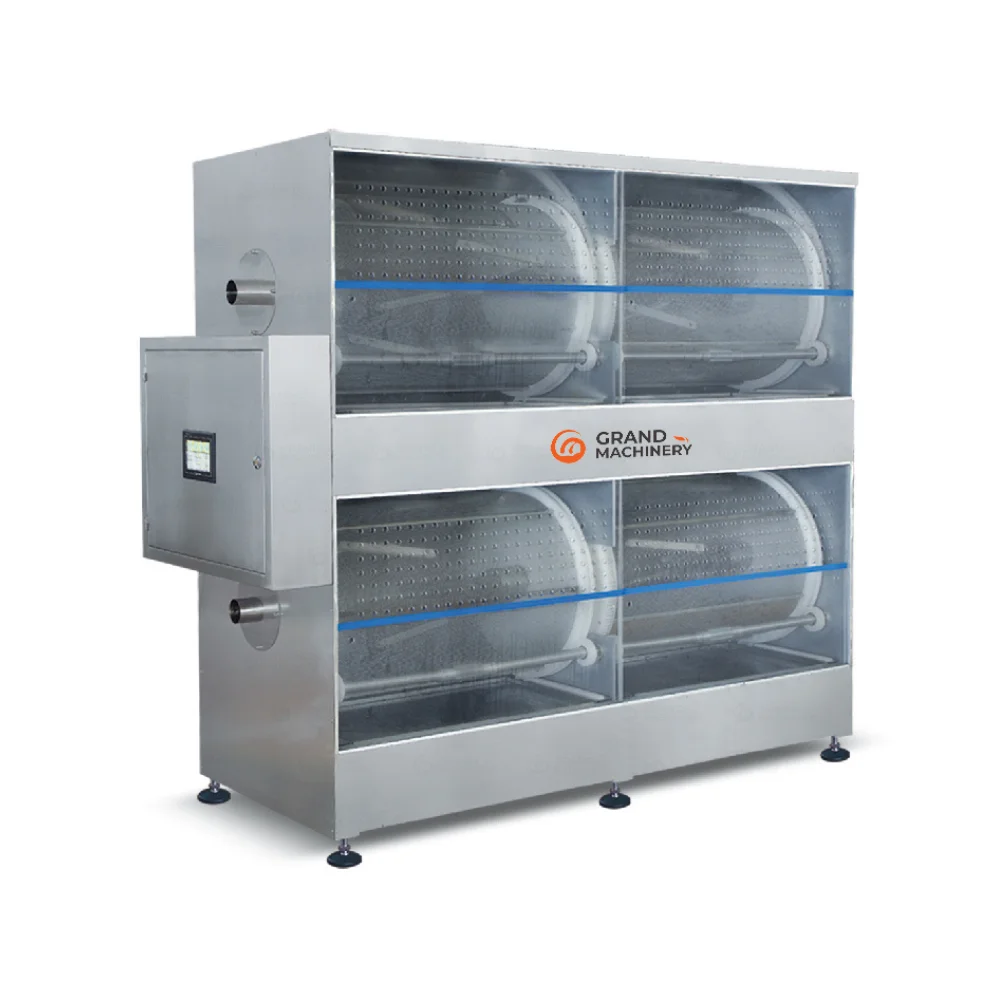
O Secadora com tambor inteligente de dupla camada ZL200S has four tumbler sections arranged in two layers. Its published working loading capacity is 60–80 kg per section, or 240–320 kg in total. The product page also describes PLC control, temperature and humidity sensors, and two dehumidification units. These are equipment specifications; they do not establish the drying time or throughput for an untested capsule formulation.
Secadora de roupas de camada única
O Secadora de roupas de camada única uses perforated stainless steel drum sections with independent reversible drives. The product description also notes removable sections for maintenance. It is a modular option to evaluate when planning the primary drying and transfer arrangement. The required number of sections and actual working load should be confirmed for the project.
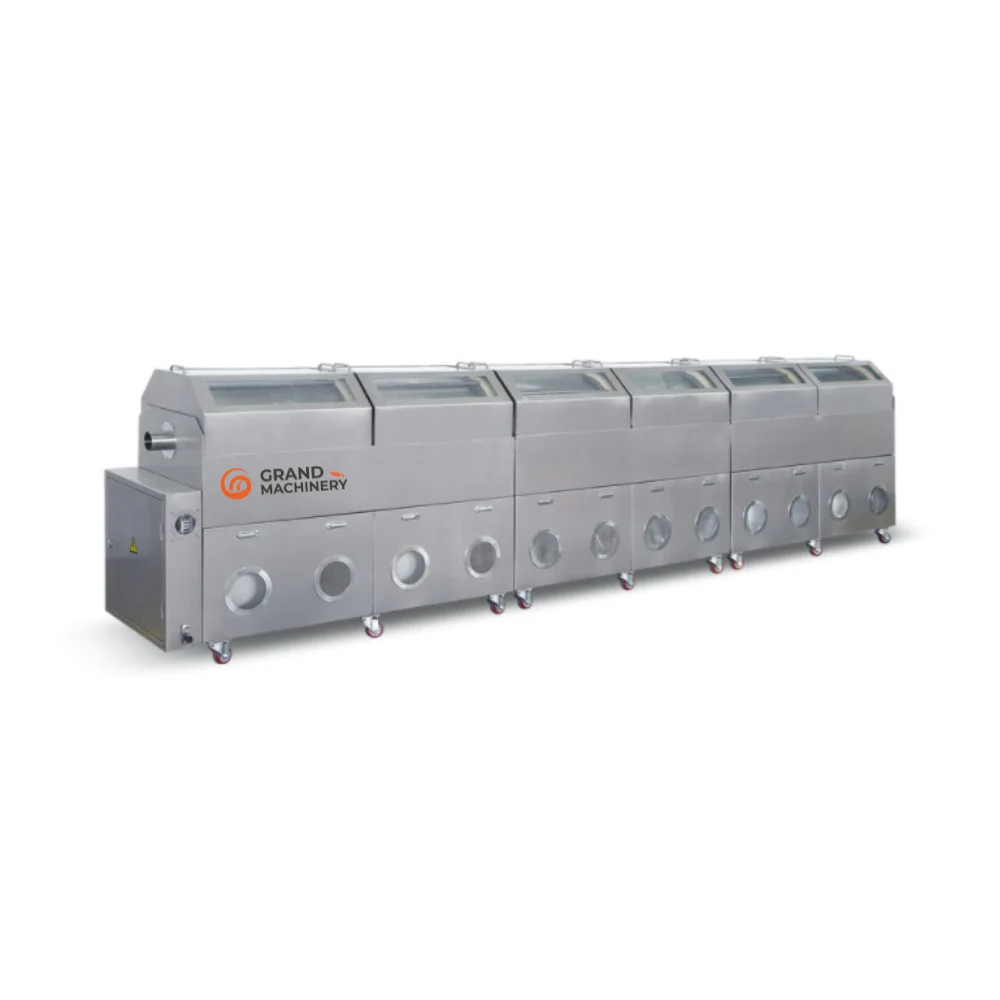
| Selection item | ZL200S | Single layer |
|---|---|---|
| Published arrangement | Four sections in two layers | Modular single-layer sections |
| Published working load | 60–80 kg/section; 240–320 kg total | Confirm for the proposed configuration |
| Drive and controls | PLC, sensor monitoring and HMI | Independent reversible drives |
| Process suitability | Confirm through product-specific drying trials | Confirm through product-specific drying trials |
See our softgel tumble dryer range e complete softgel capsule production line for equipment integration. If your encapsulator, transfer system and dryer will be purchased separately, agree on the wet output boundary, handling requirements and trial acceptance criteria before committing to the line arrangement.
What to Prepare for a Softgel Drying Trial
A useful technical discussion starts with the product and production schedule. Prepare the information below for the equipment supplier and quality team.
| Information | Por que isso é importante |
|---|---|
| Capsule shell type, size and shape | Defines the material and geometry to evaluate |
| Fill type and relevant moisture behavior | Helps identify product-specific drying requirements |
| Wet capsule rate at each transfer | Allows the drying stages to be matched to actual material flow |
| Proposed basket and tray loading | Supports a realistic inventory and movement assessment |
| Measured drying history | Shows the relationship between time and product properties |
| Transfer and final acceptance criteria | Defines what the trial must demonstrate |
| Workshop utilities and available floor area | Supports equipment and air-handling layout planning |
During the trial, record the material quantity and conditions at each stage. Sample the product at agreed locations and times, and evaluate the established quality criteria before drawing conclusions about line capacity. If a different fill or shell formulation is introduced, assess whether the evidence remains applicable. Our softgel encapsulation machine range provides upstream equipment options for the same production planning discussion.
Perguntas frequentes
What is the difference between primary and secondary softgel drying?
Primary drying firms the freshly formed shell for handling and transfer. Secondary drying continues conditioning the capsule to the approved final moisture and physical-quality requirements.
How long does the softgel drying process take?
Published gelatin processes describe a short initial tumble stage and further drying that can last hours to days. The actual duration must be determined for the specific shell, fill, size and loading conditions.
What temperature and humidity are used for tray drying?
A published example for gelatin softgels uses 21–24°C and 20–30% RH. These values are literature references, not universal operating settings. Use the formulation’s qualified process conditions.
Can a continuous tumble drying system replace trays?
It may be possible for a suitable formulation and validated equipment configuration. Confirm the final moisture, mechanical properties, uniformity and applicable product tests before removing a separate secondary stage.
Why do softgels stick during drying?
Surface tack, product loading, airflow, handling or formulation may contribute. Identify when sticking first appears and compare conditions and samples at the relevant process stages.
How do I know when a softgel is dry enough?
Check the approved endpoint measurements, including shell moisture and relevant mechanical and visual criteria. Complete any required quality tests before authorizing the next operation.
Is a 320 kg tumbler working load equal to 320 kg/h output?
No. Working load is an inventory capacity. Hourly throughput depends on actual drying residence time, loading and unloading, material behavior and other system limits.
Conclusão
A softgel drying process should bring the capsules from their fragile, freshly formed condition to a documented endpoint suitable for downstream handling and finishing. Match the primary and secondary stages to the material flow, compare actual drying records with the required quality attributes, and size the equipment around measured residence time and qualified working loads. That approach makes the drying section part of the production-line design instead of treating it as an isolated machine.
Referências técnicas
- Naharros-Molinero A, Caballo-González MÁ, de la Mata FJ, García-Gallego S. Shell Formulation in Soft Gelatin Capsules: Design and Characterization. Advanced Healthcare Materials. 2024;13(1):e2302250. Section 3.4.
- Palomero-Hernández FJ, Caballo-González MÁ, de la Mata FJ, García-Gallego S. Sustainable Shell Formulations as Alternative to the Conventional Soft Gelatin Capsules in Pharmaceutical and Nutraceutical Applications. A Review. Macromolecular Materials and Engineering. 2025;310(8):2500003.
- Damian F, Harati M, Schwartzenhauer J, Van Cauwenberghe O, Wettig SD. Challenges of Dissolution Methods Development for Soft Gelatin Capsules. Pharmaceutics. 2021;13(2):214.
- Technophar. Soft Gel Production Equipment. Continuous drying systems and drying tunnels; industry equipment example.