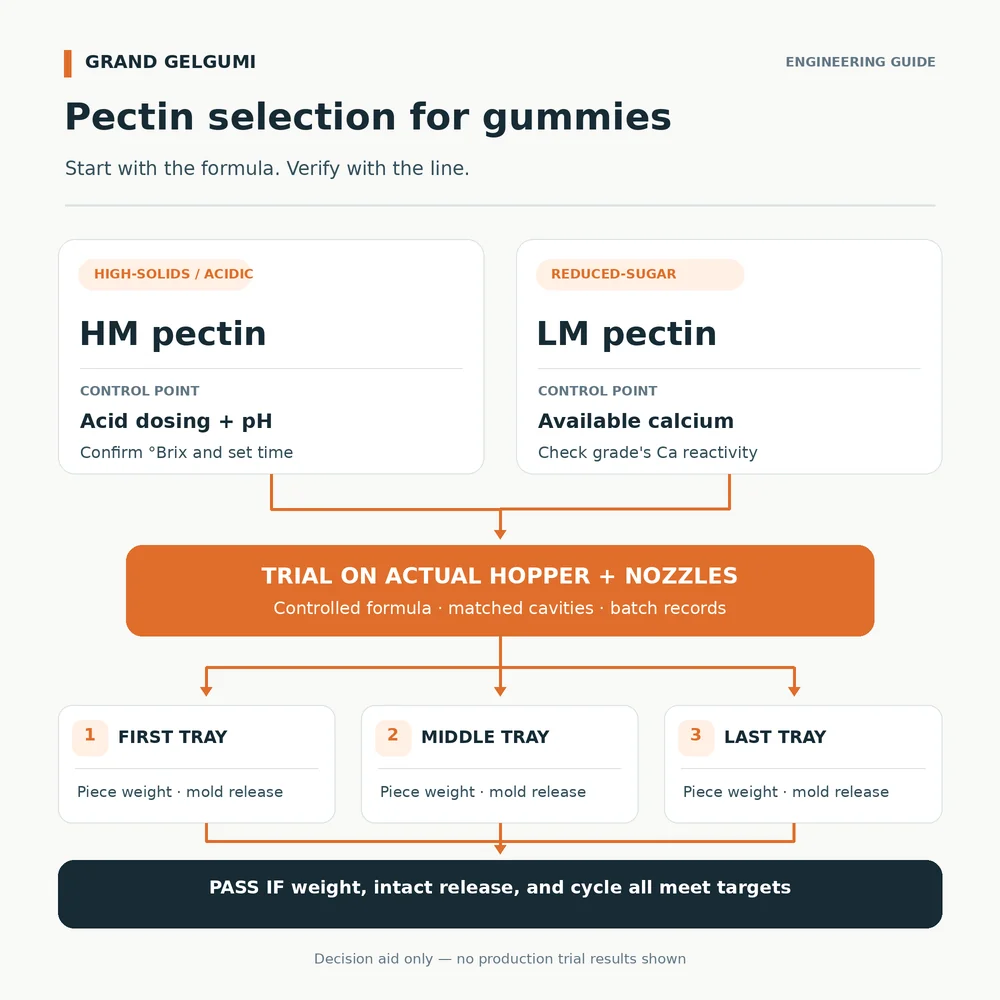
Choose pectin for gummies by matching the grade to the syrup and the time it spends on your depositing line. For a conventional high-solids, acidic formula, start by evaluating a high-methoxyl grade. For a reduced-sugar formula, evaluate a low-methoxyl grade alongside the available calcium. Then run the same formula through the intended hopper and nozzles. Compare the first, middle, and last trays for piece weight and mold release. That trial tells you whether the selected grade stays workable long enough to fill the batch and still sets in time for demolding.

HM Pectin vs LM Pectin for Commercial Gummies
After the material choice discussed in gelatin vs pectin in gummy formulations, match the pectin grade to your syrup and line. High-methoxyl pectin (HM) and low-methoxyl pectin (LM) differ in degree of esterification, not simply depositing speed. Cargill’s pectin technical overview classifies HM at 50% or greater esterification and LM below 50%.
What makes HM pectin suitable for a high-solids gummy?
HM pectin commonly gels with sufficient sugar solids and acidity. Cargill describes above 60% dry matter and pH below 3.5 as general HM gel-forming conditions, ไม่ approved line setpoints. Confirm soluble solids (°Brix), pH, dosage, and heating profile with the supplier. A bench formula may still thicken during a long hopper hold.
LM pectin can gel with calcium ions at lower sugar concentrations, making it a reduced-sugar trial candidate—not a universal HM substitute. Check calcium in water, fruit ingredients, and mineral premixes, along with buffering and grade-specific calcium reactivity.
Reduced sugar does not automatically mean LM. Some formulations replace sugar while retaining substantial soluble solids. For instance, Pacific Sugar Free Gummy Pectin is marketed as an HM blend. Compare the actual solids and gelling system before choosing a candidate.
Pectin Grade Selection by Formula and Line Condition
| Formula or line condition | First grade to trial | Why start there? | What must be verified? |
|---|---|---|---|
| Conventional high-solids, acidic gummy | HM grade matched to supplier’s setting profile | Sugar solids and acidity can support HM gelation | Actual °Brix, pH, setting rate, acid timing, and mold release |
| Reduced-sugar gummy with lower soluble solids and calcium to assess | LM grade with specified calcium reactivity | LM gelation can use calcium rather than requiring conventional HM sugar levels | Actual soluble solids, available calcium ions, texture, and release time |
| Batch acid addition followed by a long wait for the last tray | Slower-setting HM grade if the formula uses HM | May preserve a longer workable depositing window | First-to-last residence time, nozzle behavior, and setting before demolding |
Setting speed is a second selection dimension, with fast-, slow-, or extra-slow-setting grades. Obtain hydration and acid-dosing instructions plus supplier data on setting behavior. “Best pectin for gummies” means a grade that passes the formula and line trial, not merely one with longer open time.
During comparisons, hold sweetener composition, pectin concentration, acid preparation, and mold geometry constant. Check whether each grade is pure pectin or a blend with sugar/buffers, and whether its stated dosage refers to the blend.
When to Trial Slow Set Pectin on a Depositing Line
Grand’s เครื่องวางกัมมี่เพกติน overview describes servo-driven pumps, jacketed heated hoppers, short heated flow paths, separate cooking/holding/depositing temperature controls, and optional downstream acid dosing. These are platform-level features, not confirmed GM300 standard equipment. On a machine quotation, verify batch versus in-line acid addition, hopper/nozzle temperature ranges, nozzle and mold-cavity compatibility, and output at the target piece weight—including matched cooling and demolding capacity. For HM syrup, compare slower-setting grades only after checking nozzle faults, temperature gradients, and changing solids.
How long must the acidified syrup remain workable?
Trace syrup from acid contact through deposition. With batch acid dosing, timestamp first acid contact, mixing completion, hopper arrival, and first- and last-tray deposition. The elapsed time (s) must include mixing and transfer. With in-line acid dosing, identify injection and effective mixing positions, then verify residence time (s) to each nozzle.
Record hopper temperature (°C), nozzle temperature (°C), °Brix, and pH consistently. Workability depends on formula and temperature history, not the grade name alone. For late short shots, tails, or wider weight variation, compare these readings before changing pectin.
Cooking and depositor temperatures are different measurements. A supplier’s syrup-heating instruction is not automatically a hopper or nozzle setting. Confirm that the machine’s validated operating range and the pectin’s setting temperature allow sufficient flow without excessive hot holding. Record actual temperatures at both points, not only the controller setpoints.
Slower gelation may improve late filling yet delay in-mold setting. Confirm shape retention, clean release at scheduled demolding time (min), and adequate cooling capacity. Both filling และ demolding must fit the target cycle.
As a supplier-specific example, Pacific Pectin’s HMA-100 page describes an extra-slow-setting, amidated HM blend with 78–84 °Brix and final pH 3.4 for its stated gummy use. Do not transfer these settings to other grades without supplier guidance and trial evidence.
First and last trays may share similar nozzle temperatures despite different acid-exposure times. Plot average piece weight against elapsed time, and compare with demolding at the required cycle.
How to Test the Best Pectin for Gummies on Your Line
The กระบวนการผลิตกัมมี่ connects cooking, depositing, cooling, and demolding. Trial the grade on the intended route, including nozzles and molds. Record ingredient lots, grade, concentration, water source, acid recipe, mixing sequence, mold ID, and target throughput. Check instruments before the run.
What should engineers measure on the first, middle, and last trays?
Sample matching mold cavity positions in the same row and corresponding nozzle channels on the first, middle, and last trays. Otherwise cavity size or nozzle location could mimic time-related drift. Log tray/cavity IDs and maintain a consistent sample count.
Three-Tray Comparison Guide
| Sampling point | What to compare | What the result can reveal |
|---|---|---|
| First tray | Establish reference piece weights, shot shape, and mold release. | A baseline; identify isolated nozzle problems early. |
| Middle tray | Repeat the same nozzle/cavity samples and process readings. | Whether deposit consistency changes during the run. |
| Last tray | Check filling defects and intact release at the planned cycle. | Whether the longest residence time still meets agreed limits. |
For every sampled tray, record individual deposit weights (g), °Brix, pH, acid-to-deposit elapsed time (s), measured hopper/nozzle temperatures (°C), demolding time (min), and the count of intact pieces. Calculate weight mean and range from the raw values. Use a consistent cooled or diluted method if a direct pH/°Brix reading is unsuitable. Actual readings belong in the customer’s trial log, not in a generic article.
Distinguish channel effects from batch-aging effects. If one nozzle alone is abnormal, record its ID and inspect heating, blockage, alignment, or dosing. If several channels drift together across trays despite stable process values, compare residence time and setting behavior. Neither pattern alone proves causation.
How to Decide Whether a Pectin Grade Passes the Trial
Approve acceptance criteria ก่อน the run. Good first-tray gummies do not constitute a pass if later pieces miss weight or demold off-schedule. Use this plant’s configuration and tolerances.
A practical pass/fail decision has four parts:
- Deposit weight: Compare individual pieces, each tray’s mean, and first-to-last drift with the agreed target, tolerances, and sample size.
- Mold release: At the planned demolding time, calculate intact pieces ÷ pieces sampled × 100% for each tray. Extra cooling time is not an on-cycle pass.
- Line output: Confirm that depositing, cooling, and demolding sustain the agreed tray cycle and usable hourly output without unplanned holding.
- Process traceability: Check measured °Brix, pH, acid timing, and hopper/nozzle temperatures against trial limits; retain lot IDs, calibration, nozzle/cavity maps, and defect evidence.
Pass only when all three trays meet agreed weight, release, and cycle limits. Three-tray screening does not prove long-term production stability.
Hypothetical example: the first tray meets weight tolerance, but the last shows wider variation and incomplete fills. Recheck acid timing, temperature, °Brix, and nozzle channels. A localized fault suggests equipment inspection; whole-head time drift may justify comparing a slower-setting HM grade. Acceptable filling with damaged or late demolding still fails the cycle requirement.
Change one defined variable per repeat and retain both runs. Never approve solely from the first tray, bench gel, or unrecorded supplier claim.
Questions About Pectin Grades and Depositing
For a whole-line evaluation, connect cooking, acid addition, depositing, cooling, and mold release. The สายการผลิตกัมมี่เพกติน GM300 product page describes integrated cooking, dosing, depositing, cooling, and demolding stages with matched capacity. It does not specify a standard in-line acid mixer, validated hopper/nozzle temperatures, or compatibility with every pectin formulation.
Can LM pectin work in reduced-sugar gummies?
Yes. Low-methoxyl pectin can form gels through interactions with calcium ions even where a conventional HM sugar–acid system is unsuitable. Request the supplier’s required calcium range and grade-specific processing guidance. Then measure the water and ingredient calcium contribution and trial the finished recipe for texture, consistent deposit weight, and clean mold release at your target cycle.
Why do the last trays fill unevenly with HM pectin?
The acidified syrup may be losing its workable window, but a nozzle or temperature problem can look similar. Compare pH, °Brix, residence time, and hopper/nozzle temperatures on first, middle, and last trays. If one channel alone misfills, investigate that channel first. If most channels deteriorate together late in the batch, trial a controlled adjustment to acid timing or setting grade.
Why is a first-tray sample not enough to approve a pectin grade?
First-tray pieces only confirm that fresh syrup can fill the cavities at startup. They do not show whether the grade stays workable through the longest hopper residence time or sets cleanly on schedule for demolding. A pectin grade should pass only when first, middle, and last trays all meet agreed weight, mold-release, and cycle limits.
Planning a commercial trial for an HM or LM gummy formulation? Review your target °Brix, acid-dosing method, piece weight, and cooling cycle with our engineering team on the เครื่องวางกัมมี่เพกติน page, or learn more about our technical review standards from the ทีมบรรณาธิการ GRAND.