
คำตอบสั้นๆ: Tap density, also called tapped density, is powder mass divided by its final volume after mechanical tapping reaches the endpoint of a specified test method. Measure the initial, untapped volume first to calculate bulk density. Comparing the two readings helps a tableting team assess changes in powder packing and plan checks of feeding and tablet weight. Neither reading alone establishes flowability, consistent die filling, or suitability for a particular tablet press. [1]
จุดสำคัญ
- Measurement: These readings describe a powder bed, including spaces between particles, rather than the density of the solid substance.
- Volume: Record the initial loose volume and the final volume at the selected tapping endpoint.
- Calculation: The same 100 g sample gives 0.500 g/mL at 200 mL and 0.625 g/mL at 160 mL.
- Tableting: Use the pair to investigate packing differences, then check actual feeding behavior and tablet weights under recorded press conditions.
What Is Tap Density?
Here, bulk density means loose, untapped bulk density; tapped density describes the bed after the selected tapping procedure. Both use a volume that includes interparticle spaces. The public USP ⟨616⟩ preview confirms that powder bulk density depends on material density and particle arrangement. [2]
True density refers to the solid substance, excluding pore space and gaps between particles. Neither cylinder reading measures true density, and tapping does not remove every void. Keep these terms separate when comparing a supplier’s certificate with your own laboratory report.
Bulk Density vs Tapped Density
| Reading | Powder condition | Volume used | Calculation and unit |
|---|---|---|---|
| Bulk density | Loosely loaded, before tapping | V0 = 200 mL | m/V0 = 0.500 g/mL |
| Tapped density | After the specified tapping endpoint | Vf = 160 mL | m/Vf = 0.625 g/mL |
The mass stays unchanged. The smaller final volume makes the calculated density higher; it does not mean the powder gained material or its solid substance became denser.
How to Measure Tapped Density
This graduated-cylinder overview draws on WHO’s method. Apply the full selected procedure and your approved SOP for apparatus, preparation, settings, and endpoint requirements. [1]
- Sample: Take a representative portion and document any required preparation.
- Weigh: Record the test portion’s actual mass, m.
- Load: Gently introduce it into a dry, suitable graduated cylinder without compacting.
- Read: Record the initial loose volume, V0, using the method’s reading convention.
- Tap: Mechanically tap with the specified apparatus and settings.
- Check: Compare successive readings with the method’s endpoint criterion.
- Record: Save the final volume, Vf, and calculate both densities.
Use an independent laboratory tapping apparatus for this test. Hand tapping is not an interchangeable substitute for the specified mechanical procedure. A documented endpoint matters more than selecting a convenient number of taps.
How to Calculate Tapped Density
Illustrative example: One powder portion has a mass of 100 g. Its initial loose volume is 200 mL. After the selected method’s endpoint is reached, that same portion occupies 160 mL. Assume no powder was lost.
Bulk density = m/V0 = 100 g / 200 mL = 0.500 g/mL.
Tapped density = m/Vf = 100 g / 160 mL = 0.625 g/mL.
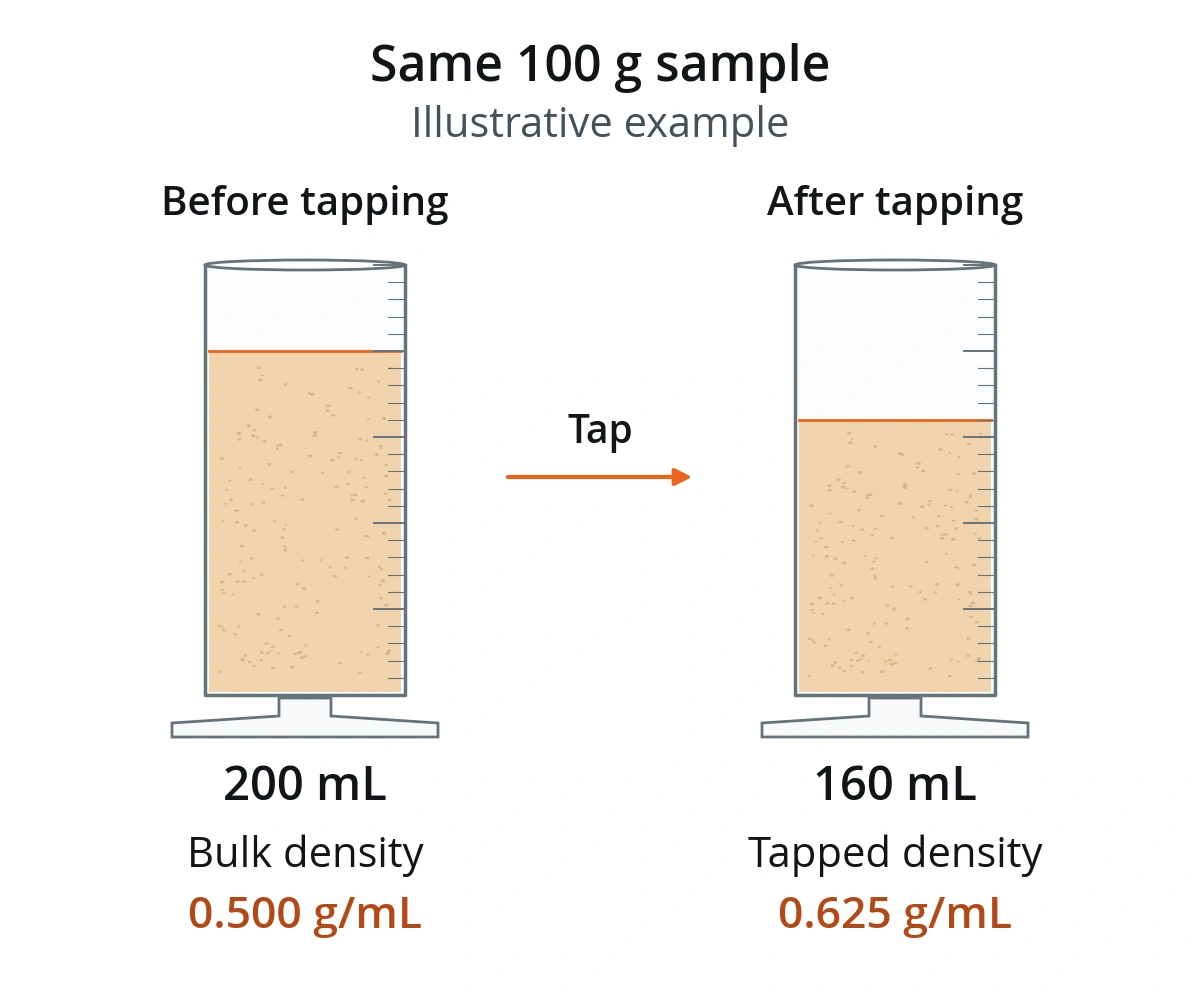
The powder occupies 40 mL less space after tapping. These two values describe different packing states of one sample; they are not results from two formulations. The final density still refers to a powder bed containing voids.
The example uses 100 g for clarity, not as a requirement for every powder. Select the sample amount and cylinder according to the applicable method. The three decimal places illustrate the arithmetic; report real measurements at the precision supported by your procedure and instruments.
Why Sample Handling Changes the Reading
A cylinder shaken during transfer has a different history from one loaded gently and read immediately. Pouring, accidental pressing, and transport vibration can rearrange a powder bed before its initial reading. WHO identifies handling history as a source of bulk-density variability. [1]
For a useful batch comparison, ask whether both samples came from equivalent process locations and received the same preparation. Record the container, transfer route, holding time, any conditioning or sieving, and relevant environmental observations. Match the cylinder, apparatus settings, endpoint rule, and repeat procedure as well.
If one result comes from a supplier’s freshly poured sample and another from material transported to your press room, investigate that difference before attributing the change to the formulation. The first question is whether the two measurements represent comparable conditions.
How Powder Packing Affects Die Filling
On a rotary press, the feeder supplies material to moving die cavities. The retained powder mass is then compressed. For an equipment overview, see how a rotary tablet press works.
At a fixed filled volume, a different effective powder density means a different mass. However, neither cylinder reading directly measures the density achieved inside an operating die. Use bulk density to compare the starting loose condition and tapped density to compare the test’s settled condition.
Research on five model formulations using a laboratory KORSCH rotary press found that material properties, turret speed, paddle speed, and fill and dosing depths influenced filling. Its results support checking these variables together; they do not establish operating settings for another machine or formulation. [3]
A practical next step is to pair a changed density result with time-stamped tablet weights, hopper observations, and feeder and turret settings from the same batch. If weights drift or become more variable, investigate the filling process and use the tablet weight variation troubleshooting guide to organize additional checks.
Common Measurement Problems and What to Check
Use this table to plan an investigation. These observations are prompts to check the record, not automatic diagnoses or batch-release criteria.
| การสังเกต | What to check first | Why check it? |
|---|---|---|
| Repeat measurements disagree. | Sampling location, preparation, loading, cylinder readability, and individual results. | An average alone cannot show whether inconsistent preparation or a real sample difference needs investigation. |
| Powder spills or remains outside the measured bed. | Mass accountability and the event record; repeat with a fresh portion under the SOP. | The original mass no longer reliably matches the volume being used in the calculation. |
| The endpoint is not established. | Successive volumes, programmed sequence, apparatus setup, and the selected endpoint rule. | A convenient stopping point cannot be reported as a completed endpoint. |
| The initial and final volumes are nearly equal. | Loading history, possible precompaction, instrument resolution, and test execution. | A small observed change does not establish good feeding behavior. |
| Two batches have similar densities but different tablet weights. | Same-batch weight trends, feeder and turret settings, fill settings, and hopper behavior. | Similar laboratory density values do not demonstrate equivalent performance on the press. |
Keep the original observation when repeating a test. Record the reason for repetition and evaluate discrepancies under the established procedure instead of selecting whichever result appears most favorable.
Quality Control Records for Comparing Batches
A practical worksheet can use the following fields:
- Material name, supplier, batch number, and sample identifier.
- Sampling location and time, operator, and storage or transfer history.
- Sample preparation, conditioning, and relevant environmental observations.
- Actual mass, balance identifier, and mass unit.
- Cylinder identifier, capacity, and graduation interval.
- Method reference and revision, tapping apparatus identifier, tap rate, and drop height.
- Initial volume, intermediate readings, final volume, and volume units.
- Tapping sequence, endpoint criterion, and recorded evidence that it was met.
- Individual replicate results, calculated densities, units, and reported precision.
- Deviations, material loss, repeat-test rationale, reviewer, and linked press-trial record.
Review the method fields before comparing the density columns. Where conditions differ, resolve comparability first. Any acceptance limits must come from the product’s established requirements, not from this illustrative calculation.
From the Lab Sample to the Press Hopper
Teaching scenario: A team changes from Batch A to Batch B of a tablet blend. Their tapped-density reports look similar, but Batch B shows wider tablet-weight variation during a trial. This is a hypothetical investigation, not a reported GRAND customer result.
Start by checking where each laboratory sample was collected. A blender-discharge sample and a press-hopper sample represent different handling histories. Ask whether transfer vibration changed packing, whether different sampling points captured different portions of the blend, and whether holding time changed the material’s condition.
Compare laboratory results with trial records from that same batch and stage. On one timeline, mark hopper refills, interruptions, and any approved setting changes alongside tablet weights. Include both the average weight and its variability; a stable average can hide a wider spread.
If a weight change follows a refill, investigate that event rather than assuming density is the cause. If it follows a speed change, examine filling under those recorded conditions. Any further trial should vary a defined factor within the approved plan so the result answers a specific question.
What to Bring to a Rotary Tablet Press Trial
Prepare a short technical brief that connects the laboratory sample to the intended product:
- Material evidence: Batch identity, preparation history, both densities, full measurement method, and repeat results.
- Tablet requirements: Target weight, shape, dimensions, tooling requirements, and the product’s established acceptance criteria.
- Trial conditions: Proposed feeder configuration, hopper loading and refill plan, turret settings, and fill and dosing settings where applicable.
- Observations: Feeding interruptions, suspected incomplete filling, individual tablet weights, average weight, and variability over time.
- Decision record: Sampling schedule, agreed evaluation criteria, deviations, and evidence needed before the next production step.
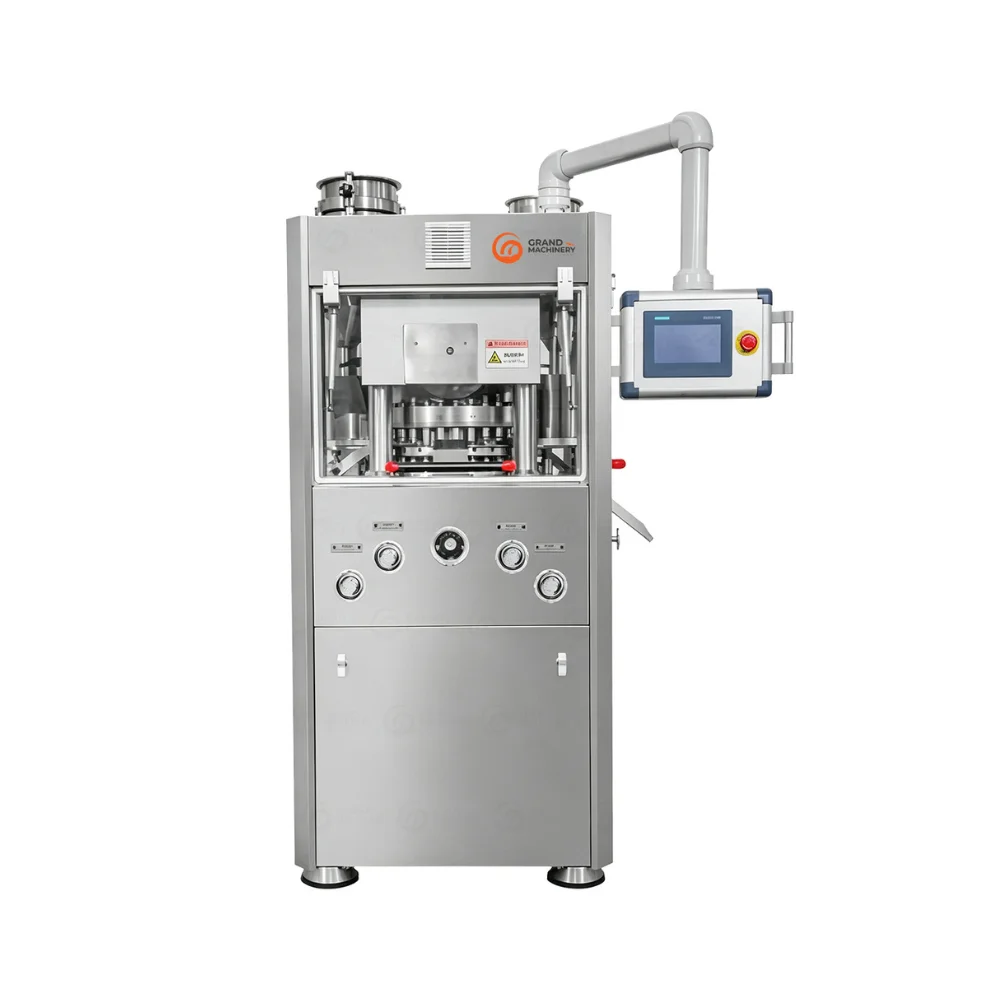
The GRAND ZPT420 rotary tablet press is an example of downstream tableting equipment. Tapped-density testing uses separate laboratory apparatus. Suitability for a particular blend depends on the proposed machine configuration and trial evidence; the two density values alone do not demonstrate compatibility.
คำถามที่มักถูกถาม
What should I request when a supplier reports only “bulk density”?
Request clarification of whether the value is loose or tapped, plus the paired reading where available. Ask for the method, sample preparation, actual mass, initial and final volumes, apparatus conditions, and endpoint so you can assess comparability.
What should I do if powder spills during the test?
Flag the affected determination and repeat it with a fresh representative portion under your SOP. Do not calculate density using the original mass after material has been lost; retain the deviation record.
What if the volumes before and after tapping are almost identical?
The test shows little measured volume change under those conditions. Check for unintended settling before the first reading and confirm the procedure and volume resolution before drawing conclusions about the powder.
Does a higher tapped density mean better powder flow?
No; a higher tapped density alone does not establish better flow. Compare materials using suitable flow measurements and observed feeding behavior rather than ranking them by this single value.
Why can batches with the same tapped density produce different tablet weights?
Tablet weight also depends on how the material fills the dies under the actual feeding and press conditions. Compare each batch’s actual weight distribution with its feeding, turret, fill-setting, and handling records to identify what changed.
สรุป
Tap density is most useful when the final reading stays connected to the initial volume, unchanged sample mass, and documented method. Use that comparison to guide investigation, then verify performance with the intended blend on the press. Bring both density results, target tablet specifications, and a proposed trial record when you ติดต่อ GRAND Machinery to discuss a tableting trial.
เอกสารอ้างอิงทางเทคนิค
- World Health Organization. Bulk density and tapped density of powders. The International Pharmacopoeia, 13th edition, 2025. Measurement methods and equations.
- United States Pharmacopeia. General Chapter ⟨616⟩, Bulk Density of Powders. Public preview: chapter identification, definition, and units.
- Schomberg AK, Kwade A, Finke JH. The Challenge of Die Filling in Rotary Presses—A Systematic Study of Material Properties and Process Parameters. Pharmaceutics. 2020;12(3):248. Original research on model formulations.